
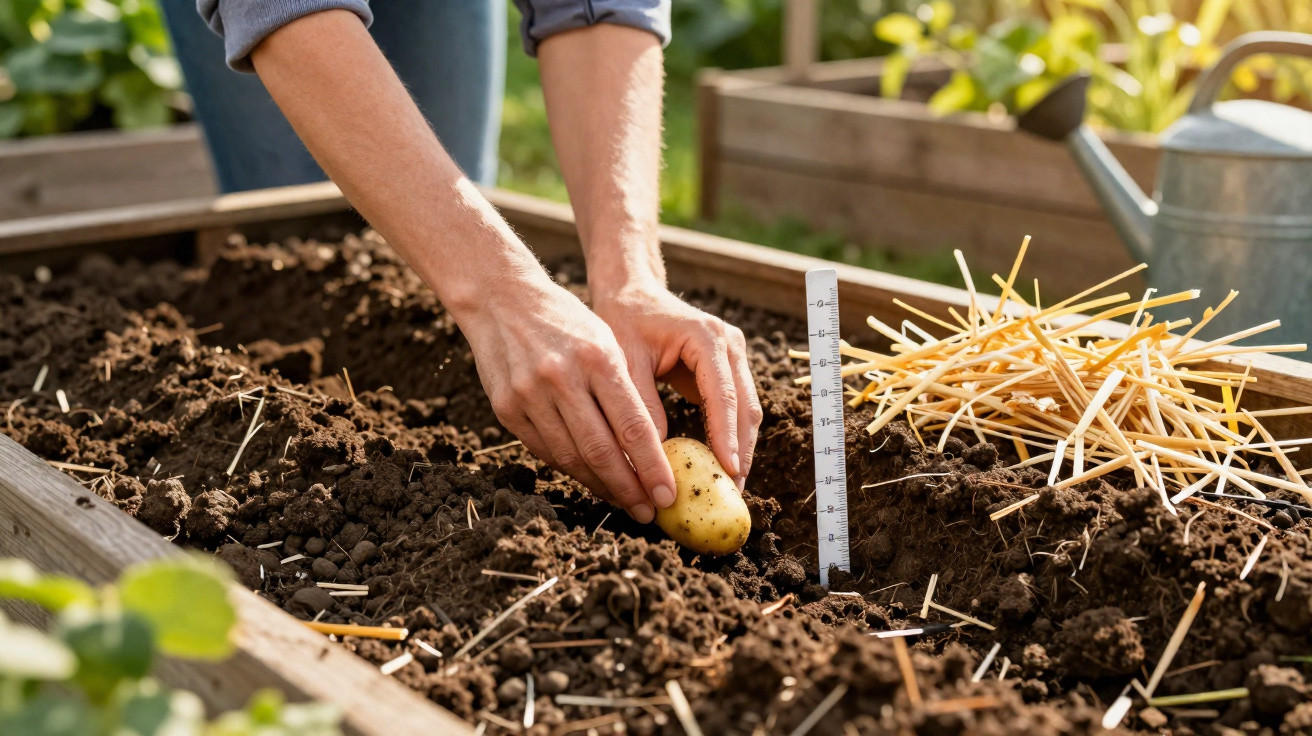
Many home gardeners spend time fine-tuning varieties, fertiliser and watering schedules, only to be disappointed by a poor harvest later on. Yet one crucial factor is literally below the surface: the correct planting depth. Just a few centimetres can decide whether you get feeble foliage or a potato box packed to the brim.
Why potato planting depth matters so much
Planting a potato essentially means placing an energy store in the soil. It must produce roots, shoots and new tubers. If this “store” has too little soil covering it, cold, drought and light can cause problems. If it is planted too deeply, young shoots take too long to reach the surface and lose vigour.
Planting depth determines how quickly plants emerge, how healthy they remain and how plentiful the harvest will be.
Potatoes planted at the right depth establish quickly, are less susceptible to disease and produce even, well-developed tubers. Incorrectly planted potatoes are more sensitive: they can rot more easily, dry out faster or produce only a few small tubers.
The ideal potato planting depth in numbers
Most growing guides arrive at the same guideline: potatoes should be planted with around 10 to 15 centimetres of soil above them. This refers to the layer of earth covering the tuber, rather than the overall depth of the hole.
- under 10 cm: risk of frost damage and tubers turning green
- 10–12 cm: a good compromise for most gardens
- 12–15 cm: useful in dry locations or areas at risk of frost
Before planting, loosen the soil thoroughly to a depth of around 15 to 20 centimetres. Place the tubers in prepared furrows with their eyes – the small growth points – facing upwards. This gives the shoots the quickest route to the surface.
Planting substantially deeper often delays emergence. The plant uses more of its reserves to reach the light and consequently puts less energy into forming new tubers later. If a potato is planted too shallowly, only a few hours of sunshine can discolour exposed tubers and make them bitter.
How soil affects the right planting depth
The ideal depth is not a fixed figure. It depends heavily on the feel of the soil and the way it handles water.
Heavy, clay-rich soils
Water tends to collect in loamy or clay soils. If potatoes are buried too deeply in these conditions, they sit in a cool, wet layer – the ideal environment for rot.
- Loosen the soil thoroughly and break up large clods.
- Improve drainage, for example by adding some coarse sand or well-rotted compost.
- Keep planting depth towards the middle of the range: 10–12 cm of soil above the tuber.
This provides adequate protection from cold without trapping the tubers permanently in overly wet layers.
Light, sandy soils
Sandy soil drains water quickly. It warms up sooner, but it also dries out more readily. Potatoes can generally be positioned a little deeper here.
- Work in plenty of compost to retain water and nutrients.
- Aim towards the upper end of the planting-depth range: 12–15 cm.
- Gaps between watering matter less because the tubers sit slightly deeper in a moister layer.
The basic principle still applies: loosen the ground well first, then plant. In compacted, neglected sandy soil, roots may otherwise struggle to access nutrients.
Climate, frost and water: adjusting potato planting depth
Taking the local climate into account can help you gain a few extra per cent of yield.
Areas with late frosts
Where night frosts are still possible in spring, planting slightly deeper and earthing up promptly can help. The tubers themselves will already be protected, but young shoots cannot tolerate frost.
In locations at risk of frost: plant a little deeper, then earth up quickly and protect the shoots.
By planting closer to 15 centimetres deep and starting to earth up early, you create an insulating layer of soil around young plants. This allows them to continue growing through cool nights.
Dry summers and hot locations
In frequently dry conditions, a second technique is useful: mulching. Rather than burying potatoes extremely deeply, cover the rows with organic material once the shoots have emerged – such as straw, grass clippings or leaves.
- Evaporation of moisture from the soil is significantly reduced.
- The soil stays loose and crumbly for longer.
- Intense heat is less likely to reach the tubers.
The planting depth can therefore remain within the normal range, while the plants still benefit from a consistently moist root zone.
Spacing, earthing up and care for full boxes
Perfect planting depth only delivers its full effect when the rest of the growing method is suitable too. Spacing and regular earthing up are particularly important.
Suitable spacing in the bed
Planting too closely creates competition for light, water and nutrients. Leaving overly large gaps wastes space. These measurements have proved effective:
| Spacing | Recommendation |
|---|---|
| between plants | 30–40 cm |
| between rows | 60–75 cm |
This gives every plant enough room to develop dense foliage and form plenty of usefully sized tubers.
Earthing up: the overlooked yield booster
Begin earthing up no later than when the shoots are 15 to 20 centimetres tall. Pull soil from between the rows towards the stems until small ridges are formed.
This step has three benefits:
- new tubers are reliably kept in the dark and do not become discoloured
- it creates extra space in which further tubers can develop
- plants are more stable in wind and rain
If you add a little more soil every two to three weeks until the ridges are clearly defined, you will get noticeably more from every planted tuber.
Common planting-depth mistakes and how to avoid them
Many issues in a potato bed can be traced back to a few recurring mistakes.
- Planted too shallowly: tubers soon become exposed, turn green and are inedible.
- Planted in wet hollows: waterlogging, fungal infection and rot are almost inevitable.
- Too deep in hard soil: late, weak shoots and fewer tubers.
- No or infrequent earthing up: many tubers remain underdeveloped despite the correct depth.
Anyone who observes their bed before planting – noting where water lingers and where it dries out quickly – and then adjusts the depth and position accordingly will have a clear advantage from the start.
When it is worth moving away from the standard depth
The guideline of 10 to 15 centimetres is suitable in most cases. There are, however, exceptions where sensible adjustments are worthwhile:
- Early potatoes in a sheltered garden: closer to 10 cm, so that they emerge more quickly.
- Late varieties in a cold, exposed location: closer to 15 cm, plus substantial earthing up.
- Extremely sandy, drought-prone soil: plant slightly deeper, combined with plenty of compost and mulch.
When in doubt, carry out a small trial strip in your own garden: plant one row slightly shallower and another slightly deeper, then observe the differences. After one season, you will know the most suitable measurements for your plot.
What terms such as “ridging” and “mulching” mean
Many guides use terms that are not immediately clear to everyone. “Ridging”, or earthing up, simply means drawing soil up around the stems. You can do this with a hoe, a cultivator or even your hands if the soil is loose enough.
“Mulching” means covering the soil with organic material. In potato beds, straw and lightly dried grass clippings have proved particularly effective. The layer should remain airy so that persistent damp does not collect directly around the stems.
By combining planting depth, soil structure, earthing up and mulch effectively, even a small bed can become a remarkably productive patch. The real skill lies less in specialist fertiliser than in a few well-considered spadefuls at the right depth.

Comments
No comments yet. Be the first to comment!
Leave a Comment