
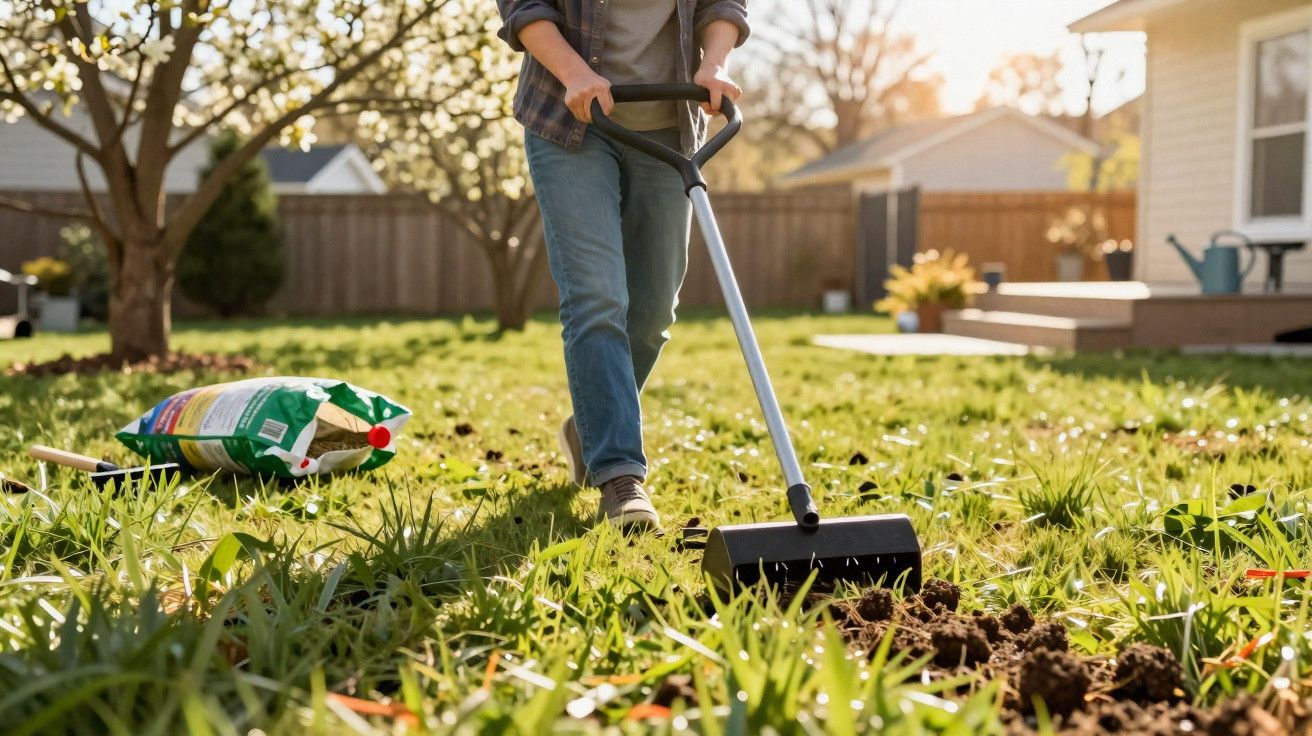
A simple, little-known professional tip could give your lawn the boost it needs right now.
Every year, many amateur gardeners are surprised by the same sight: as soon as the snow has gone, the lawn looks pale, matted and generally tired. Yet the aim is a thick, lush green carpet that feels good under bare feet. A garden-centre chain employee has revealed a straightforward method that can revive even struggling patches remarkably quickly – provided you get started properly in March.
Why spring is the crucial time for your lawn
March is when a lawn begins to wake from its winter dormancy. The blades start growing again, soil temperatures gradually rise, and the conditions are set for a proper refresh. However, acting too early or too aggressively can damage the lawn rather than help it.
The garden-centre expert stresses one point in particular: do not overdo the first cut after winter.
“For the first cut, remove no more than one third of the current blade length. Any more will harm the lawn and hold back its recovery.”
Many people set their mower to its lowest setting straight away because they want to “tidy everything up in one go”. This puts huge stress on the plants. The result can be brown patches, bare areas and more moss than grass.
Timing the first cut correctly
The time is right once the grass has visibly grown and the ground no longer feels completely wet and cold. Then follow these rules:
- Set the mower to a relatively high cutting height.
- Do not mow when the soil is soaking wet.
- Keep the blades sharp so that grass is cut cleanly rather than torn.
One further important tip: at the start of the season, it is usually best to leave the popular mulching function switched off.
Why mulching in March is nearly always the wrong choice
Mulching sounds convenient: clippings are left behind to “feed” the soil. After winter, though, this is often counterproductive. The grass is still damp and can be partly matted, while the soil struggles to dry out.
“If damp clippings are left on the lawn in March, they can quickly form a dense layer that smothers the grass rather than nourishes it.”
The employee’s recommendation is to use the collection box for the first cut, and usually the second one as well. This allows air to reach the lawn, helps blades dry more effectively and significantly reduces the risk of fungal diseases. Mulching is far more suitable later on – from around May, when:
- the soil is warmer;
- the grass is growing faster;
- clippings are drier and finer.
The key professional tip: aerate the lawn rather than simply cutting it
According to the garden-centre specialist, the real secret weapon is not mowing but aerating the lawn. Many lawns do not mainly suffer from a shortage of nutrients; instead, their soil has become compacted.
This is especially common in loamy or clay-rich soil. Rainfall, foot traffic and garden equipment can compress the ground until it forms a hard crust. Water then remains on the surface, while very little air reaches the roots.
“Compacted soil no longer absorbs water properly – the grass blades are starving even though you are watering.”
How to relieve your lawn step by step
The employee outlines a simple process that anyone can carry out without specialist knowledge:
- Remove thatch and moss: Pull a sturdy rake, ideally a metal one, firmly across the lawn. Old grass, moss and dead plant matter will loosen and collect in the rake.
- Pierce the soil: Push a garden fork or lawn-aerator fork into the ground in several places. The holes do not need to be deep, but they should be spaced regularly across the area.
- Scarify larger lawns: If you have a lawn covering many square metres, use a scarifier. Its blades score the turf and remove thatch and moss in one pass.
The result is that water, air and nutrients can once again reach the roots. The lawn can grow much more effectively and regenerate itself.
Closing gaps: turning patches back into a dense green carpet
After aerating, the garden may look a little worse before it looks better. That is normal. This is the ideal time to overseed thin or bare spots, or repair them with turf.
“Never simply ignore bare patches – otherwise moss and weeds will spread there faster than grass.”
Two ways to restore green growth
- Turf / turf sods: Ideal if you are impatient. Cut the rolls into suitably sized pieces, lay them tightly together, press them down well and water regularly. Even large gaps can be visually covered within a few hours.
- Overseeding: If you prefer a cheaper option and have time to wait, use a specialist overseeding mix. Scatter it over loosened, lightly roughened soil, press it in and keep the area evenly moist for several weeks.
The garden-centre employee points out something many people underestimate: birds love grass seed. If you sow early in March, you are effectively offering blackbirds and sparrows a free buffet.
Possible solutions include:
- bird-feeding stations with fat balls placed some distance away from the lawn;
- nets or horticultural fleece loosely laid over freshly seeded areas;
- waiting a few weeks and sowing later in spring, when more natural food is available.
The right fertiliser: more is not better for lawns
In spring, many people instinctively reach for heavily dosed fertilisers. A nitrogen-rich starter fertiliser can be useful for a recovering lawn, but the quantity must be right.
“Too much fertiliser may make the lawn grow quickly, but it also leaves it soft, vulnerable and stressed.”
A balanced lawn fertiliser with a higher nitrogen content helps the blades grow back strongly and enables the surface to fill in quickly. The key is not to exceed the recommended application rate, to spread it over dry grass where possible and then water it in thoroughly.
Once temperatures are consistently moving towards early-summer levels, mulching comes into its own. The finely chopped clippings can then provide many lawns with almost enough natural fertiliser on their own. Regular mowing continually returns small amounts of organic material to the turf.
Common mistakes – and how to avoid them this year
The garden-centre professional repeatedly sees the same issues. Three of them are particularly easy to prevent:
| Mistake | Consequence | Better approach |
|---|---|---|
| Mowing too short in March | Yellowing areas, weakened grass blades | Cut only one third of the blade length |
| Mulching a wet, dense turf surface | Thatch, fungal risk, more moss | Use a collection box at the start of the season |
| Not aerating heavy soils | Waterlogging, weak growth, bare lawn | Use a rake, fork or scarifier |
When equipment such as a scarifier is genuinely worthwhile
Not every garden needs its own scarifier immediately. Small areas can certainly be treated with a rake and fork. A machine is particularly worthwhile when:
- the lawn is clearly larger than around 100 square metres;
- moss and thatch extend across wide sections;
- the soil is heavy, loamy and often wet.
If you only want to go over the lawn briefly once a year, you can hire a machine from a DIY store. Anyone who knows they will aerate every spring, and perhaps in autumn too, will usually find that owning an electric scarifier is cheaper.
How the lawn becomes stable over the long term
Thoroughly aerating once, mowing gently and filling bare areas creates the foundation for a resilient lawn that can look after itself much better later on. Dense, healthy grass naturally crowds out weeds and moss to a large extent. Mowing little and often rather than rarely and drastically is just as important as watering appropriately.
A regular routine proves especially effective in early summer: leave the grass slightly longer, but mow more frequently. The blades then form a close network that leaves less room for unwanted plants and shades the soil. As a result, it does not dry out as quickly, reducing overall water demand.
With the spring routine described here – aerating, gentle mowing, targeted overseeding and moderate fertilising – you give your lawn the decisive start. The much-mentioned “English lawn” no longer has to be an unattainable ideal; it can gradually become a reality in your own garden, without a professional landscaping company.
Comments
No comments yet. Be the first to comment!
Leave a Comment