
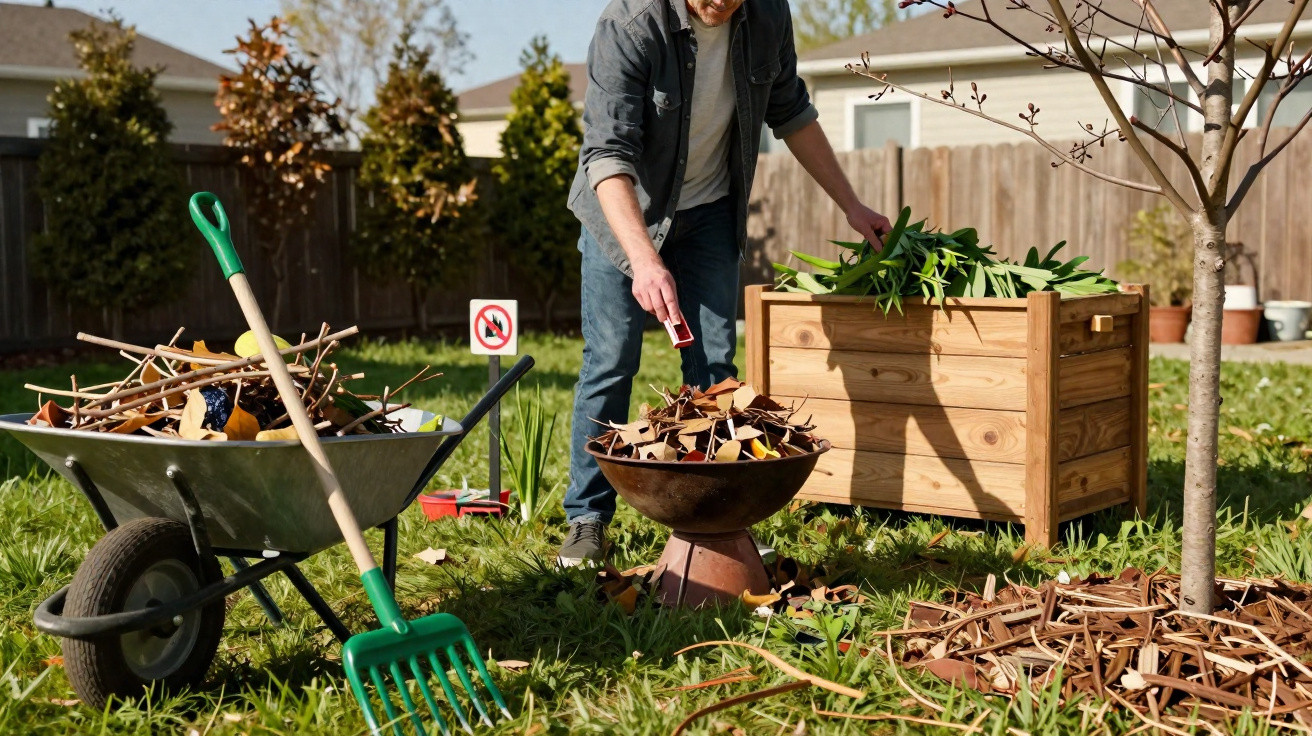
Many garden owners throw themselves into the new season with enthusiasm in March: mowing the lawn, pruning shrubs and clearing leaves, all in the hope of making everything look tidy again quickly. What remains afterwards are large piles of clippings and foliage. At precisely this point, many people still turn to a method once considered normal – but which is now a clear legal offence.
Why the old garden-fire trick can become expensive
Anyone who simply sets fire to garden waste in the back garden is no longer operating in a legal grey area. In many European countries – including France, where the current figures originate – burning so-called “green waste” in private gardens is prohibited across the board. Authorities in German-speaking regions are also taking an increasingly restrictive approach.
The reasoning is straightforward: grass cuttings, leaves, twigs and perennial trimmings are classed as organic waste and therefore as waste under environmental law. They should be recovered rather than burned. What was once seen as “common-sense country practice” – a small fire behind the shed – is now regarded as air pollution that poses health risks.
According to the authorities, a single fire involving around 50 kilograms of garden waste can release as many fine particulate emissions as a modern diesel vehicle over 13,000 kilometres of driving.
The result is that anyone who burns branches and leaves regardless risks a substantial fine. In France, this is typically up to €450, while some cases can incur penalties of up to €750. In Germany, the federal states and local authorities set the amounts themselves; many fine schedules list illegal garden fires at sums in the high hundreds of euros.
What counts as “prohibited burning”
Many homeowners and gardeners underestimate how broadly the ban applies. It does not concern only huge bonfires, but generally the burning of plant waste from homes and gardens.
Common garden waste that must not be put on a fire
- Lawn cuttings after mowing
- Leaves from trees and shrubs
- Branch and twig cuttings from hedges and fruit trees
- Perennial remnants and spent plants
- Roots, root balls and smaller stumps
- Plant-based kitchen waste, such as vegetable peelings
Whether the fire burns openly on the ground or inside a so-called garden incinerator or bin burner usually makes no legal difference: both are treated as impermissible burning of organic waste.
People who supply or lend equipment specifically intended to burn this waste may also face action. Environmental legislation contains separate provisions that do not apply only to the person striking the match.
What penalties can apply – and who checks?
Legally, illegal garden fires are generally treated as regulatory offences. That may sound minor, but it can prove costly. The French example refers to a fine of up to €450, rising to €750 under stricter interpretations; comparable ranges also appear in German schedules.
| Offence | Possible consequence |
|---|---|
| Private garden fire involving green waste | Fine, usually in the hundreds of euros |
| Repeated offences | Significantly higher penalties and stricter requirements |
| Severe smoke nuisance affecting neighbours | Additional proceedings for odour and smoke nuisance |
| Risk to nature reserves and protected wildlife areas | Potential criminal consequences |
Proceedings are usually triggered by reports from neighbours or notifications to the public-order office, local council or fire service. Anyone hoping to excuse it as “small” or “brief” is unlikely to succeed: as soon as smoke is visible and clearly comes from garden waste, the rules apply.
The famous “small fire that nobody sees” does not exist in legal terms – the smoke gives away almost everything.
What to do with piles of leaves and branches instead of burning them
Since the start of 2024, Europe has placed greater emphasis on separate collection of organic waste. In Germany too, kitchen and garden waste should be collected separately from residual household rubbish. Home gardeners have several lawful and practical alternatives to lighting a fire.
Option 1: Compost in your own garden
A traditional compost heap or enclosed compost bin turns much of this garden waste into valuable humus. If set up properly, it does not smell strongly and attracts only limited numbers of pests.
- Add lawn cuttings and leaves in thin layers
- Shred or cut branches into smaller pieces first
- Mix with kitchen waste, excluding meat and dairy leftovers
- Turn it occasionally so that air can reach the material
After a few months, it produces nutrient-rich compost that improves beds and feeds container plants. It can even save the cost of expensive bags from the garden centre.
Option 2: Shred it and use it as mulch
A garden shredder converts branches and twigs into loose woodchip. This is ideal as a mulch layer on beds and beneath shrubs. It protects the soil, retains moisture and suppresses weeds.
Garden experts assume that a thick mulch layer can reduce water requirements in summer by up to 40 per cent.
This becomes particularly noticeable during hot summers. Plants suffer less, watering is needed less often, and the waste pile almost disappears by itself.
Option 3: Recycling centre and council collection
Those without room for composting or a shredder can take their green waste to a collection point. Most local authorities operate recycling centres where private households can dispose of garden waste free of charge or for a small fee.
Many towns also provide:
- regular collections for leaves and garden clippings
- container schemes in spring and autumn
- brown food-and-garden-waste bins or dedicated green-waste bins
A quick look at the local council website or a call to its customer service team is enough to establish the local rules – and put the risk of a fine to rest.
More than money: smoke, health and wildlife
The legal position is not based solely on abstract environmental legislation. Smoke from garden fires irritates the airways, particularly for children, older people and those with pre-existing health conditions. Fine particles penetrate deep into the lungs, while soot settles on house facades and laundry.
There is also a factor many people overlook during their spring clear-out: heaps of leaves and brushwood are popular shelters for wildlife. Hedgehogs, insects, amphibians and many small animals use them as winter quarters or refuges in early spring.
Anyone who sets fire to a seemingly lifeless pile in March may unknowingly burn entire populations of small animals.
In nature reserves or near protected habitats, this may even result in criminal consequences if protected species or their habitats are destroyed. The line between “just a little smoke” and serious damage to nature can blur more quickly than expected.
Practical tips for a stress-free spring garden clear-out
A few simple rules can help ensure that the start of the gardening season does not end with trouble from the public-order office:
- Check local waste rules before the first major pruning session
- Sort leaves and cuttings: what can be composted and what can be used as mulch?
- Arrange transport to the recycling centre early if dealing with large quantities
- Briefly move leaf piles before relocating or shredding them, so hidden animals can escape
- Inform neighbours when noisy work or shredding is planned
Anyone thinking ahead will design their garden to produce fewer “problem wastes” in the first place: hardy hedges rather than shapes requiring intensive pruning, areas of leaves deliberately left as a natural layer, and a section of the garden allowed to remain wilder.
This not only reduces the risk of a costly fine. It also makes the garden more resilient to heat, provides more habitat for wildlife and leaves you with less stress at the next spring garden clear-out.


Comments
No comments yet. Be the first to comment!
Leave a Comment