
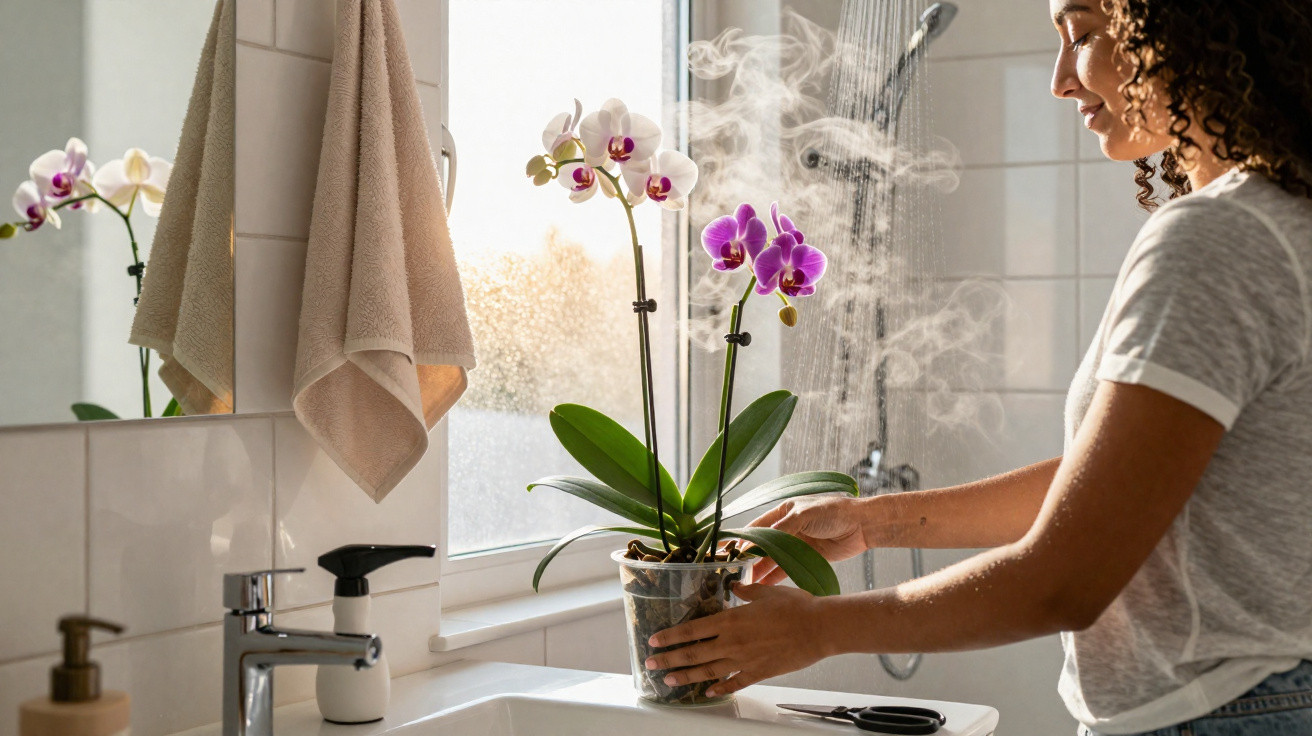
Many homes contain orchids that have sat on the same windowsill for years, receiving more water at times and less at others, yet refusing to produce another flower. Rather than being “temperamental” or “difficult”, the issue is often something quite different: their position. A straightforward move, particularly during summer, can provide the crucial prompt the plant needs to start growing again.
Why the windowsill holds many orchids back
The familiar moth orchids, botanically known as Phalaenopsis, originate in tropical forests. There, they grow attached to tree trunks, surrounded by moving air, with humid nights and warmer days. Our permanently heated rooms offer virtually none of those conditions.
Keeping an orchid on one windowsill throughout the year deprives it of an important signal: the change of seasons. In many homes, temperatures remain at around 20°C both day and night, the air is dry, and a radiator is often positioned beneath the windowsill. The plant stays in permanent living-room mode and does not recognise that it is time to flower.
New flower spikes develop chiefly when daytime temperatures are noticeably warmer than those at night and the climate varies slightly.
Broadly speaking, the ideal temperatures for forming new flower stems are:
- around 18 to 22°C during the day
- around 12 to 15°C at night
When temperatures remain constant, this contrast is missing. The orchid may continue growing, but it will produce few flowers, if any.
Light: between “too dark” and scorched leaves
Light is just as important as temperature. Many owners place their orchid either too far from a window or directly in intense sunlight.
An orchid positioned in the middle of a room will usually receive insufficient light. It may still have attractive green leaves, but it tends to become sluggish and will not produce fresh flower spikes. At the other extreme, placing it directly behind a large south-facing window can cause problems: the sun scorches the plant, pale dry patches form on the leaves, and the orchid remains under constant stress.
A bright position that is not blazing with direct sunshine is best. These locations work particularly well:
- an east-facing windowsill with gentle morning sun
- a bright north-facing window without direct sun
- a west-facing window with lightly filtered afternoon sun, for example through a curtain
The unusual spot: outside for summer – but protected
The real game changer arrives with summer. Many experienced plant enthusiasts move their orchids outdoors during the warmer months. Not onto a table in full sun, but into a hanging basket in dappled shade.
Time outdoors provides natural humidity, temperature differences and a genuine day-night rhythm – precisely what the plant is often missing.
Suitable locations include a covered balcony, a terrace shaded by trees or a sheltered corner of the garden. The key requirements are:
- no direct midday sun
- protection from persistent rain and strong gusts
- a position where air can circulate
A hanging basket or wire basket is practical, as the pots can simply be placed inside. Those living on the ground floor, or dealing with slugs in the garden, should hang the plants slightly higher. This helps keep both leaves and roots undisturbed.
When to move an orchid outside – and when to bring it back in
The right timing depends on the local climate. As a rule of thumb, overnight temperatures should reliably remain above 10°C. In many areas, this is possible from around June onwards. Usually, checking the forecast is enough to decide when it is time to bring the plant indoors again.
As soon as late-summer night temperatures start dropping towards single figures, the orchid should return inside. Missing this point risks cold damage to the leaves. In central Europe, the period from June until late August or early September is often suitable.
Outdoor orchid care: less watering, more observation
Outdoor air is often more humid than the air in a living room. The plant loses moisture differently and responds more strongly to sun, wind and changing temperatures. It is therefore worth keeping a close eye on the growing medium and roots.
A few basic rules can help prevent damage:
- Water only when the top of the growing medium has dried out well.
- Do not allow water to stand in the outer pot, as waterlogging encourages root rot.
- After rainfall, check whether the pot has become overly wet and pour away excess water if necessary.
The orchid does need fertiliser during its growing period, but only sparingly. A specialist orchid fertiliser, heavily diluted and applied roughly every two to three weeks, is generally sufficient. Excessive concentrations are the cause of many mistakes.
What to do in autumn and winter
After its summer outdoors, move the plant back to a bright, sheltered position indoors. A windowsill without direct midday sun and without constant heat rising from below is ideal.
Rooms that become slightly cooler at night are particularly suitable: a bedroom, a lightly heated corner of a guest room or a bright hallway. Temperatures of around 20°C by day and 15 to 18°C at night are already much closer to the plant’s natural rhythm than a living room kept at a constant 22°C.
Patience is worthwhile at this stage. Many orchids do not immediately produce new flowers, instead putting energy into fresh roots and leaves first. The sought-after flower stems often emerge several weeks or months after the time spent outside.
Common mistakes that prevent flowering
If an orchid still will not flower despite a change of location, it is worth checking several familiar issues:
- Too much water: Soggy growing medium and brown, soft roots indicate waterlogging.
- Too little light: Long, soft-looking leaves and no flower spike are signs of this problem.
- Constant heat: The plant is positioned directly above a radiator, where the air is very dry.
- Old growing medium: After several years, the bark becomes compacted and the roots receive too little air.
The final point in particular is often overlooked. Orchids should be repotted into fresh bark every two to three years so that their roots can sit loosely with plenty of air around them.
What lies behind the “cold stimulus”
A spell outdoors does not work by magic; it makes use of a biological mechanism. Many orchids align their life cycle with temperature and day length. Cooler nights signal that the dry period has ended and that flowering is worthwhile.
This mild cold stimulus encourages the plant to form new flower spikes. A similar effect can be achieved indoors by placing the orchid for several weeks beside a noticeably cooler but bright window, such as in an unheated guest room.
Who benefits from the orchid location trick – and when to take care
Moving outdoors is particularly suitable for robust supermarket moth orchids. Anyone growing highly sensitive or rare species should first check which temperatures they can tolerate. Some specialist varieties do not cope well with major fluctuations.
Pet owners should also make sure that cats or parrots are not constantly nibbling the leaves. Although many orchids are considered only mildly toxic, the stress harms the plant and is not good for the animals either.
Those without a garden can recreate the effect on a balcony or on an open windowsill beneath an overhanging roof. The amount of space matters less than the modest temperature difference between day and night, along with the air movement that is often absent in a closed living room.
With this relatively simple change of position, an apparently “stubborn” houseplant can become an orchid that produces new flowers year after year. The effort remains manageable, while the effect in the living room is highly impressive.



Comments
No comments yet. Be the first to comment!
Leave a Comment