
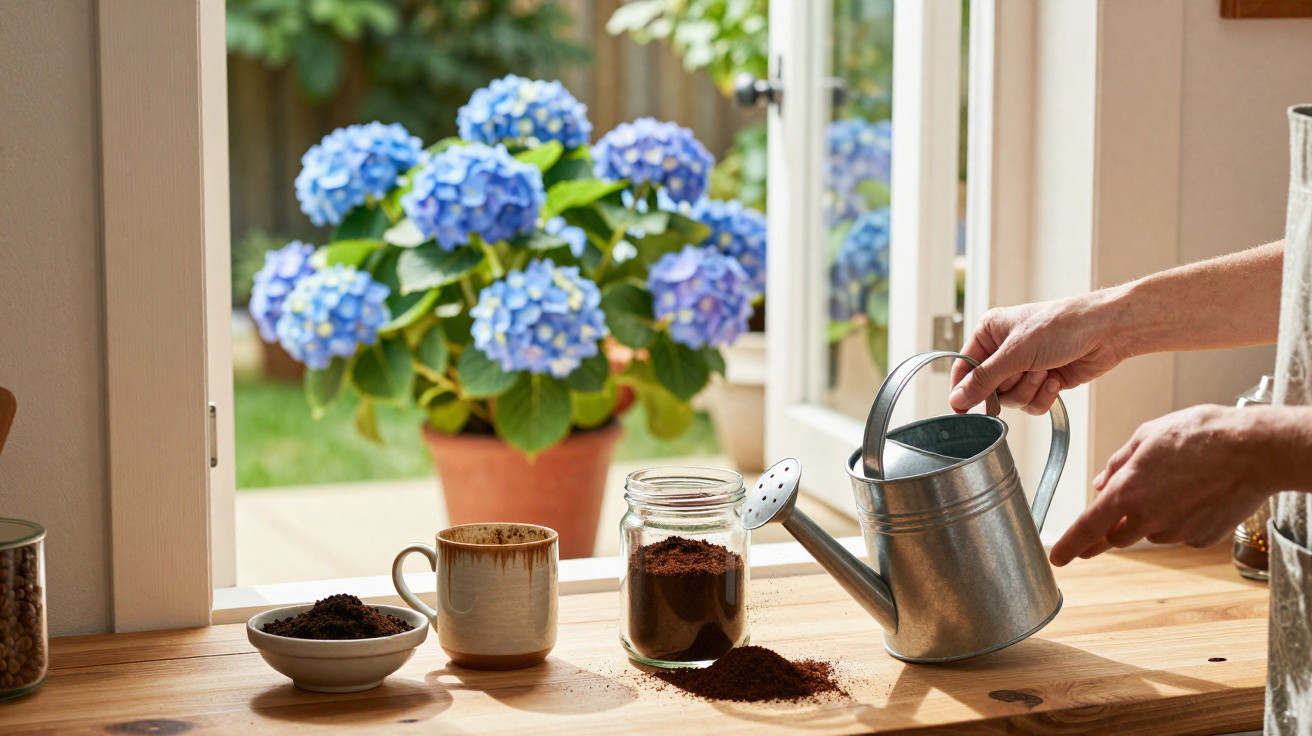
A simple kitchen staple can reverse the change.
Anyone who buys a vibrant blue hydrangea at a garden centre rarely expects it to return the following year in candy pink. This colour shift is not caused by a new variety, but by a subtle change in soil chemistry – triggered by tap water, lime and unsuitable compost. Taking action in late winter or very early spring can steer the flower colour back towards a deep blue by summer.
Why hydrangeas change colour at all
Hydrangeas are often seen as small mood indicators in the garden. In particular, varieties of Hydrangea macrophylla and Hydrangea serrata react strongly to the pH of their soil. Blue or pink is not determined by genetics alone; the chemistry surrounding the roots also plays a decisive role.
The process itself is straightforward: aluminium in the ground becomes soluble in acidic soil. The plant absorbs this element and stores it in its flowers, creating a blue pigment. If the compost is more neutral or calcareous, aluminium becomes virtually “invisible” to the roots – and the flowers shift towards pink and red.
Blue-flowering hydrangeas need slightly acidic soil and available aluminium – otherwise they gradually slip into pink.
A rough guide to the pH value around a hydrangea:
- pH 5.0–5.5: distinctly acidic – the ideal range for rich blue flowers
- pH 6.0–6.5: transition range – lilac, mauve or washed-out blue
- pH 6.5–7.0 and above: neutral to lime-rich – pink and red become dominant
If the soil remains too alkaline for an extended period, the hydrangea may display further signs of stress. A typical symptom is chlorosis: the areas between leaf veins turn pale yellow while the veins themselves stay green. This indicates issues with nutrient uptake, especially iron. This is a common sight in gardens with hard tap water and compacted soil.
It is important to note that not every hydrangea joins in this colour display. Mophead hydrangeas and mountain hydrangeas can be controlled well. Panicle hydrangeas, smooth hydrangeas and entirely white varieties, by contrast, largely retain their original colour regardless of what happens in the soil.
Apple cider vinegar: the simple kitchen helper for blue hydrangea flowers
Rather than buying expensive specialist fertilisers, many gardening enthusiasts now reach for something already in the cupboard: apple cider vinegar. When diluted in watering water, it can lower the pH around the roots slightly and make the soil more acidic.
A practical guideline often used by amateur gardeners is:
- around one cup of apple cider vinegar to roughly 10 litres of water
- stir thoroughly and water the root zone only, not the leaves or flowers
- repeat every one to two weeks in late winter and spring
Acetic acid has a mild effect and breaks down relatively quickly in the soil. That is precisely what makes this method appealing: the pH does not change abruptly, but shifts gradually. Once the hydrangea has reached the desired blue shade, the amount of vinegar can be reduced or stopped altogether.
Those who stop the “blue treatment” once they like the shade can maintain their preferred colour reasonably well – provided the rest of the care is right.
Garden experts point out that ordinary white household vinegar can also reduce pH. Apple cider vinegar is often more pleasant for sensitive noses and is considered slightly gentler. Whichever type is used, dosage is what matters. Too much vinegar can damage roots and upset the balance of microorganisms in the soil.
Other household remedies: what genuinely works and what is mostly a myth
Garden tips concerning blue hydrangeas have circulated for years. Not all of them stand up to close scrutiny. Some additions can genuinely help, while others are at best questionable.
Useful helpers from the kitchen and garden
- Coffee grounds: Dried coffee or espresso grounds are mildly acidifying and provide nitrogen. Work them lightly into the soil around the plant, rather than leaving them in thick layers, as they can go mouldy.
- Leaf compost: Compost made mainly from oak or beech leaves is slightly acidic and improves both soil structure and water retention.
- Conifer needles and bark: Used as a mulch layer, they create a mildly acidic environment as they slowly decompose.
- Specialist rhododendron or ericaceous compost: These growing media are naturally acidic and are ideal for new planting or repotting.
More legend than solution
- Coins or nails in the soil: Rusting nails or coins supply hardly any usable metal for the plant. They also have virtually no effect on pH.
- Blue food colouring: Even if it makes the soil look blue, the plant does not incorporate this dye into its flowers.
Anyone seeking deliberate but controlled results can combine gentle household remedies, such as diluted vinegar and coffee grounds, with an overall acidic soil structure. This helps the hydrangea stay healthy in the long term rather than merely being “recoloured” for a short time.
Step-by-step: how to turn your hydrangea blue again
The right timing is essential if the flowers are to shine by summer. Many of the relevant processes are already under way well before the first buds can be seen.
- Check the pH in late winter: Using a simple test kit from a garden centre, mix a small amount of soil from the root area as directed. If the reading is clearly above 6.0, it is time to act.
- Improve the soil structure: Loosen compacted ground and work in some acidic compost, composted bark or ericaceous compost. This improves water retention while lowering the pH gradually.
- Prepare the vinegar solution: Add one cup of apple cider vinegar to a watering can containing 10 litres of water, then mix well.
- Water precisely: Moisten only the root area around the base of the hydrangea. Avoid the leaves to prevent scorching.
- Repeat regularly: Continue every one to two weeks until late spring. Once the buds start to show colour, avoid making major further adjustments.
- Choose rainwater where possible: Collect rainwater and use it for watering on an ongoing basis if you can. Hard tap water repeatedly pushes the pH upwards.
The real colour decision is made in spring as the flower buds develop. Acting too late usually changes only the nuances.
Rainwater, hard water and the hidden effect of lime
Many gardens have a problem that is barely visible: lime-rich tap water. In hard-water regions, every watering adds small amounts of lime to the soil. Over the years, the pH rises noticeably, particularly in containers and raised beds.
Providing hydrangeas consistently with rainwater greatly slows this effect. Even a simple water butt connected to a downpipe may be enough to supply container plants throughout the summer. In areas with especially calcareous water, it is worth reserving collected rainwater for all plants that prefer acidic conditions – including rhododendrons, blueberries and camellias as well as hydrangeas.
Risks, limits and sensible combinations
As tempting as this kitchen-helper trick may sound, a hydrangea cannot be turned “blue” without limits. Every location has natural boundaries that can only be shifted to a certain extent.
- Too much acidity stresses the plant: A severely lowered pH can harm the roots and block the uptake of other nutrients.
- Container plants react more quickly: Treatments have a stronger effect in pots. Use less vinegar here and check the pH regularly.
- Respect the dependence on variety: Some cultivated pink varieties have limited genetic potential for true blue. Even in ideal soil, they are more likely to turn a cool lilac shade.
A dependable approach is therefore to build up the soil over time with acidic materials such as ericaceous compost, leaf mould and conifer mulch. Make rainwater the norm and use tap water only as an exception. Diluted vinegar or coffee grounds should serve only as gentle corrections, not as a high-dose permanent solution.
Once you understand how your hydrangea responds, you can fine-tune its colour more precisely over time. Some gardeners even enjoy playing with the shades: a bed with subtly different pH levels can produce blue, lilac and pink flower heads in a single summer – all from the same plant species, determined solely by small variations in the soil.
Comments
No comments yet. Be the first to comment!
Leave a Comment