
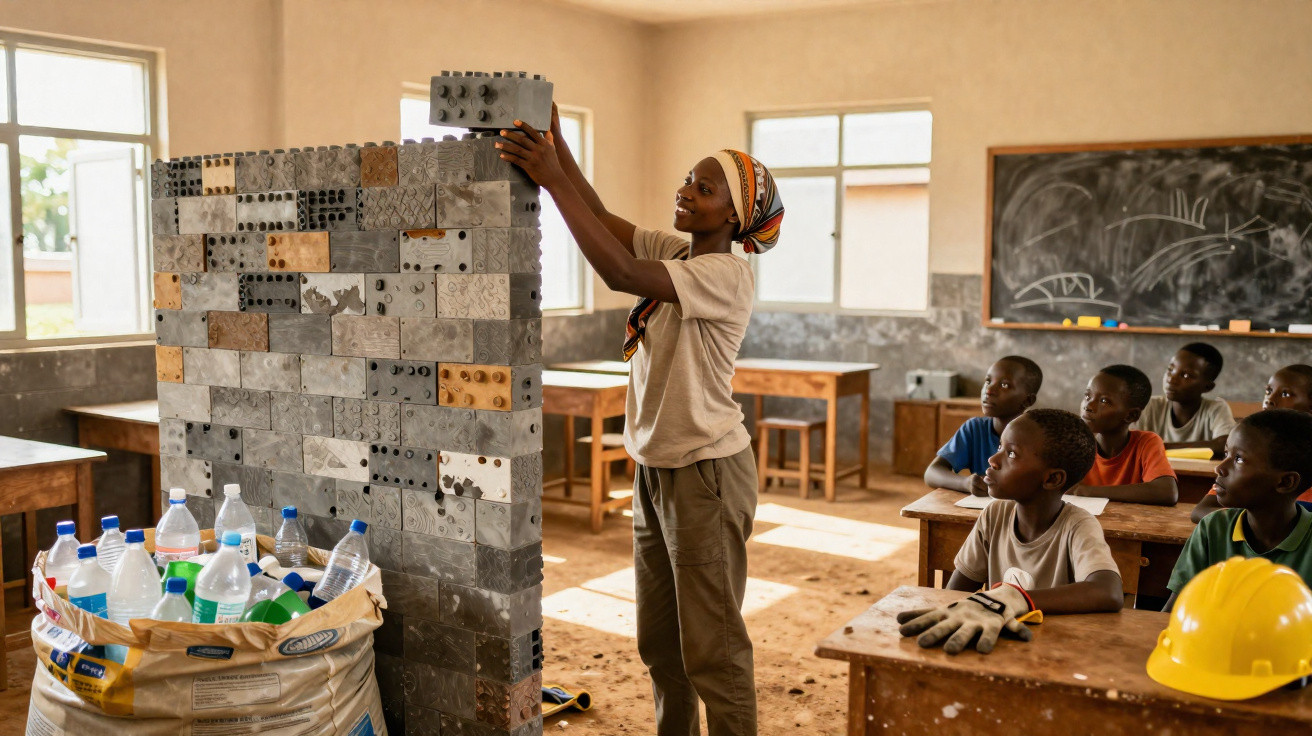
Côte d’Ivoire has found a way to tackle two challenges at once: the build-up of plastic waste and the shortage of suitable spaces for pupils. Using Colombian modular-block technology, the country had already built 516 classrooms, with another 12 under construction as of July 2026.
How is discarded plastic turned into material for schools?
The scheme uses waste collected in Abidjan and nearby communities, where it is sorted and processed at a local factory. The material is converted into lightweight, durable blocks designed to slot together without requiring complex bricklaying methods.
- Plastic waste is collected and sorted;
- Unsuitable materials, including PVC, are removed;
- The plastic is processed and moulded into blocks;
- The pieces are transported to construction sites;
- The blocks are fitted together to create walls and partitions.
Why are the recycled plastic blocks likened to giant Lego?
The components have matching shapes that allow the blocks to interlock, much like an enlarged construction toy. This feature cuts down the number of building stages and means that a classroom can be assembled within a few weeks, whereas conventional construction may take several months.
The technology behind blocks made from recycled plastic was created by the Colombian company Conceptos Plásticos and introduced to the country through a partnership launched in 2018. Africa’s first factory of this kind opened in Abidjan the following year.
What benefits do the blocks bring to classrooms?
As well as reusing waste, the blocks are waterproof, insulating and treated to improve their fire resistance. They are also lighter than conventional materials and do not transfer heat easily, helping classroom interiors remain cooler.
- Faster construction than traditional brickwork;
- Lower use of cement and other raw materials;
- Reduced labour and maintenance costs;
- Resistance to water, wind and certain pests;
- Improved thermal and acoustic insulation;
- Use of waste that would otherwise pollute streets and rivers.
How does the project also create income for women?
A large share of the plastic used is collected by women who had already been working informally with waste. The project has helped to organise associations, provide training and establish safer conditions for collecting, storing and selling the material.
The factory also keeps the value of recycling within the country itself. Rather than importing every block from Colombia, as happened during the initial phase, production now uses locally discarded plastic, turning an environmental problem into income and educational infrastructure.
Did the project really build 550 schools?
The published figures refer to classrooms rather than 550 fully completed schools. An update released on 2 July 2026 recorded 516 completed classrooms, 12 under construction and more than 3,220 tonnes of plastic recycled. The original goal was to reach 528 classrooms able to serve around 25,000 children.
The solution demonstrates how the circular economy can link waste management, employment and education. Just as other materials need protection against pests that can damage buildings and furniture, these blocks must undergo safety and durability testing. Where those checks are in place, plastic once accumulating in the streets can become walls for new learning spaces.
Comments
No comments yet. Be the first to comment!
Leave a Comment