
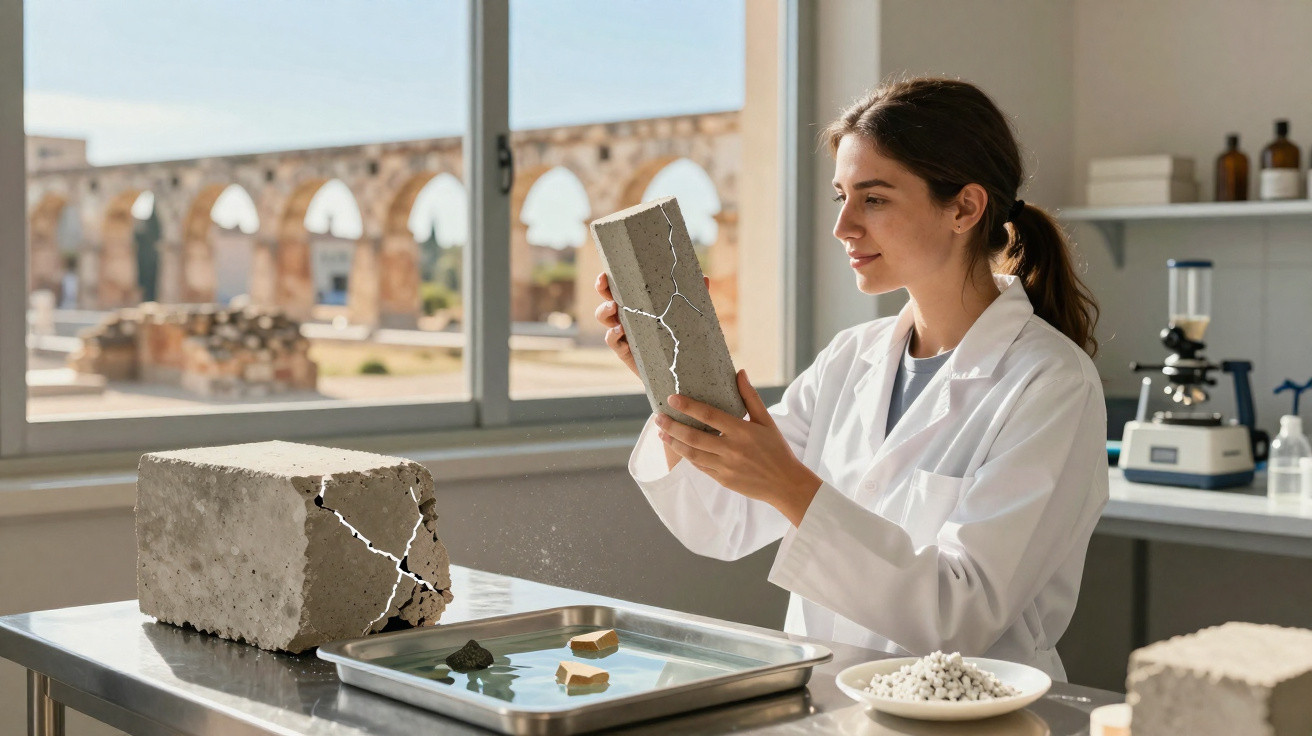
Roman concrete is among the greatest puzzles of ancient engineering. While many modern structures develop cracks after only a few decades, buildings constructed around 2,000 years ago still astonish researchers because of their strength and durability.
Why does Roman concrete last for so long?
For years, scientists have sought to explain why monuments such as Rome’s Pantheon have remained largely intact for two millennia. The explanation lay within the composition of the material used by ancient builders.
Recent studies have found that a blend of volcanic ash, lime and other minerals produced concrete that could react naturally with its surroundings, becoming stronger still over the centuries.
How does water help repair cracks?
Unlike modern concrete, which generally loses strength once cracks appear, Roman concrete has a natural self-repair mechanism. Contact with water triggers chemical reactions that can fill minor cracks.
As water enters the material, it dissolves lime particles contained in the mixture. New crystals then form, sealing the fissures and considerably extending the service life of the structures.
What sets modern concrete apart from Roman concrete?
Much of today’s construction relies on Portland cement, which was developed to enable building work to be completed quickly. Although efficient, this material can deteriorate as a result of moisture, temperature changes and corrosion.
Roman concrete, by contrast, was designed to develop over time. Rather than weakening after small cracks form, its composition encourages new mineral bonds, increasing its strength as the years pass.
Which ingredients made this mixture so remarkable?
The precise recipe remained unknown for centuries, but modern research has identified several essential components behind the exceptional strength of this historic material.
The main elements identified by researchers include:
- Volcanic ash, rich in reactive minerals;
- Quicklime, which contributes to the self-repair process;
- Fragments of volcanic rock;
- Water, including seawater, which intensifies certain chemical reactions.
Could this technology transform the construction industry?
Specialists believe that fully understanding the Roman formula could lead to concretes that are far more durable and sustainable. Alongside lower maintenance costs, it could reduce material consumption over the decades.
Researchers are continuing to develop versions inspired by this ancient technique. If testing progresses successfully, future projects may combine modern technologies with knowledge retained since the era of the Roman Empire.
The Roman legacy continues to inspire science
Historic monuments demonstrate that some ancient solutions still outperform more recent technologies in certain respects. Roman concrete shows how observing nature and understanding materials can deliver extraordinary results.
As further discoveries emerge, expectations are growing that this technique could influence the construction of stronger buildings, bridges and coastal works, capable of lasting for centuries as Roman structures have done.




Comments
No comments yet. Be the first to comment!
Leave a Comment