
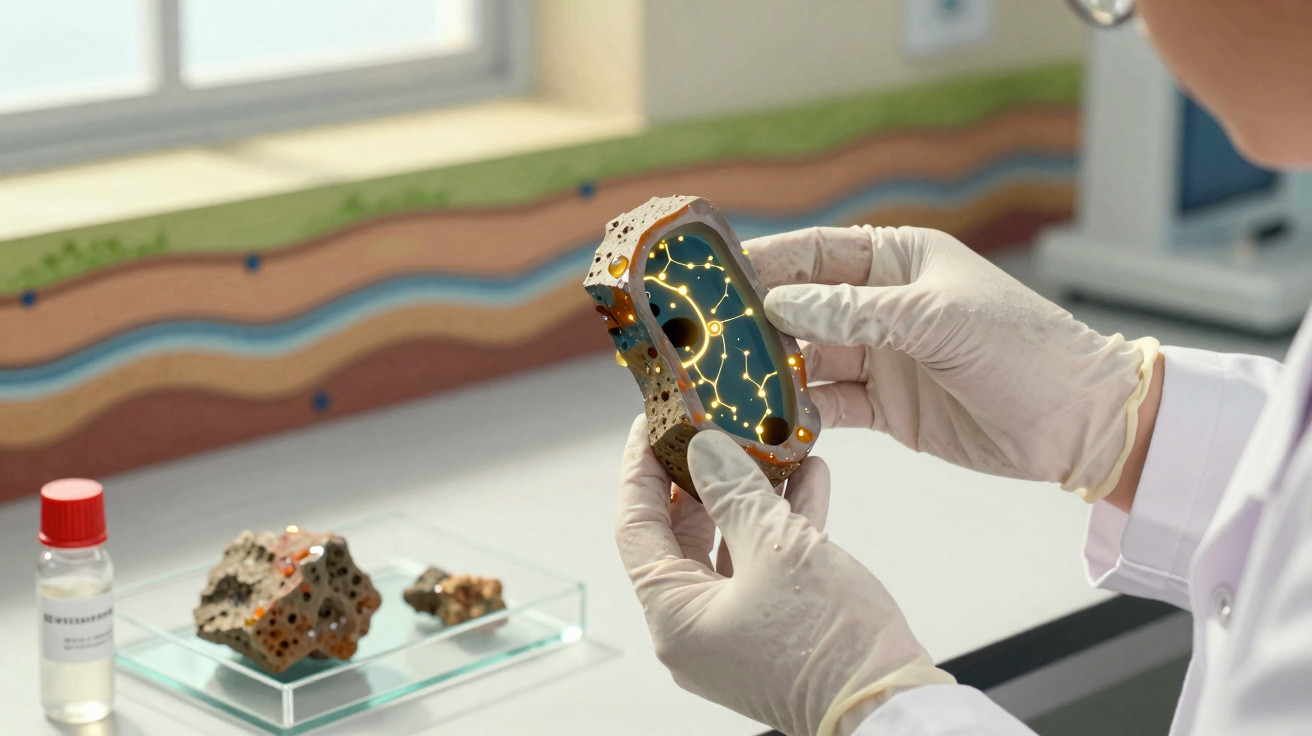
Groundwater is often regarded as something straightforward, despite being full of microbes that influence its behaviour. It travels through fissures, supplies wells and can eventually reach a glass on the kitchen table.
Below its apparently still surface lies a densely populated microscopic world carrying out unobtrusive yet vital work.
For many years, scientists concentrated largely on microbes freely suspended in groundwater because they were simple to collect. Researchers could take a water sample, examine the organisms within it and proceed from there. Although this seemed sensible, it overlooked a major part of the picture.
The majority of subterranean microbes do not float freely. Instead, they adhere to rock surfaces and create thick biofilms. These attached organisms may be up to a thousand times more plentiful than those suspended in the water. Leaving them out means missing most of the activity.
Microbial worlds share aquifers
To investigate this more closely, researchers examined a natural aquifer in the Thuringian Hainich region. Their work focused on carbonate rock, a widespread underground rock type through which groundwater passes.
Using modern genomic analysis methods, they compared microbial communities on the rock with those in the water around it.
The findings were notable. Microbes fixed to rock and microbes floating in water represented two distinctly different ecosystems. Although they occupied the same space, their functions and capabilities differed considerably.
Alisha Sharma carried out the research for her doctoral thesis at Friedrich Schiller University Jena.
“The lifestyle of the microorganisms – attached to rock or floating free in the water – has a stronger influence on the structure of the community than environmental factors, such as the availability of oxygen,” said Sharma.
What rock microbes actually do
Microbes living on rock do more than simply gain a stable foothold. They are highly specialised workers.
Rather than relying on organic matter for food, many obtain energy from inorganic materials such as iron or sulphur. In the process, they bind carbon dioxide.
As a result, they actively retain carbon underground, a process that could be much more important than scientists had previously understood.
Subsurface carbon binding influences the way carbon moves around the planet. This makes these microbes relevant not just to groundwater chemistry, but also to climate models and research into natural carbon sinks.
In terms of the long-term climate balance, what occurs below ground does not remain there.
“If we ignore the community attached to rock, we overlook an important functional actor in the groundwater system,” said Dr. Martin Taubert, a research group leader at the University of Jena.
“These microorganisms make an important contribution to central chemical processes such as the carbon cycle.”
Microbes help protect groundwater
Groundwater is among the planet’s most important drinking-water sources. Almost half of the global population relies on groundwater for everyday domestic use, so safeguarding it also requires protecting the microbial life it contains.
Its chemistry is determined by more than rock composition and flow rates. It also depends on microbes transforming substances as the water travels below ground.
A better understanding of attached microbial communities allows scientists to assess more accurately how groundwater naturally cleans itself.
It can also clarify how some chemicals are broken down or held back before they reach wells and springs. This insight is important for water safety and long-term water management.
Active microbes underground
The study forms part of the wider objectives of the Cluster of Excellence “Balance of the Microverse.”
The team investigates how microbial communities influence their surroundings, and how changes in those surroundings affect the communities in return.
“Microorganisms keep many natural systems in balance without us noticing,” said Professor Kirsten Küsel. “By unlocking their hidden habitats, we better understand how stable – or vulnerable – these systems really are.”
The central message is straightforward, but easily overlooked. Subsurface microbes are not passive background activity; they actively influence water quality, carbon storage and chemical cycles.
Most are not drifting past one another. They remain anchored to stone, carrying out their roles in place every hour of every day.
The complete study appeared in the journal Microbiome.






Comments
No comments yet. Be the first to comment!
Leave a Comment