
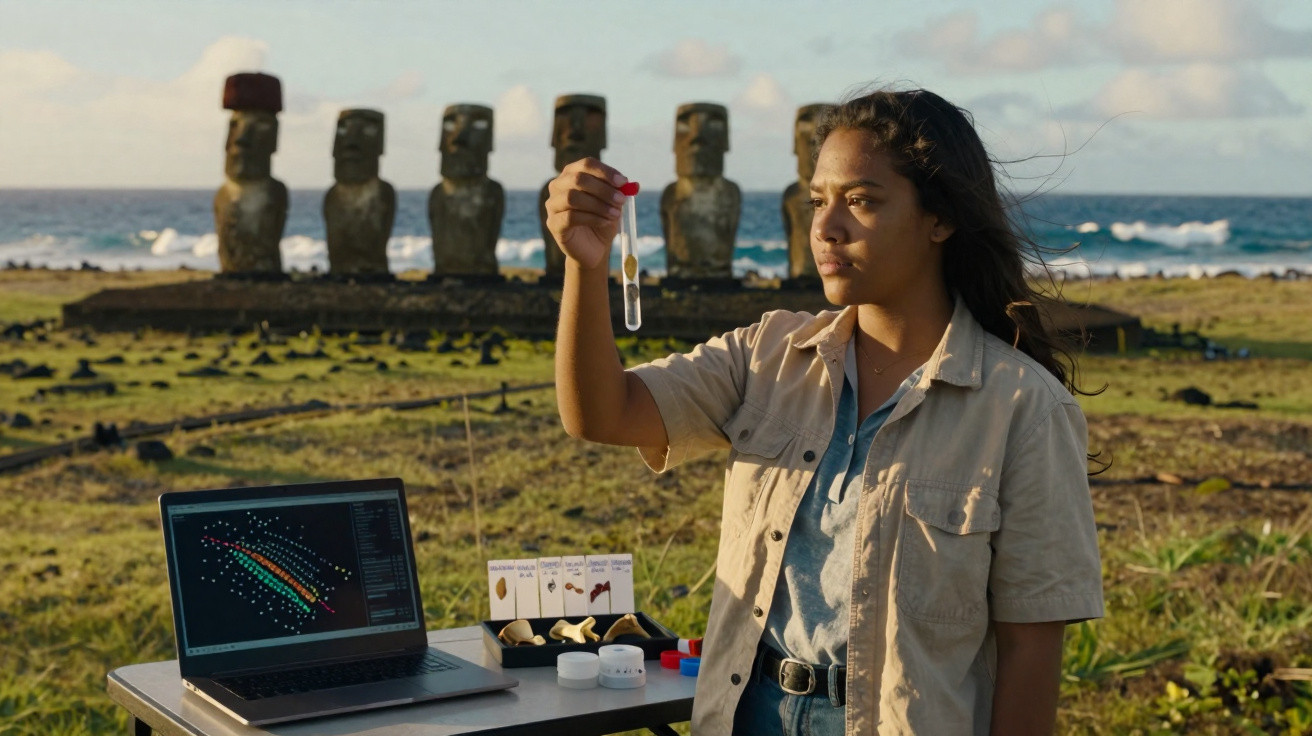
“In just a few centuries, the people of Easter Island wiped out their forest, drove their plants and animals to extinction, and saw their complex society spiral into chaos and cannibalism.”
That is how Jared Diamond described the island's history in Collapse, his best-selling book published in 2005.
Almost two decades on, an international group of geneticists has uncovered evidence suggesting that this well-known warning narrative did not occur.
Their findings portray the history of Rapa Nui - termed Easter Island by colonial Europeans - not as a self-caused demographic collapse, but as one of cultural resilience.
Rapa Nui population history
The ancient Rapa Nui people appear not to have been completely cut off from other populations during the 1600s. The evidence also shows they did not exhaust their resources to the extent of causing ‘ecocide’.
Instead, ancient genetic evidence indicates that the island formerly supported a modest population of 1,500 to 3,000 people. These inhabitants interbred with groups of Polynesian and Indigenous American ancestry well before Europeans arrived in either area.
Genetic evidence further suggests that Rapanui civilisation continued expanding until the 1860s. Peruvian slave raids, followed by epidemics associated with European colonial activity, then reduced the island's population to approximately 110 people.
More than 1,500 current residents of Rapa Nui now identify as Indigenous Rapanui.
“These results do not support a major population collapse on Rapa Nui after its initial peopling and before the 1800s,” conclude the study's authors, geneticists from the University of Copenhagen in Denmark and the University of Lausanne in Switzerland.
A substantial amount of archaeological and anthropological evidence has already challenged Rapa Nui's ecocide theory. However, this research is the first to question that account through ancient genomic data.
The study draws on the remains of 15 ancient Rapa Nui individuals. Europeans removed their bones and teeth from the island during the 19th and 20th centuries, after which they were held in several Paris museums.
Following stringent museum protocols, the scientists sequenced each person's genome with backing from the Comisión de Desarrollo Rapa Nui (CODEIPA) and the Comisión Asesora de Monumentos Nacionales (CAMN).
Researchers also held regular meetings with Rapanui community representatives. They hope the findings will support the community's campaign to return its ancestors to the island.
Ancient genomes and Indigenous American ancestry
Using genomic analysis to reconstruct Rapa Nui's population over the past 100 generations, the team concluded that it is improbable that the sampled individuals were born after European contact.
Each of the 15 ancient Rapanui people had about 90 percent Polynesia-like ancestry. Their genomes also contained roughly 10 percent Indigenous American ‘admixture’, indicating an interbreeding event that probably took place between 1250 and 1430.
Columbus did not arrive in the Americas until 1492. European-like ancestry occurs in modern Rapanui people, but not in ancient Rapanui individuals.
Present-day Rapanui and Polynesian groups also possess an Indigenous American genetic component. Studies indicate that this entered both gene pools between 1150 and 1495.
This points to Polynesian voyagers reaching both the Americas and Rapa Nui before Europeans did.
So far, however, the only other studies examining ancient Rapanui DNA found no evidence of Indigenous American ancestry.
The principal authors of the latest work - geneticists J. Víctor Moreno-Mayar, Anna-Sapfo Malaspinas and Bárbara Sousa da Mota - told ScienceAlert that low-resolution data and sampling mistakes were the likely explanation.
After re-examining ancient genomes from one earlier study, the researchers identified an Indigenous American-like element in three of five ancient Rapanui individuals.
A separate earlier investigation may instead have sequenced ancient Rapanui people who lived before the interbreeding event, or immediately afterwards, when the signal had not yet become incorporated into their genomes.
The latest evidence “leave no doubt” that ancient Rapanui people interbred with populations of Indigenous American descent, wrote evolutionary archaeogeneticists Stephan Schiffels and Kathrin Nägele in an independent review for Nature.
Polynesian seafaring and Rapa Nui contact
The remaining question is how Rapanui people encountered Indigenous Americans on the place Diamond called “the world's most isolated scrap of habitable land”. Rapa Nui lies around 1,800 km from the nearest inhabited Polynesian island and 3,512 km from Chile in South America.
Experts have long disputed whether Pacific Islanders reached the Americas before European explorers.
In 2020, a genetic study produced evidence that Polynesians contacted Indigenous American communities most closely related to the Indigenous people of what is now Colombia before Rapa Nui was settled.
“While it is true that long-distance sea voyaging became less frequent with time, we know that Polynesians were really adept seafarers that managed to get to every Polynesian island in a matter of 1 to 2 thousand years,” Moreno-Mayar, Malaspinas, and Mota explained to ScienceAlert.
“Since the sea was more a road to them rather than a barrier, we believe our results make it very likely that they managed to reach the Americas. Therefore, the data suggest that at some point, Rapa Nui was not as isolated despite the thousands of kilometers separating [it], other islands and the Americas.”
The study appeared in Nature.





Comments
No comments yet. Be the first to comment!
Leave a Comment