
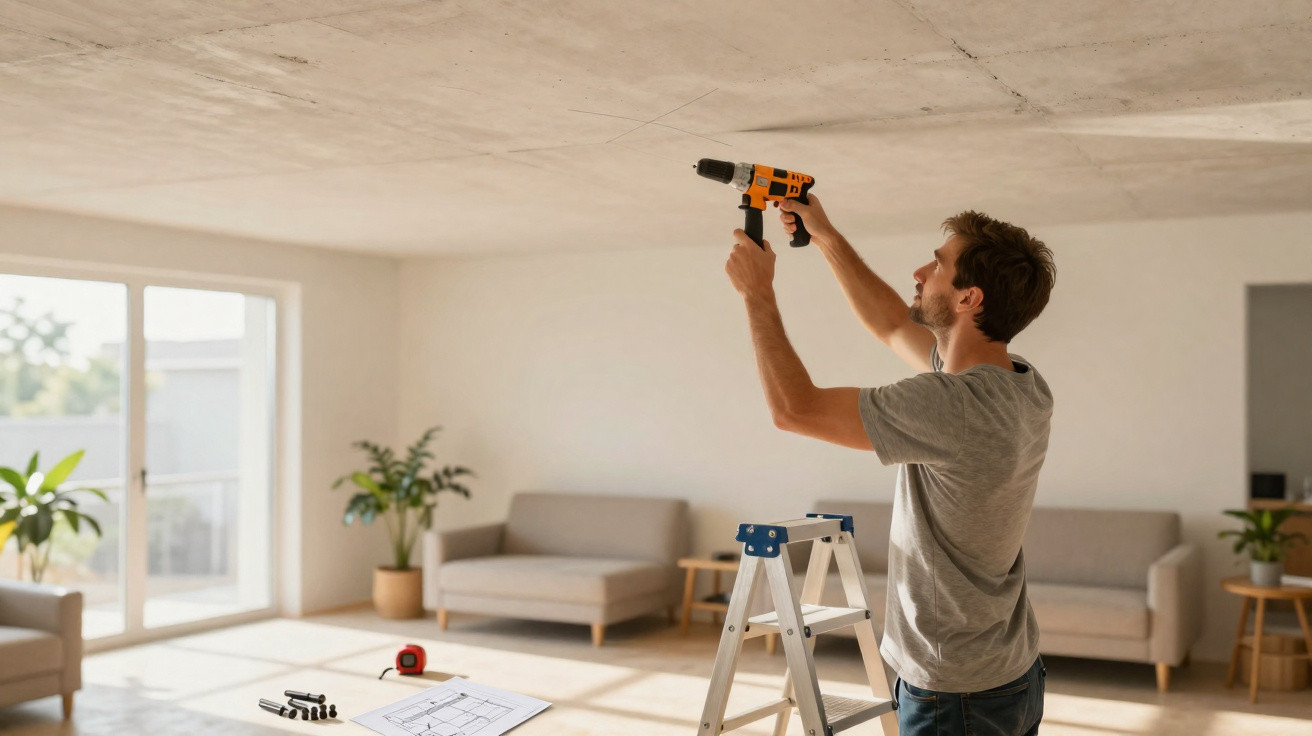
Drilling into a ceiling without knowing where the reinforcement bars in the concrete slab run can damage the drill bit, strike the reinforcement and create weak points in the concrete. Before fitting a light fitting, ceiling fan or hanging clothes airer, it is worth carrying out a simple, safe check.
Why is drilling into concrete slab reinforcement dangerous?
A reinforced concrete slab combines concrete and steel to withstand the loads imposed on the structure. If the drill bit hits a steel bar, it may jam or break, and the metal can be exposed to moisture, encouraging corrosion over time.
Reinforced concrete contains steel reinforcement that withstands tensile forces, while the concrete mainly resists compression. For this reason, concrete slab reinforcement must not be regarded as an ordinary obstacle during drilling or finishing work.
Before drilling into the ceiling, consider these points:
- Reinforcement: steel bars contribute to the slab’s strength.
- Detector: simple devices can help locate metal before drilling.
- Sudden resistance: if the drill bit jams, stop straight away.
- Correct drill bit: use a carbide-tipped masonry bit suitable for concrete.
- Load: ceiling fans and clothes airers require fixings rated for the load.
How can you understand reinforcement spacing?
In many residential slabs, the bars form a grid with relatively regular spacing, but the distance varies according to the design, slab type and intended load. It is therefore never safe to guess the route of the reinforcement simply by eye.
The following approach can serve as a starting point: if a detector identifies metal along one line, look for nearby parallel patterns before marking the hole. In older slabs, renovated properties and beam areas, the layout may be less predictable and requires extra care.
How should you use a metal detector before drilling?
Basic metal detectors, available from builders’ merchants, are among the most accessible ways to map steel bars before installation. Move the device slowly across the ceiling in horizontal and vertical lines, using a pencil to mark points of warning and repetition.
Detect before using the drill bit
The reinforcement may be exactly where you intend to drill.
Move the detector in several directions and compare its signals before selecting the location.
If the hole is for a heavy load, confirm the position with a professional before installation.
Once you have found a metal line, move the drilling point to an area with no signal, leaving a safety margin. A detector does not make the installation completely risk-free, but it greatly reduces the chance of hitting reinforcing bars, conduits or metal components.
Use the detector as follows:
- Clean the ceiling area, removing dust and loose paint.
- Move the device slowly in horizontal and vertical directions.
- Mark the points where the detector signals metal.
- Look for repeating patterns that may indicate reinforcement lines.
- Select a clear point away from the strongest markings.
What should you do if the drill bit meets sudden resistance?
If the drill bit enters the concrete normally but suddenly jams, overheats, makes a metallic noise or stops advancing, stop drilling. This is a classic sign of possible contact with a steel bar, conduit or another hard element inside the slab.
In this situation, do not force the drill or try to break through the obstruction. Remove the bit, inspect the dust produced and relocate the hole to another safe position. Forcing it can damage the tool, create a route for corrosion and compromise the integrity of the concrete.
While drilling, follow these rules:
- Use a carbide-tipped masonry bit compatible with concrete.
- Make shallow holes where the fixing allows.
- Do not force the drill if metallic resistance appears.
- Do not widen the hole without knowing what is inside the slab.
- For a ceiling fan or heavy clothes airer, use fixings suitable for the load.
When should you call a professional before installation?
As with the trick for hanging a picture without getting the hole wrong, marking the point correctly prevents unnecessary rework. On a ceiling, however, the risk is greater because the slab forms part of the house’s structure.
Call a professional if the installation is heavy, if you are unsure about beams, if the detector identifies metal throughout the area or if the building has an old slab. For light fittings, ceiling fans and clothes airers, planning, a detector and careful drilling help prevent damage, but safety must always take priority over speed and appearance.



Comments
No comments yet. Be the first to comment!
Leave a Comment