
In cities such as Phoenix, Arizona, pavement is so commonplace that it barely registers. It sits beneath car tyres and shopping trolleys, enduring the seemingly endless summer heat.
However, an expanding body of research indicates that asphalt may do much more than raise urban temperatures. It could also emit chemicals into the air people breathe each day, particularly where roads and car parks spend months roasting in sunlight.
This concern underpins the work of Elham Fini at Arizona State University. She has spent years examining how asphalt deteriorates as it ages and which chemicals it gives off.
Fini’s findings indicate that discussions about pavement should extend beyond climate and energy consumption to include public health.
Phoenix feels the heat from its pavement
Phoenix has an enormous expanse of paved ground. Roads, car parks and other sealed surfaces are estimated to make up 40 percent of the city.
That scale alone makes pavement a major urban concern. If every paved surface in Phoenix could be gathered in a single location, it would cover San Francisco four times over.
Pavement absorbs heat efficiently during daylight hours, then releases it gradually overnight. In doing so, it contributes to the urban heat island effect that leaves cities warmer after dark.
People experience this without scientific explanation: roads continue to radiate warmth well after sunset, car parks remain hot into the evening, and buildings need more cooling.
Yet Fini’s research indicates that heat may represent only half of the issue.
Asphalt chemical fumes increase in the heat
Bitumen, the black, sticky petroleum-based material that binds asphalt together, releases volatile organic compounds, or VOCs, into the atmosphere.
These emissions do not occur solely during roadworks or from newly laid car parks. They are released continuously, although people tend to notice them most on intensely hot days, when asphalt’s familiar smell becomes more pronounced.
Two studies, published in the Journal of Hazardous Materials and Science of the Total Environment, found that the compounds alter after sunset and may create ultrafine particles that degrade air quality.
In the immediate term, the fumes may lead to dizziness and respiratory problems. This is already a concern for those who work nearest to the source.
Construction teams and road-laying workers, for instance, spend extended periods around hot asphalt and its chemical fumes, frequently without a respirator.
Long-term exposure brings greater risks
The potential consequences seem more severe over longer timescales. Prolonged exposure has been associated with an increased risk of lung cancer, making repeated occupational exposure particularly concerning.
Fini is currently collaborating with Dr. Bruce Johnson through a partnership with Mayo Clinic to gain a clearer understanding of how these emissions influence respiratory health.
Ultimately, the research could result in stronger worker safeguards, better awareness among neighbouring communities and improved materials for roads.
Ageing asphalt becomes more toxic
Fresh asphalt alone would provide sufficient reason for concern, but evidence suggests that ageing pavement may pose an even greater problem.
Heat and sunlight gradually degrade bitumen, changing the combination of chemicals emitted from the paved surface.
Asphalt that has aged begins to give off different VOCs, including compounds that seem more toxic than those released at an earlier stage.
Some have little or no strong odour, perhaps the most unsettling aspect. A lack of smell does not indicate a lack of harm.
These minute toxic compounds can enter arteries and organs. Testing and modelling also indicate that they could cause substantial neurological damage, particularly among women and older adults.
Scientists have not yet established precisely when exposure reaches an unequivocally unsafe level. Even so, what is known already should prompt people to stop viewing pavement as neutral infrastructure.
Converting algae into asphalt
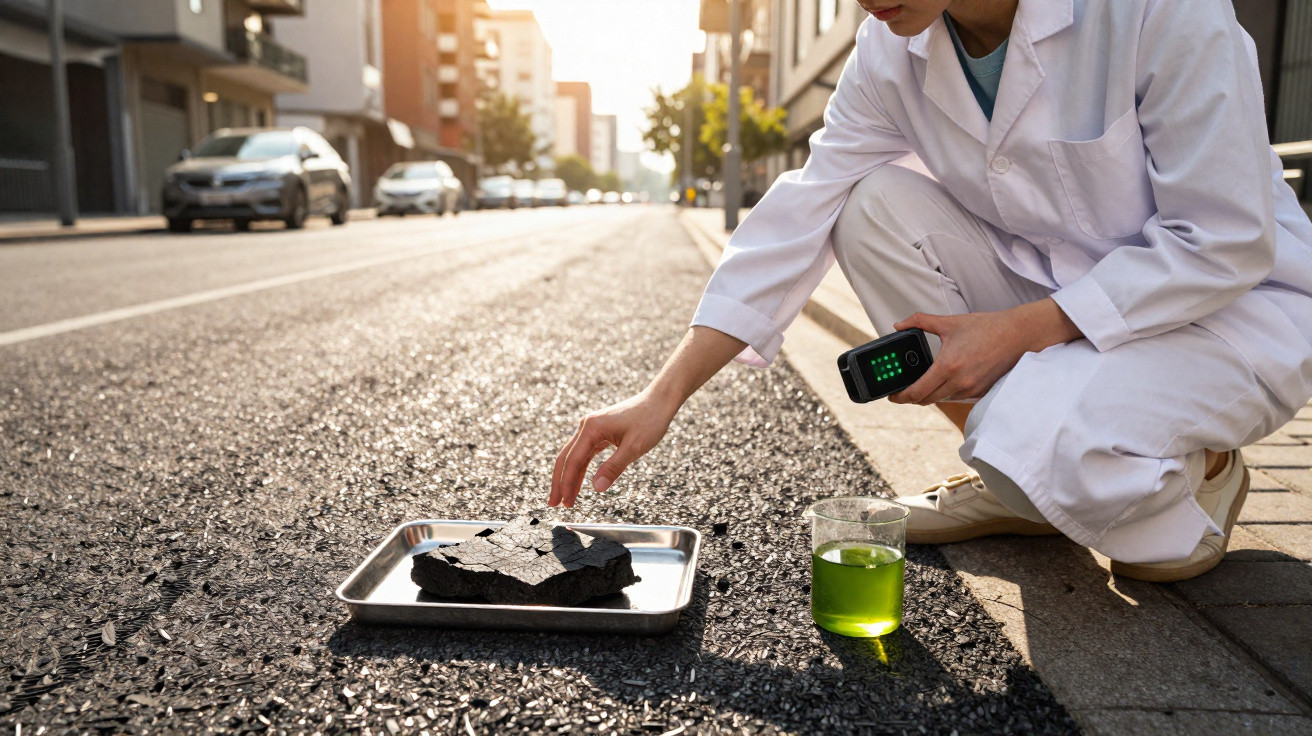
Fini has joined Peter Lammers, chief scientist at the Arizona Center for Algae Technology and Innovation, to cultivate algae with wastewater from a Phoenix treatment plant.
Rather than allowing this nutrient-rich, chemical-laden water to be wasted, the team uses it to create a material that could make asphalt less toxic.
“It’s a great setup because we use water that’s far too high in nitrogen and phosphorus to be released anywhere. Instead, we reuse it to grow more algae,” Lammers said.
Fini then heats the algae at high temperatures with very little oxygen, producing a binder that can be incorporated into asphalt.
What testing found
Tests found that the algae-infused material cut the toxicity of asphalt emissions by roughly 100-fold.
There could be a practical benefit as well. Algae appears to slow the rate at which pavement deteriorates, potentially reducing maintenance costs and making it more appealing to councils and paving firms for reasons beyond health.
Fini is investigating additional binders too, including one produced from branches left over after forest-thinning projects. She is working with Phoenix to surface a stretch of road with algae-infused asphalt.
This will make it possible to assess the material beyond laboratory conditions. Conditions in the real world are invariably more complicated - and more revealing.
A concealed pollution issue
Such real-world trials are important because pavement VOCs are commonly omitted from standard air-quality assessments. When cities do not measure them adequately, they can easily be overlooked.
Roads are so familiar that many people no longer notice them. They are simply a functional, fixed part of urban life.
Yet they affect how hot a city feels, the cleanliness of its air and, potentially, the health of those who live and work nearby.
“We have 4 million miles of roads in America,” Fini said. “We should make those 4 million miles do more for us than just get from A to B.”
Viewed this way, pavement no longer fades into the background. It instead appears to be one of the everyday features that may have been affecting people all along, while few were asking the necessary questions.





Comments
No comments yet. Be the first to comment!
Leave a Comment