
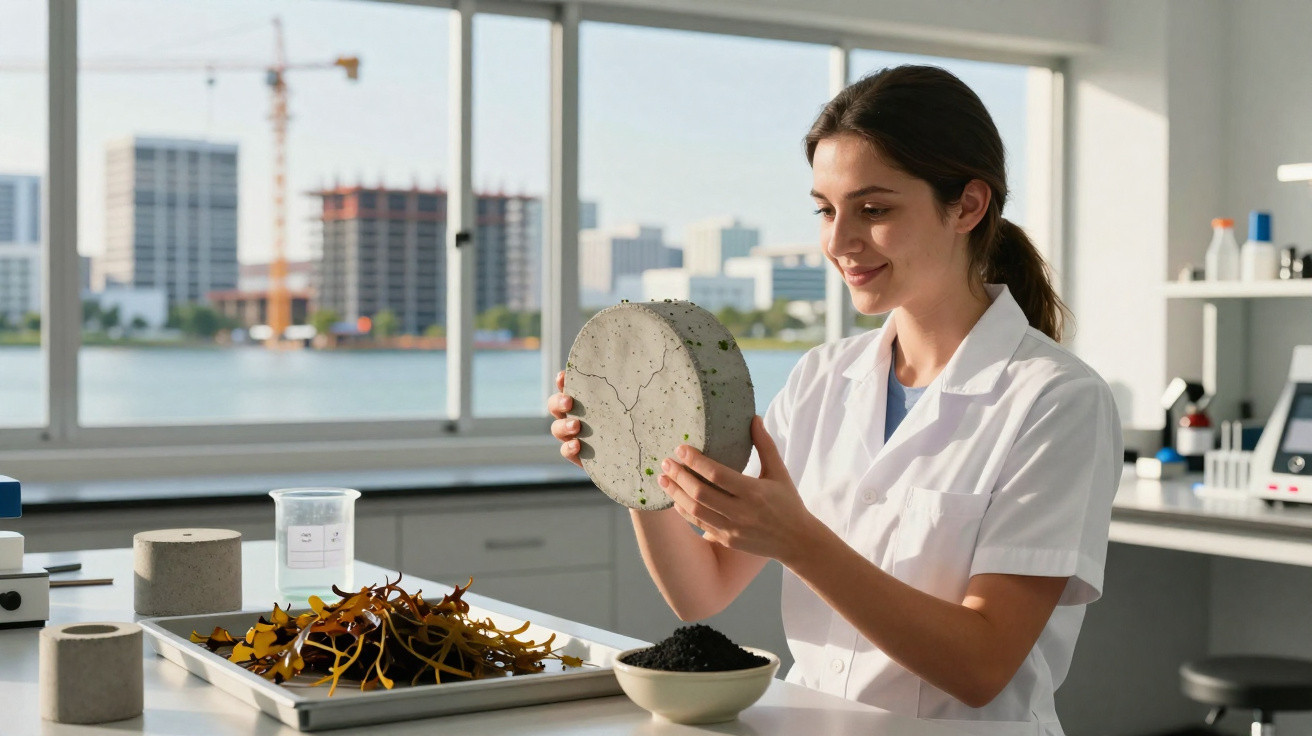
Researchers have found that seaweed could become a concrete ingredient, displacing some cement while capturing additional carbon as the material sets.
This discovery gives a familiar coastal crop a different purpose, with the potential to reduce concrete pollution before construction is complete.
Turning seaweed powder into wet cement
For the experimental mixtures, algae was raised in hatchery tanks before being processed into a dark powder and mixed throughout wet cement.
At the University of Miami, civil engineering professor Ali Ghahremaninezhad led modifications intended to enable the material to replace a greater amount of cement without compromising the project’s key aim.
Achieving that aim required more than adding algae alone, as untreated material can disrupt the way concrete sets and binds together.
The findings raise the broader issue explored by this article: can this lower-emission formula match the performance of concrete already relied upon by people?
From algae to biochar
UM’s hatchery on Virginia Key, a barrier island near Miami, cultivates the native algae used for the trials.
Following harvesting, the algae is converted into biochar - a charcoal-like carbon material - by heating it in low-oxygen conditions that remove most gases.
The material’s pores can retain water and provide more sites for cement products to form, making the treatment process particularly important.
At this point, the work moves beyond seaweed itself and becomes an engineering challenge.
Cement and carbon emissions
Cement creates most of concrete’s climate impact, with its production responsible for roughly 7 to 8 percent of worldwide carbon emissions.
Its manufacture emits carbon through fuel burned in kilns and through limestone breaking down at very high temperatures.
Removing each bag of cement from a mixture reduces pollution before a building has even begun fulfilling its function.
Even a partial substitution is significant: concrete is so extensively used that modest changes to its formula can quickly accumulate.
Increasing cement replacement
Previous biochar experiments in the same laboratory showed that increasing the dose may improve crack healing, but can also lower strength.
This trade-off is why the Miami team treats algae char before incorporating it into mixtures, rather than simply adding larger quantities.
In a separate study of algal biochar, a 30 percent cement replacement reached comparable strength after several weeks.
Although these findings cannot ensure the same outcome in this project, they indicate that algae-derived carbon can serve as more than a waste material.
Locking carbon inside concrete
The team additionally applies carbon curing, in which newly made concrete is exposed to concentrated carbon dioxide as it hardens.
The gas reacts with calcium-rich components to produce stable minerals, turning carbon into part of the solid material rather than leaving it in the air.
One recent method retained up to 45 percent of injected carbon dioxide without reducing concrete strength.
Miami’s mixtures seek to combine this carbon-storage measure with reduced cement use, tackling emissions in two ways simultaneously.
Seaweed, cement, and Florida
Florida provides a demanding testing environment, as salt, heat, humidity and storms take their toll on conventional concrete.
Any lower-carbon mixture must retain its strength, withstand cracking and avoid creating straightforward routes for water intrusion and corrosion.
These local conditions are why the project prioritises durability as well as a smaller carbon footprint.
If a material deteriorates prematurely in a coastal setting, its climate advantage is lost through repairs, replacements and additional cement use.
Award and momentum
The project received backing after UM researchers showcased it at Climate Correction in Orlando in March 2026.
The $25,000 grant will assist with purchasing equipment that allows the researchers more precise control over biochar production.
“Look at the problems happening in your community and look across disciplines and think creatively,” said Rodriguez.
That approach is important because the solution requires marine science, materials engineering and construction to work in concert.
What could scale
Algae may offer concrete producers something they urgently need: a nearby source material that is not dependent on diminishing industrial waste streams.
Using material grown locally can reduce transport requirements and make supply less dependent on coal plants or steel mills.
“A lot of the solutions that we’ve derived came from things that are right around us,” Rodriguez said.
Nevertheless, widespread adoption of this type of mixture will require consistent quality, affordable costs and standards that builders can rely on.
Limits before launch
It has not yet been demonstrated that algae concrete can move unchanged from laboratory cylinders to highways, towers and bridges.
Its long-term durability, corrosion performance, curing rate and cost will determine whether it becomes a specialist product or routine practice.
Since treatment stages introduce added complexity, the climate benefit must outweigh the energy and cost required to carry them out.
Such uncertainties are typical at this point, but they help explain why even promising concrete formulations can take years to become widespread.
What comes next
Miami’s project demonstrates how a single material can fulfil two roles: replacing a polluting ingredient and storing additional carbon.
Whether algae concrete reaches construction sites soon or not, it has already redirected engineers’ search for improved cement.




Comments
No comments yet. Be the first to comment!
Leave a Comment