
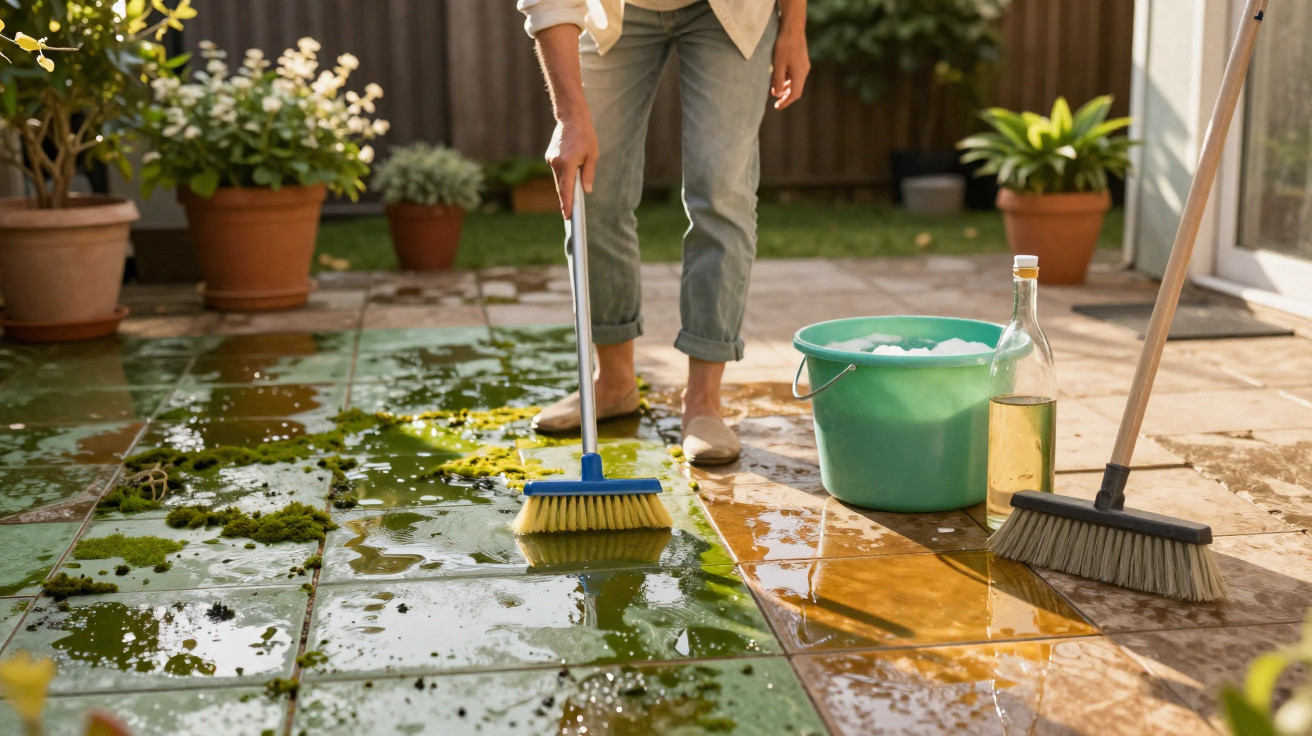
Almost anyone with a garden or balcony will recognise the situation: weeks of rain, very little sunshine, plus leaves and grime. By spring, the outdoor surface can resemble a slippery ice rink rather than an inviting seating area. That was exactly how my own patio looked until I tried a straightforward approach that needs no pressure washer, costly specialist products or hours of scrubbing.
From a green slip hazard to a usable patio
After the cold, damp months, every concrete slab was covered: moss had filled the joints, green growth coated the surface, and dark marks made it impossible to tell what colour the patio had originally been. Placing a chair securely was difficult, and walking across it barefoot was out of the question.
The DIY shop had shelves full of containers labelled “green growth remover”, “moss remover” and similar specialist treatments. Their prices were considerably higher than I wanted to pay. On top of that, the instructions recommended applying them in dry weather while wearing gloves and, in some cases, respiratory protection. I also looked into hiring equipment: renting a pressure washer for a day was hardly cheap, and I wanted to avoid the effort of carrying it around as well as the noise.
So I looked for something inexpensive, quick to use and not dependent on what felt like half a chemistry lab. The answer was surprisingly unremarkable: an ordinary bottle of household vinegar, specifically clear table vinegar available from the supermarket for just a few pence.
The vinegar method: cleaning a patio without a pressure washer
The basic principle is uncomplicated: vinegar contains acid, which weakens organic growth such as algae and moss. Mixed with water, it can be spread across a large area without overloading the surface. A British journalist had described using precisely this method to make her own patio usable again, so I recreated those instructions.
Preparation: sweep first, then mix
The first stage is one that many people underestimate: sweeping thoroughly. Using a stiff-bristled broom, I cleared away loose leaves, dirt, sand and fragments of moss. The cleaner the area is at the outset, the more effectively the vinegar can reach the growth underneath.
Next, I used a basic bucket and mixed the solution at a 1:1 ratio:
- 1 part clear household vinegar
- 1 part water, either cold or lukewarm rather than boiling
The amount of water required depends on the size of the patio. For roughly 15 to 20 square metres, half a bottle of vinegar - around 0.5 litres - plus the same quantity of water was enough for me. The benefit is that the total cost comes to well below £1.
“An inexpensive 1:1 vinegar-and-water mix was enough to make a heavily green-covered patio usable again in around an hour.”
Applying the solution and letting it work
I simply poured the prepared mixture directly from the bucket over the patio. Anyone who prefers can use a watering can or pressure sprayer, although neither is essential. The important thing is to wet the surface properly, particularly the areas that look dark green or almost black.
After that, leave it alone. Around 45 to 60 minutes of contact time was sufficient in my case. The patio changes very little in appearance during this period; the real result only becomes clear during the following stage.
Gentle brushing rather than heavy scrubbing
Once the waiting time was over, I used the broom again. I brushed the surface with light pressure, and, to my surprise, the green growth came away almost effortlessly. The slabs immediately looked lighter as I worked, while the joints became cleaner too.
Rather than kneeling for hours and struggling with a small brush, it took only a few minutes to cover the entire area. Finally, I gave the patio a quick rinse with water; an ordinary garden hose is sufficient.
Where vinegar works well - and where it should not be used
Useful as this trick may be, it is not automatically suitable for every patio. The surfacing material is the deciding factor. Vinegar is acidic, and certain surfaces react badly to it.
Suitable surfaces
- Concrete slabs: The mixture generally works very well here, especially on green growth and light staining.
- Frost-proof outdoor porcelain tiles: Many modern patio tiles can tolerate diluted acid, provided their surface does not have a special coating.
- Joints with weeds: Vinegar also weakens small weeds and patches of moss growing between slabs.
Materials on which vinegar can cause problems
- Natural stone, including marble, limestone or certain types of granite: The acid may roughen the surface, cause staining or leave it looking dull.
- Metal components: The bases of railings or decorative metal trims should not remain in contact with vinegar, as corrosion may result.
- Sensitive timber decking: On oiled or stained wood, vinegar can attack the protective coating.
If you are unsure, test the treatment on an inconspicuous area first, such as a corner or a single slab behind a plant pot. Only use it over the full surface once that test area still looks fine.
Vinegar compared with anti-moss chemicals and a pressure washer
There are three main categories of solutions sold for green growth on patios: biocidal products, pressure washers, and simple household treatments such as vinegar or soda. Each option has benefits and drawbacks.
| Method | Cost | Effort | Risks |
|---|---|---|---|
| Vinegar-and-water mix | A few pence per application | Sweep, pour, briefly brush | Unsuitable for sensitive stone; use sparingly around plants |
| Anti-green-growth treatment | Several pounds per application | Protective equipment, precise dosing and dry weather required | Biocides affect the environment; keep pets away |
| Pressure washer | Hire or purchase cost, plus water | Carry and connect the machine, noise and spray | Can wash out joints and roughen soft stone |
The vinegar mix stands out chiefly for its low cost and simplicity. There is no need for an outdoor electricity supply, specialist protective clothing or spray clouds containing aggressive active ingredients. For heavily soiled large areas, professional treatments or a pressure washer may still make sense, for example with decades-old deposits or driveways with severe moss growth.
Practical advice for anyone trying the method
How to improve your first attempt
- Choose dry weather: The surface should be as dry as possible when applying the mixture, so it is not immediately diluted again.
- Avoid working in strong sunshine: If the solution dries too quickly, it becomes less effective. Light shade is ideal.
- Keep pets indoors briefly: Dogs and cats should not walk across the area while it remains wet.
- Allow for more than one treatment: A second application may be needed where the build-up is exceptionally heavy.
If sensitive flower beds sit directly beside the patio, do not allow the mixture to run towards the plants. Kerbs or small drainage channels can help direct the water.
How often can vinegar be used on a patio?
Once or twice a year is enough for most surfaces. More frequent use is usually not a problem on concrete, but it is not a good idea on more delicate stone. For regular cleaning in between, plain water is a better choice, possibly with a little neutral cleaner.
What really causes moss and green growth
Moss and algae grow in places where moisture lingers and there is limited sunshine. North- or east-facing areas are far more affected than sunny south-facing patios. Canopies, large trees and dense hedges also encourage the green layer to form.
Anyone wanting less work in the long term should therefore do more than clean: check the surrounding conditions too. Keep drainage channels clear, improve ventilation and, if necessary, prune shrubs that cast shade. Every extra hour of sunshine reaching the slabs helps them dry more quickly and removes the conditions moss needs to thrive.
Vinegar is not a miracle solution that replaces those measures; it is more of a practical helper for a spring clean. For many ordinary patios, though, that is already enough to turn a slippery green surface back into an attractive spot for the first coffee outdoors - without the noise of a pressure washer or a large DIY-shop bill.

Comments
No comments yet. Be the first to comment!
Leave a Comment