
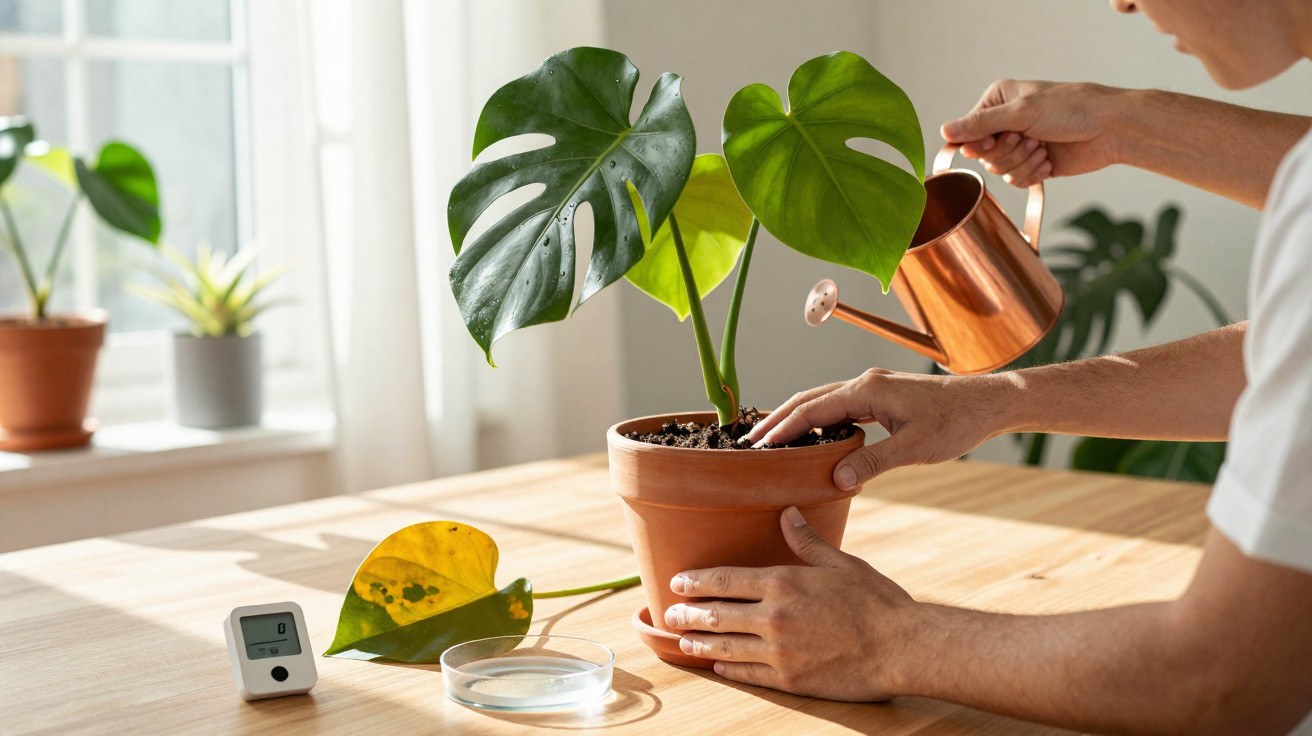
The morning was still grey and the coffee had gone half cold when Anna stopped in front of the shelf holding her houseplants. Something was clearly wrong. Her Monstera’s leaves were drooping, the compost looked glossy with moisture, yet the plant appeared as though it had not had a drink for days. “You can’t possibly be thirsty again,” Anna muttered, pushing a finger into the pot. It was sludge. No resistance at all, just wet mush.
We all know that moment when it almost feels insulting that our care has been received so badly. You water, you tend, you even search online for “what to do about yellow leaves” – and the plant responds with brown edges and a miserable droop. Then a quiet, uncomfortable thought begins to surface: perhaps I am being too kind to it. Perhaps it is drowning in love.
What if watering too much kills your plants just as effectively as watering too little – only far more sneakily?
When love becomes water – and water becomes a problem
Anyone who starts taking plant care seriously knows that inner voice: “One more splash, just to be safe.” It sounds caring, almost maternal. But that is precisely the point at which care turns into a risk. Water does not simply disappear; it remains in the compost, filling every pore and every tiny gap between its particles.
Roots are meant to breathe, yet they can suddenly end up submerged like a marathon runner sent off wearing a plastic bag over their head. At first, the visible signs seem harmless: a little yellowing, a slight droop. Inside, though, the quiet decline has already begun. Waterlogging is not a dramatic storm; it is a slow, silent form of suffocation.
A familiar scene plays out on windowsills every day: a new plant, a lovely pot with no drainage hole, and ten minutes of pride. The next morning comes the thought: “I’d better water it regularly in case it dries out.” Two weeks later, the leaves are hanging over the rim like wet towels. Care turns into panic, and panic leads to even more water. It is a vicious circle shaped like a watering can.
Studies in the home gardening sector show that more than 70 per cent of houseplant damage is caused by care mistakes, with incorrect watering at the top of the list. Underwatering may sound more dramatic, but overwatering is far more common. Many plants do not die from drought; they succumb to a creeping form of root rot that goes unnoticed. After all, brown leaves tend to look much the same.
Why is overwatering so dangerous? Roots need oxygen as well as water. In loose compost, they sit within a balance of air and moisture. When the compost stays wet permanently, water forces out the air, microorganisms shift into an unfavourable environment, and rot fungi have a party. The roots become soft, grey and rotten. They can no longer absorb water – so, ironically, the plant dries out while sitting in a water bath.
The plant then gives signals that we often misread: limp leaves, drooping stems and sometimes curled tips. Many people take this to mean “it urgently needs water” – and add more. Let us be honest: nobody enjoys digging deep into compost with a finger and then waiting. We want to do something. Yet doing nothing is often the greatest form of care.
How to water without drowning your houseplants
The first step sounds obvious, but it changes everything: water according to the compost, not the calendar. Rather than following “Monday, Wednesday, Friday”, use this rule: check first, then act. Push a finger two to three centimetres into the compost. If it feels cool and still slightly damp, pause. Only when the upper layer feels dry should water enter the picture.
Ideally, water thoroughly until it runs from the bottom of the pot, then empty the saucer after a few minutes. This moistens the whole root ball without leaving the roots standing in water for hours. Many plants cope much better with this approach of “less often, but properly” than with a constant trickle from the watering can. One simple rule is useful: it is better to soak the compost properly once than lightly moisten it five times.
Perhaps the most widespread mistake is watering out of guilt. The leaves do not look particularly happy, the air has been dry, or you have been away for a few days – so you water automatically. These are exactly the moments when disaster happens. Plants operate at their own slow pace. What you see today is often the result of the past two weeks, not the last two hours.
It helps to think of plants more as housemates than babies. Babies make their needs known loudly and immediately. Plants are delayed, passive and almost stoic. And yes, let us be honest: nobody feels the compost in ten pots every day, checks drainage holes and records everything in a plant journal. Nor do you need to. In everyday life, a quick finger test, a checking glance at the leaves and a realistic assessment of the location are often entirely enough.
“Most houseplants do not die because nobody looks after them. They die because somebody looks after them too much.” – an older gardener at a small town garden centre, who has to witness it every day.
To avoid the overwatering trap, a brief mental checklist is helpful. It is simple, but it may save more greenery than the most expensive specialist compost:
- Before every watering: put a finger in the compost – feel first, decide afterwards.
- Use a pot with a drainage hole – keep pots without holes only as decorative outer pots.
- Empty the saucer after 10–15 minutes; do not leave plants with permanently wet feet.
- Water plants with thick, fleshy leaves, such as succulents, far less frequently.
- Water less in winter as a general rule – many plants are resting.
When drought stress and a love of water look alike
Eventually, you arrive at an awkward realisation: too much and too little water often create the same picture. Yellow, brown, limp. The difference lies below the compost, in the invisible part of the plant. Once you understand that, you move around the home differently with your watering can. You become slower and more observant, almost like someone who has learnt that silence in a conversation can sometimes say more than any speech.
You start to notice patterns: the Calathea that reacts as though offended when it dries out; the cactus that secretly hates receiving a “just in case” splash every other day; and the pothos that forgives an astonishing amount, which is why it is often the first to reveal when something is generally going wrong in the home. Anyone who lives with the same plants for long enough realises that they tell stories, just not at our speed.
Perhaps that is the quiet appeal of watering correctly. It forces us to slow down. Rather than reacting automatically, we stop for a moment, put a finger into the compost and tolerate those few seconds of uncertainty. Should I water today? Should I wait? This tiny pause between impulse and action saves roots, leaves and nerves. It also shows us how often, in other areas of life, we go too far simply because we are afraid of “not doing enough”.
If you like, tell friends over coffee about the Monstera that nearly drowned in well-meaning attention. These stories stay with people because they sound familiar. Perhaps someone will look at their own windowsill while reading this, feel the compost and quietly put the watering can back in the corner. No drama. Just a small, calm moment of control – and the chance that the plant will continue growing taller, stronger and completely unfazed in a few months’ time.
| Key point | Detail | Benefit for the reader |
|---|---|---|
| Overwatering suffocates roots | Permanently damp compost displaces oxygen, encourages rot and weakens the plant from within | Explains why “more is better” is dangerous when watering |
| Water by feel rather than by calendar | Finger test, thorough watering, then remove water from the saucer | Provides a practical, everyday method for healthier plants |
| Interpret warning signs correctly | Limp leaves can indicate too much or too little water – the condition of the compost is decisive | Reduces poor decisions and saves plants from well-meant “extra watering” |
FAQ:
- How can I tell for certain whether my plant has had too much water? Typical signs include compost that remains wet, a musty smell, yellow leaves alongside soft stems and, in severe cases, mushy brownish roots when repotting.
- Can I still save an overwatered plant? Often, yes: allow the compost to dry completely, then take the plant out of its pot, cut away rotten roots, repot it in fresh, loose compost and do not water it for several days.
- How often should I water my houseplants? There is no fixed number. The rhythm depends on the species, pot size, compost, light and temperature – the finger test is more reliable than any schedule.
- Are hygrometers or moisture meters useful? They can help you develop a sense of the right moisture level, but they do not replace observing the leaves, growth and location.
- Does it matter whether I water in the morning or evening? Indoors, it is less critical, but many people prefer to water in the morning because excess moisture can dry more effectively during the day and plants do not have “cold feet” overnight.
Comments
No comments yet. Be the first to comment!
Leave a Comment