
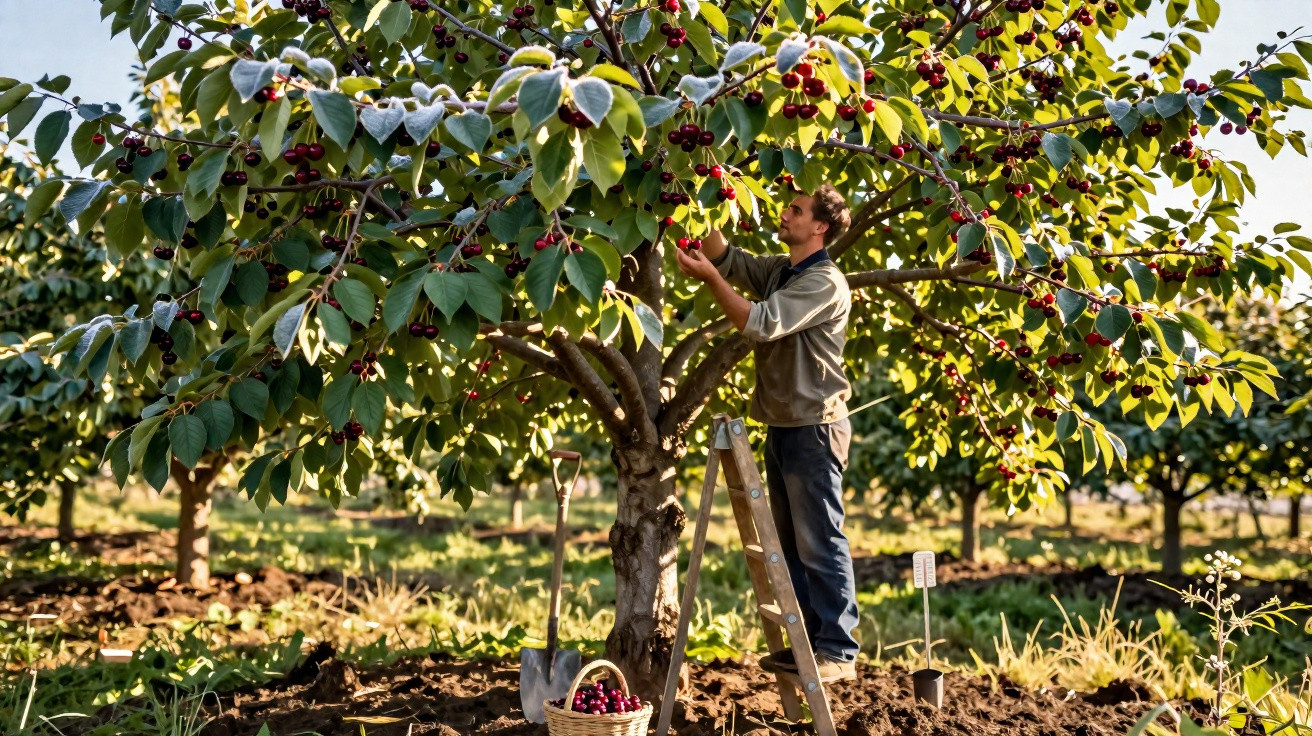
While many amateur gardeners worry each spring that late frost or heavy rain will ruin the blossom, there is an almost forgotten cherry variety that copes remarkably calmly with both. Give it a sunny spot in the garden and it offers not only sweet fruit, but also dependable crops even in difficult years.
Why weather ruins so many cherry-growing hopes
Cherry trees have a reputation for being demanding. One frost during flowering can wipe out the entire crop. Heavy rain shortly before ripening is another problem, causing the fruit to split. Frustrated gardeners often give up, or choose varieties that are hardy but produce only average fruit.
In many areas, springs are becoming more common in which commercial cherry growers and home gardeners are left with almost nothing. Trees flower early, a cold night follows, and every prospect of a harvest can disappear overnight. This is precisely where an old variety, selected in Germany during the 19th century and now once again regarded as an insider tip, comes into its own.
A historic German cherry tree shows how reliable yields can be achieved despite late frost – without excessive use of chemicals.
‘Riese von Hedelfingen’: an old variety with modern strength
Known as ‘Riese von Hedelfingen’, this variety dates from around 1850. Botanically, it belongs to the sweet cherries (Prunus avium). It has moderate vigour, generally growing to 4 to 6 metres tall with a spread of around 3 to 5 metres. That makes it suitable for both traditional orchard meadows and larger domestic gardens.
By mid-July, its branches are laden with large cherries coloured deep red to almost black. The flesh is firm, exceptionally juicy and distinctly sweet, making the fruit ideal for eating straight from the tree as well as for jams, cakes and preserving.
What particularly distinguishes this tree is its remarkable productivity. Treated properly, it delivers year after year, looking more like a small cherry orchard than a single tree. Many owners report “baskets without end”, even in seasons when other varieties struggle.
Its secret weapon: the so-called ‘May bunches’
The key to this variety’s performance lies in its wood. Many branches carry dense clusters of flower buds, known in fruit growing as ‘May bunches’. These remain productive for several consecutive years – for roughly four seasons in the same position.
- Dense groups of flower buds form along a branch.
- They stay active over several years and repeatedly produce fruit.
- The clusters must not be torn off during harvesting.
Picking carefully is therefore important: detach stems individually rather than pulling away whole clusters. This provides a kind of built-in yield guarantee. The same points on the branch bear fruit year after year, without the need for complicated pruning methods.
Hardy to -15 °C and ready for erratic weather
The great benefit of this old variety becomes clear in spring. While many other cherries flower very early and are therefore easy targets for late frost, ‘Riese von Hedelfingen’ starts a little later. Depending on the region, its flowers open from late March into April. As a result, many buds avoid the most critical frosty nights.
The tree itself is considered winter-hardy down to around -15 °C. In sheltered positions where it is well established, it can often withstand even lower temperatures. This makes it especially suitable for:
- cooler upland regions,
- northern and exposed sites,
- gardens with a relatively damp climate.
In addition, its fruit is noticeably less prone to splitting when heavy summer downpours hit fully ripe cherries. This avoids much of the disappointment caused by thunderstorm fronts that turn other varieties to mush.
The tree also shows good overall health. Many common cherry diseases occur far less severely, meaning it can be grown with significantly fewer sprays – something that should particularly appeal to gardeners with a nature-focused approach.
Less frost damage, less fruit splitting, fewer diseases – this tree is like a safety net for your own cherry supply.
A turbo boost for the whole orchard: a strong pollinator
‘Riese von Hedelfingen’ impresses not only through its own yield. Its abundant blossom acts as a magnet for bees and other pollinators. When planted within reach of other cherry varieties, it can substantially boost their crops too.
It pairs particularly well with classic varieties such as:
- ‘Burlat’ – a very early, sweet firm-fleshed cherry
- ‘Napoleon’ – a traditional yellow-red cherry variety
- ‘Moreau’ – an aromatic dessert cherry
- ‘Van’ – a juicy, mid-early variety
Anyone with room for two trees can combine ‘Riese von Hedelfingen’ with an early variety to extend both the flowering period and the harvest season. Bees reward this with plenty of activity, while the picking basket fills with more cherries.
How to plant ‘Riese von Hedelfingen’ correctly
Planting can generally take place from November to March on frost-free days. Late winter is especially convenient, once the soil has warmed slightly and can be worked easily.
Choosing a site and preparing the soil
This tree thrives on warmth and light. A south- or south-west-facing position, sheltered from the wind where possible, gives the best fruit quality. Deep, nutrient-rich, slightly loamy soil is ideal: it should retain water well without becoming waterlogged.
- Dig a planting hole measuring roughly 60 x 60 cm and loosen the base.
- Mix the excavated soil with mature compost; add some sand if the ground is very heavy.
- Plant the tree with the graft union just above soil level.
- Drive in a support stake and tie the trunk loosely to it.
- Water thoroughly and mulch the root area.
A mulch layer of bark chippings or straw retains moisture and protects young roots from severe drying out during their first summer.
The right rootstock for large and small gardens
If space is plentiful, a vigorous wild cherry rootstock is the best choice. It will produce a large, long-lived tree like those found in traditional orchards. For smaller gardens, less vigorous rootstocks are more suitable. They reduce growth, keep the crown lower and make harvesting easier.
During the first few years, regular watering in dry weather and a bucketful of compost in late winter are important. Usually, a light thinning prune is enough: remove a few steeply upright, inward-growing shoots to bring air into the crown.
Harvesting: how gardeners protect record yields
Cherries from ‘Riese von Hedelfingen’ normally ripen in mid-July. This is when the tree reveals its full potential. To preserve the May bunches, pick with care:
- Hold individual fruits, or pairs of fruits, by their stems.
- Twist gently until the stem comes free.
- Make sure the thick bud clusters remain on the branch.
This keeps the productive areas of the wood active. In return, the tree provides reliable yields for many years. For children, this tree is a garden highlight: it carries plenty of highly visible fruit and even forgives the occasional less-than-perfect picking attempt.
What new gardeners should also know about this variety
Anyone planning to use cherries in the kitchen will be well served by this variety. Its firm flesh keeps its structure during baking rather than immediately running out. For juice and syrup, the dark fruit provides an intense colour.
Cherry fruit flies concern many gardeners. ‘Riese von Hedelfingen’ is not immune, but its firm skin and later ripening often mean it is affected somewhat less severely. Yellow sticky traps placed near the crown, along with keeping the grass beneath the tree short, reduce the pressure.
This variety is also interesting in the context of climate change. Milder winters followed by sudden cold snaps in spring, along with intense summer thunderstorms, put fruit trees under pressure. A variety that flowers later, withstands frost down to -15 °C and is less likely to split gives amateur gardeners a genuine advantage.
Anyone currently planning a new cherry tree should ask for this old variety specifically at a nursery. It is often displayed rather inconspicuously among modern cultivars, despite being exactly the tree that could finally solve the cherry problem in many gardens.



Comments
No comments yet. Be the first to comment!
Leave a Comment