
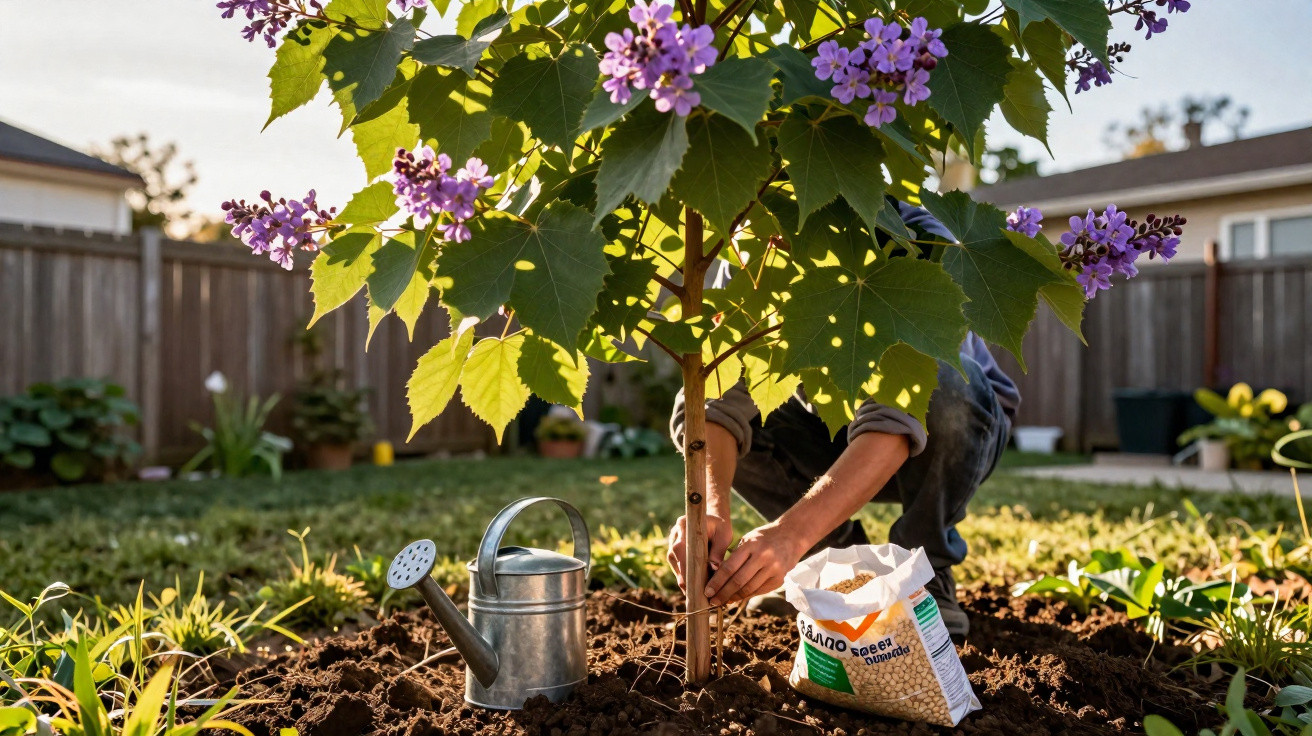
For anyone who has previously relied on bamboo to create quick privacy and add a touch of the exotic to the garden, competition is arriving from an unexpected source: the Paulownia, often called the emperor tree or foxglove tree. It grows at a similarly rapid rate, is easier to keep under control and produces some of the most striking flowers found in an ornamental garden. Particularly in built-up residential areas, this plant is sure to attract curious glances over the garden fence.
The tree that grows almost as quickly as bamboo
Paulownias rank among the fastest-growing decididuous trees for private gardens. Given the right position, a young tree will usually put on between 1.5 and 2.5 metres each year. Heights of five to seven metres are realistic after only three years, while mature trees generally settle at around ten to twelve metres.
A straight trunk and broad canopy of enormous heart-shaped leaves are among its defining features. The foliage quickly forms a dense area of shade. Anyone hoping to shade a patio, seating area or children's play space in summer can often achieve this much faster with a Paulownia than with traditionally planted trees.
“The Paulownia offers bamboo-like speed, but without the problem of spreading runners.”
Unlike bamboo, the emperor tree does not produce aggressive rhizomes that suddenly appear in a neighbour's garden. It stays where it has been planted. This also makes it suitable for smaller plots, where gardeners do not want the hassle of root barriers and continual containment.
A violet cloud of flowers: why the emperor tree becomes a focal point
Its greatest advantage appears in spring. Before the first leaves emerge, countless flower clusters cover the bare branches. From a distance, the crown resembles a pastel haze with a hint of violet or lilac.
Depending on the variety, the flowers may appear more mauve, lilac or faintly blue. Each bloom resembles a small bell, with the flowers held together in dense panicles. Their fragrance is delicate yet clearly noticeable, especially on still days.
The tree is a magnet for insects. Its abundant flowers are among the appealing food sources available in spring.
- Bees find plentiful nectar and pollen early in the year.
- Butterflies and other pollinators visit the tree regularly.
- For anyone creating an insect-friendly garden, Paulownia is a valuable ally.
The emperor tree therefore combines several roles at once: it provides shade, acts as a visual feature and supports biodiversity.
The right location: sun, space and loose soil
Choosing a site: where Paulownia truly thrives
For rapid growth, the emperor tree needs one thing above all else: light. A position in full sun, sheltered from cold, persistent winds, is ideal. Draughty spots between buildings or low-lying areas prone to late frosts are less suitable.
Although it is relatively tolerant of soil conditions, it responds particularly well to:
- deep, free-draining soil without waterlogging
- a high proportion of organic matter, such as compost
- loose ground that allows its roots to penetrate easily
Waterlogged clay soils slow its growth and encourage root rot. Where this is the case, thorough soil improvement or planting on a slightly raised mound can help rainwater drain away more effectively.
How to plant it step by step
Careful preparation of the planting hole will help the tree establish and grow quickly.
- Dig a hole at least 60 x 60 x 60 centimetres, making it larger for heavy soils if necessary.
- Mix the excavated soil with 10 to 20 litres of well-rotted compost.
- Position the plant so that the root collar sits just above soil level.
- Refill with the growing medium, firm it gently and water in thoroughly – around 20 litres of water is a useful guide.
- Finally, create a mulch ring five to eight centimetres deep, without covering the trunk itself.
Mulch retains moisture, suppresses weeds and gradually adds more humus to the soil.
Care during the first few years: water, pruning and protection
Watering and feeding: encouraging speed without strain
During the first two to three years, water supply determines how quickly the tree grows. In summer, the soil should not dry out completely, but it must not remain permanently wet either. As a general guide, ten to twenty litres of water per tree each week is usually sufficient, depending on the heat.
Working in around ten litres of mature compost around the trunk each spring, or scattering it beneath the mulch, will provide adequate nutrients. Heavy additional feeding with mineral fertilisers is seldom necessary and is more likely to produce soft wood that is vulnerable to wind damage.
Pruning: maintaining shape and encouraging flowers
It is worth inspecting the canopy shortly after flowering. Any dead, crossing or inward-growing shoots can then be removed. This strengthens the structure and allows more light into the crown, which in turn has a positive long-term effect on the number of flowers.
Those who mainly want to enjoy the enormous leaves can prune the tree back more firmly during its first few years. The plant will then direct more energy into fewer shoots, often resulting in impressively large foliage, though at the expense of abundant flowering.
Frost: the buds are more vulnerable than the trunk
The emperor tree survives normal winters in many areas, but late frosts remain a risk. Flower buds form early and may be damaged by a cold snap. As a result, flowering may be weaker that year or may not happen at all.
Young trees are more sensitive. In exposed areas, light winter protection can help:
- Wrap the trunk and crown with horticultural fleece when severe frost is forecast.
- Cover the root area in autumn with a mulch layer ten to fifteen centimetres thick.
If shoot tips are damaged by frost, they can be cut back once the frosty period has passed. The tree will usually produce vigorous new growth.
Risks and limitations: where the emperor tree can cause issues
For all its appeal, this tree is not entirely without drawbacks. In mild regions with light soils, the seeds ripen well and may be carried by the wind. Under favourable conditions, they can germinate in open ground.
To avoid a thicket of young plants, check the area around the tree regularly and simply remove unwanted seedlings while weeding. In many locations, the issue remains manageable, although stricter rules may apply in ecologically sensitive areas.
“Before planting in protected areas, it is worth making a quick check with the local authority or nature conservation bodies.”
Space is another consideration: a mature Paulownia needs room both upwards and outwards. Positioned directly on a boundary or beside roof terraces, its canopy may prompt discussions with neighbours. A distance of six to eight metres from buildings and other trees is considered a useful guide.
Which varieties are suitable for home gardens
Two species in particular are commonly found in garden centres: Paulownia tomentosa and Paulownia fortunei. Both reach similar heights, but differ slightly in their flowers and growth habit.
| Species / variety | Characteristics | Suitable for |
|---|---|---|
| Paulownia tomentosa | Lilac to violet flowers, vigorous crown, very rapid growth | Specimen tree in the garden, fast shade provider |
| Paulownia fortunei | Slightly more delicate flowers, sometimes a slimmer habit | Tighter urban spaces, avenue planting |
Anyone considering an avenue or loose row of trees should allow at least six metres between specimens. This gives their crowns room to develop without crowding each other too heavily.
More than ornament: uses and practical ideas
Beyond its role as an ornamental tree, the emperor tree offers several additional benefits. Its timber is regarded as lightweight and easy to work, and in some countries it is used for furniture, musical instruments and interior fittings. This is rarely the main consideration in a private garden, but it demonstrates that the tree is much more than decoration.
Paulownia is also particularly appealing in the following situations:
- as a quick source of shade in young gardens with few or no mature trees
- as a focal point in insect-friendly planting schemes with perennials and spring-flowering plants
- as a living alternative to uninspiring privacy fences
Combining an emperor tree skilfully with underplanting of ornamental alliums, catmint, cranesbill or lavender creates a changing display over many months. The tree's violet flowers in spring, followed by its rich green leaves and flowering perennials below, produce a lively garden space with structure and depth.
For families with children, the tree offers another benefit: its large leaves invite touching, crafting and play. At the same time, its shade keeps temperatures pleasant on hot days, without the need to keep moving parasols around.
Anyone tempted by bamboo but wary of invasive runners should give the emperor tree serious consideration. Its combination of turbo-charged growth, remarkable flowers and comparatively straightforward control makes it one of the most exciting trees for modern home gardens.





Comments
No comments yet. Be the first to comment!
Leave a Comment