
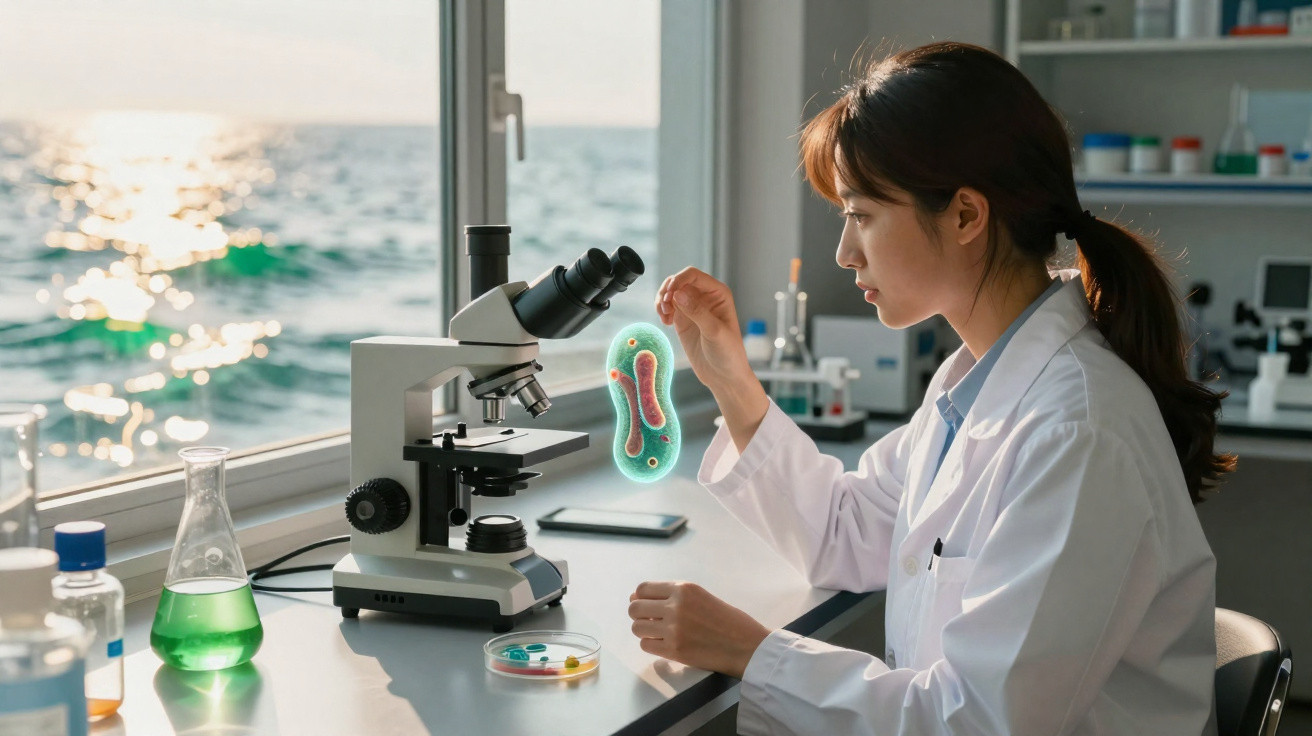
Some of the ocean’s most widespread bacteria cannot divide when conditions around them shift, despite continuing to replicate their DNA.
This previously unseen weakness changes how warming seas and sudden nutrient pulses might disturb systems long regarded as biologically resilient.
Loss of stability disrupts cells
The problem occurs in SAR11 bacteria, the most abundant microbial inhabitants of nutrient-poor surface waters around the world.
Cameron Thrash of the University of Southern California (USC) monitored these cells as conditions changed and recorded repeated failures in the fundamental link between DNA replication and cell division.
Rather than being an occasional defect, the pattern appeared as a reliable cellular response whenever environmental conditions became less stable.
This limitation defines how much change SAR11 can withstand, raising broader questions about the cause of this failure and its future consequences for ocean ecosystems.
A dominant marine bacterium
Throughout the sunlit ocean, SAR11 bacteria are more numerous than most other microbes and prevail in many nutrient-poor marine environments.
Natural selection has driven them towards streamlined genomes, with genes discarded to reduce energy demands in sparse seas.
In certain surface-water samples, they account for as much as 40% of marine bacterial cells worldwide.
Because they are so prevalent, even minor changes in their condition can affect food webs and chemical cycles.
Key control genes were lost
Many SAR11 genomes no longer contain essential genetic instructions needed to regulate orderly growth.
After examining hundreds of genomes, the researchers found that many were missing genes responsible for the cell cycle, including the timing of DNA replication and division.
Under stable conditions, these reduced genomes still enabled normal division, with cells often splitting only once a day.
However, when the environment shifted, the absence of this regulation allowed errors that other bacteria would generally avoid.
A distinct cellular signature
When stressed, many SAR11 cells continued increasing their DNA content but failed to complete the final division.
Following changes in nutrients, carbon sources or temperature, researchers found cells with too many or too few chromosomes.
“The surprise was that such a clear and repeatable cellular signature emerged,” said Chuankai Cheng, a PhD candidate in biological sciences at USC.
These enlarged, overloaded cells frequently died, while the wider population grew more slowly even where the growth medium contained ample nutrients.
Changes in chemistry create problems
A nutrient increase was not always beneficial, and apparently modest adjustments could cause serious difficulties for the cells.
Additional nitrogen in the form of ammonium, a dissolved compound that microbes can use, together with water warmed to about 25 °C, repeatedly interfered with division.
Other adjustments reduced growth without producing extra chromosomes, indicating that stress can disrupt cells through more than one mechanism.
This susceptibility suggests that future ocean changes may influence SAR11 through subtle chemical changes, rather than solely through the total quantity of available nutrients.
Algal blooms prompt failures
In a spring bloom, algae release fresh carbon and nitrogen that may rise sharply and decline again within days.
Later in the bloom, newly produced dissolved organic matter - carbon-rich molecules suspended in seawater - can move SAR11 beyond its preferred conditions.
“Now we have an explanation: Late bloom stages are associated with increases in new, dissolved organic matter that can disturb these organisms, making them less competitive,” Thrash noted.
Should blooms become more common or more intense, this vulnerability could allow other bacteria to become dominant.
Ocean carbon cycling depends on bacteria
By consuming dissolved compounds, SAR11 contributes to ocean carbon cycling, the movement of carbon between living and non-living reservoirs.
If SAR11 populations slow down or decline, less carbon passes through their metabolism and other microbes process the remaining material.
“This work highlights a new way environmental change can affect marine ecosystems, not simply by limiting resources, but by disrupting the internal physiology of dominant microorganisms,” Cheng said.
Such internal breakdowns challenge models that portray microbes as straightforward nutrient-processing machines that accelerate whenever more food becomes available.
Efficiency can limit adaptability
Losing genes can be advantageous in a stable world, since producing additional control systems requires energy.
Over time, genome-streamlined microbes may abandon backup mechanisms, leaving them with fewer options when temperature or chemistry changes rapidly.
Comparable genetic reduction occurs in other ocean bacteria, suggesting that further unexpected vulnerabilities may exist among the microbial majority.
As ocean conditions grow less stable, microbes with more extensive regulatory systems may gain an advantage while SAR11 loses its competitive position.
Laboratory methods require changes
Conventional laboratory practice often involves adding nutrients to stimulate microbes, yet SAR11 may react in the opposite manner.
When scientists enriched seawater samples or warmed cultures, they sometimes caused division failures that made it difficult to maintain otherwise healthy cells.
More precise growth mixtures that reproduce stable, nutrient-poor seawater could improve cultivation and help laboratory findings better reflect conditions in the open ocean.
This approach also provides a practical test for future research examining which missing genes lead to the failure.
The findings connect SAR11’s success with its limitations, demonstrating how an efficient system can break down when conditions fluctuate.
Researchers at USC now intend to identify the molecular triggers, so ocean forecasts represent biology as well as chemistry.




Comments
No comments yet. Be the first to comment!
Leave a Comment