
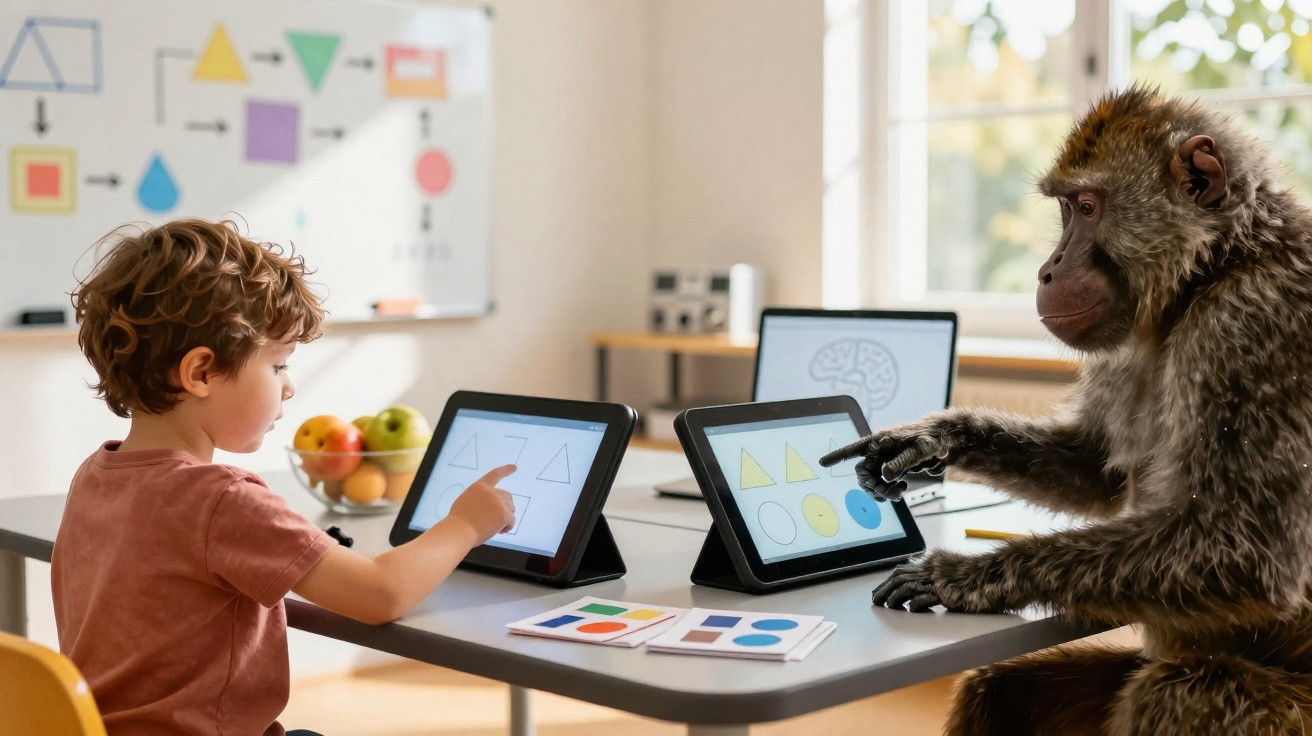
A new study reports that baboons and macaques use the same geometric intuitions as human preschoolers when matching shapes. In the most difficult form of the test, the monkeys depended more strongly on abstract shape properties than the children.
The result challenges a frequently cited assertion that humans alone represent shapes symbolically. It also has implications for classrooms: children arrive with a basic grasp of angles, symmetry and parallel lines already in place.
The monkeys behind the study
The research involved eight adult monkeys: four rhesus macaques housed at Carnegie Mellon University (CMU) and four olive baboons from a zoo in Rochester, New York, where they live in a group of ten.
The baboons participate by choice. Their enclosure includes a touchscreen station known as the Primate Portal, which they can approach to begin a session or simply leave unused.
The experiments were conducted by the laboratory of Jessica Cantlon, a cognitive neuroscientist at CMU. For two decades, she has given monkeys and young children the same puzzles involving numbers and shapes.
Testing geometric intuition
Cantlon’s matching task removes the usual shortcuts. A sample shape is displayed at the top of a screen, with two possible matches below, and participants must touch the matching shape. Because the choices have half the area of the sample, they cannot succeed by matching pixel counts.
“That might seem easy, but it’s actually pretty difficult, because there are no distinctive features among the objects, no major differences in color, or size or form,” said Cantlon.
Nobody was told the rule. Human participants were simply instructed to try the matching game and work it out through trial and error. A correct choice produced a chime. Monkeys received a cereal pellet, whereas children were given a sticker.
The monkeys initially performed at chance level. None had previously encountered geometric images, but every animal ultimately passed the 70 percent accuracy threshold set by the researchers before testing.
“One of the baboons, named Kalamata, was the hardest working monkey that I’ve ever seen,” said Jialin Li, a CMU doctoral student and the paper’s lead author.
How the brain sees shapes
The team took an unusual approach. Instead of comparing accuracy results, they examined which internal representation of a shape most effectively predicted every individual’s decisions from trial to trial.
Their model considered three possibilities. The first was a low-level visual code, comprising the edge and contrast signals extracted at the earliest stage of the visual cortex. The second was a high-level code from later visual-processing stages, in which the brain represents complete forms.
The third possibility was a symbolic representation: a shape reduced to a checklist of Euclidean geometric features, including equal sides, equal angles, parallel sides, right angles and symmetry. This was assumed to be the uniquely human form of representation.
The low-level code accounted for almost none of the choices in any group. High-level coding explained a substantial proportion in all groups. The symbolic checklist also appeared in monkeys, less strongly than in adults but clearly overlapping with preschoolers.
Asked by Earth.com what this pattern indicated about human cognition, Cantlon said, “This work shows us that the human mind is not radically different from the minds of other primates, especially early in development.”
Rotation changes geometric intuition
The researchers then added rotation. In one condition, the two choice shapes were tilted by 20 degrees, one clockwise and the other anticlockwise, while the sample remained upright.
Rotation was expected to disrupt the monkeys, because orientation-independent shape recognition is precisely the ability they are thought to lack. Yet their dependence on the symbolic representation approximately tripled, and their response to rotated shapes surpassed the preschoolers’ response to unrotated shapes.
This finding complicates the conventional interpretation. The five checklist features – parallel sides, right angles and the others – remain unchanged when a shape is rotated. By definition, they are rotation-invariant.
As a result, any animal that recognises a tilted square as the same object as an upright square will seem symbolic in the data, even if it is not applying anything like a rule. Before this research, those two possibilities had not been disentangled.
The team therefore created a high-level visual model that first returned each shape to a standard orientation. Despite containing no symbolic information whatsoever, its predictions correlated with those of the symbolic models at around 0.7 across all groups.
Why an earlier study missed this
The original claim stems from a 2021 experiment in which participants selected the odd shape from six quadrilaterals. People of all ages and cultures found this easier when the odd item was regular. Baboons showed no comparable advantage, and that result was taken as evidence of a uniquely human ability.
Cantlon’s team reanalysed the same dataset alongside its own results, looking at individual participants and individual trials rather than group averages. The overlap, it appears, had been concealed by averaging.
Each participant was positioned according to their reliance on high-level and symbolic representations. The monkey grouping fell largely within the human groupings. There was 38% overlap between monkeys and preschoolers, compared with 42% between preschoolers and adults.
In an email to Earth.com, Li said, “The most surprising finding is that young kids, before receiving any formal math education, are struggling with the task as monkeys do. We found the overlap between kids and monkeys is almost as much as the overlap between kids and adults in representing the geometric shapes.”
Relative to the variation within each group, the difference between species was statistically indistinguishable from zero. By contrast, the difference between rotated and unrotated conditions was almost three times the internal variation.
What schooling actually adds
The researchers structured the human sample to distinguish the effects of age and education. In addition to 55 preschoolers, they tested 79 Tsimane’ adults from farming and foraging communities near San Borja, Bolivia, who had received between zero and five years of schooling.
Rather than using a touchscreen, the Tsimane’ participants completed the task with laminated cards. They showed the strongest reliance of any group on high-level shape representations in the matching test. Across both tests, adults displayed the strongest symbolic effects overall and monkeys the weakest, while children overlapped with both groups.
Formal education, therefore, does not create this intuition. An earlier study reached a similar conclusion from another direction, finding that Amazonian adults and children without mathematical training still possessed usable intuitions about points, lines and parallels.
Speaking with Earth.com, Cantlon said, “Human children bear a lot of similarities to non-human primates in terms of their mathematical intuitions and if we can better understand what these primitive mathematical intuitions are, then we will have a better idea of how to educate children about mathematical concepts – we can develop educational techniques that complement and build on their natural intuitions and abilities.”
A shared geometric sense
Until now, the field had a straightforward account: sensitivity to geometric regularity emerged in the human lineage and went no further. This study indicates that the dividing line has been drawn in the wrong place.
In these results, species is not what separates the groups. The key difference is the degree of abstraction demanded by the task. When the shapes are rotated, the representations shift in every group; changing species has very little effect.
Primates may not be the outer limit. Carrion crows performed well in a version of the odd-shape test described in a 2025 paper, although a subsequent reanalysis suggested that ordinary visual processing might explain their performance.
The precise nature of the shared abstraction remains unresolved. Cantlon’s team offers a specific possibility: it may resemble a mental image that can be rotated and resized while remaining intact, rather than a catalogue of rules. This distinction can be tested, giving comparative research a target it lacked last week.
For those teaching squares to a four-year-old, the practical message is more direct. The child already possesses the intuition and has done so since before having language to describe it. The educator’s role is to name that intuition and refine it.




Comments
No comments yet. Be the first to comment!
Leave a Comment