
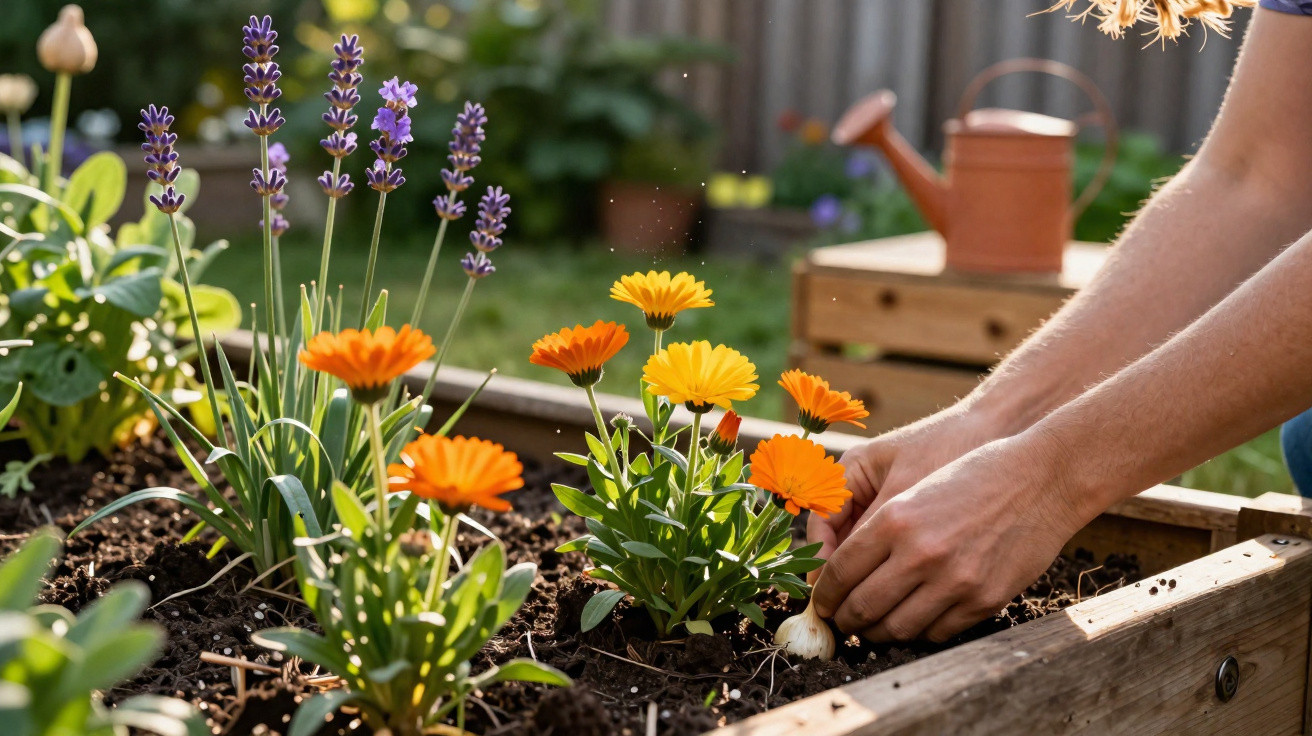
Warmth still lingered over the little terraced houses as I stepped into Anna’s garden one evening. The air carried the scent of tomato leaves and damp soil, while somewhere a bumblebee hummed with such focus that the place seemed to belong to it alone. Anna stood by her vegetable bed, wiping her hands on her trousers, with the quietly proud smile gardeners wear when something has genuinely worked. Between her roses and lettuces, a carpet of marigolds glowed, punctuated by tall lavender stems, delicate dill and a few garlic cloves around the edges. “Look at the tips,” she said softly. There were no aphid colonies. No sticky residue. Instead, the shoots were smooth and vigorous. A year earlier, this spot had been an aphid buffet. Now it looked as though the aphids had deleted this garden from their satnav. And there is a rather simple reason why.
Why this unassuming plant community really bothers aphids
Anyone who has brushed through an aphid colony in early summer knows the feeling: sticky fingers, distorted leaves and a quiet fury at these tiny, seemingly unstoppable specks. Many of us instinctively reach for a spray bottle or a homemade remedy. Anna chose another route. She planted marigolds, lavender and garlic among her roses and vegetables – densely, colourfully and almost a little chaotically. Then something curious happened. The aphids became fewer. Not instantly, and not overnight. But each week, the plant community seemed to become better at resisting the infestation. Like an understated neighbourhood that had quietly agreed: “Not here.”
A few streets away, at an old allotment site, experienced gardeners tell me the same story. One swears by roses, lavender and garlic; another relies on lettuces with marigolds and dill. In some beds, there may still be a handful of aphids in June, while just a few plots away the shoots are blotched black. It is not a scientific trial, but rather a living open-air laboratory built on years of observation. Even so, the patterns are strikingly similar. Where strongly scented herbs and flowering companion plants grow, aphids appear less keen to stay. Where there is monoculture – roses only, beans only or lettuces only – it seems like an open invitation. “All you can eat”, free of charge.
There is surprisingly little magic involved. Marigolds attract beneficial insects that happily feed on aphids. Lavender and garlic release scents that disrupt the aphids’ sensitive sensors. Meanwhile, plants such as dill and fennel provide umbel-shaped flowers where hoverflies and ladybirds thrive – the real predators in this story. Suddenly, the bed is no longer a buffet but a complex web of scents, stimuli and natural enemies. Put simply, aphids struggle to find their way, remain unsettled and are eaten before they can multiply in huge numbers. A bed that looks chaotic is actually following a quiet plan.
The aphid brake in the bed: what the combination looks like
The mix described by many amateur and professional gardeners follows a straightforward pattern. At its centre are the main crops – often roses, beans, brassicas or peppers. Between them and around the edges sits the protective team: small clusters of marigolds, lavender forming a fragrant boundary, and individual garlic cloves or leeks in the gaps. Vegetable growers often add dill or fennel too, to encourage hoverflies to move in. It sounds almost too simple, yet in a bed it works like an invisible fence. Aphids may still land, but they no longer spread explosively. That is precisely the difference between an annoyance and a disaster.
Many gardeners take a gradual approach. One year, they try roses with lavender; the following year, they add garlic and marigolds. One gardener told me that his beans became an aphid disaster every year until he simply planted a strip of French marigolds and marigolds in front of them. The photographs on his phone say it all: before, curled and misshapen leaves; afterwards, smooth, deep-green tendrils. Let us be honest: nobody wants to walk around the garden every day with a magnifying glass, picking off aphids. Most people want watering, a little care – and peace. This plant combination seems made for exactly that: it works quietly in the background while we sit on the patio with a coffee.
The logic behind it is reassuringly down to earth. Plant scents act as signals throughout the garden. Where highly aromatic herbs grow, navigation becomes more difficult for sap-sucking insects. Where flowers such as marigolds, dill or fennel invite beneficial insects in, a living counterbalance develops. Gardeners refer to “confusion planting” and “beneficial-insect magnets”, but at its heart it is about something very human: balance. Rather than fighting every aphid, the bed is designed to cope with them. It is neither sterile nor perfect. It is more like a busy town, where a pickpocket has a harder time than in an empty car park.
How to use the anti-aphid combination in your garden bed
If you would like to try the aphid brake, the next planting session is the best time to start. Use your main plants – such as roses, beans, brassicas or peppers – as the foundation. Then arrange three protective layers around them. The first layer consists of marigolds in small groups of three or four, planted directly among or just in front of vulnerable plants. The second is lavender along the bed edges or between rose bushes, spaced roughly 30–40 centimetres apart. The third is made up of individual garlic cloves or a little leek tucked into the gaps. This creates a plant community that not only smells good but also acts as a guard. Over time, you will see which areas remain especially calm.
Does that sound like effort? Perhaps a little in the first year. Many people struggle because they plant too closely or force everything into rigid rows. The bed needs room to breathe. Leave small open spaces between herbs, flowers and vegetables so that air can circulate and insects can land. Another common mistake is putting companion plants in just one spot, then expecting the entire garden to benefit. Aphids do not read property plans. If a rose bed stands completely bare while marigolds flower 2 metres away in the vegetable garden, some of the effect is lost. Gardens are not perfect, and that is fine – the plant combination can spread gradually, like an idea taking root.
“Since I planted the marigolds and lavender among my roses, I hardly spray anything any more,” an older gardener tells me, looking at his round, glowing orange flowers. “The aphids are still there, of course. But they no longer take command.”
This calm attitude runs through many of the conversations. Nobody expects a completely aphid-free paradise. What matters is the feeling that the garden is doing some of the work itself. In practical terms, that means less panic, less rushing about and more observation. Sometimes, it even brings a little wonder when the beneficial insects suddenly appear.
- Plant marigolds as colourful protective islands among roses, beans or lettuces.
- Put lavender around the edges to create a protective belt of scent.
- Tuck garlic or leeks into gaps, especially close to plants under heavy threat.
- Include dill or fennel to attract hoverflies and other predators.
- Be patient for two or three seasons – the plant community needs time to settle in.
What remains when aphids are no longer centre stage
When you speak to gardeners at length about this plant combination, the conversation soon reaches a quiet longing: less fighting, more tending. The garden becomes a place where not every imperfection is scrubbed away. There is still a soft hum, and a few aphid colonies here and there, but they no longer dominate the picture. Instead, the bed begins to recall old cottage gardens, where scent, usefulness and chaos blend together. Your eye no longer goes first to the damage, but to the colours, shapes and six-legged visitors.
In the end, this mixture of marigolds, lavender, garlic and herbs is more than an aphid trick. It changes how you see your own patch of ground. You begin to think in relationships: which plant supports another, which one attracts what, and which one keeps what away. For many people, that is the moment when the garden changes from a project into a small world. A world to share with neighbours peering sceptically over the fence, friends asking for cuttings and people who still believe a spray bottle is the only answer to aphids. Perhaps the biggest change starts in that moment, when someone looks at sticky shoots, sighs briefly and decides: this time, I will try a plant community.
| Key point | Detail | Benefit for the reader |
|---|---|---|
| Plant combination | Marigolds, lavender, garlic plus dill/fennel around main crops | A clear, easy-to-use approach against aphids in garden beds |
| How it works | Scent confusion for aphids, attraction of beneficial insects, greater diversity | Understand why fewer aphids occur instead of simply believing in a “miracle cure” |
| Practical tips | Plant loosely, use bed edges, test over several seasons | Avoid common mistakes and develop realistic expectations |
FAQ:
- Which plant combination do many gardeners say works best against aphids? The blend most often mentioned uses roses or vegetables as the main plants, combined with marigolds, lavender and a little garlic or leek. Dill or fennel can also help as beneficial-insect magnets.
- How close together should the plants be planted? Marigolds can go directly between vulnerable plants, lavender along bed edges at intervals of 30–40 centimetres, and garlic cloves in smaller gaps. The bed should remain airy rather than becoming a solid carpet.
- When will I see the first effects on aphids? A slight improvement is usually visible in the first year. The effect tends to become properly noticeable after one or two seasons, once beneficial insects have established themselves and the bed structure has settled in.
- Is this method enough to get rid of aphids completely? Hardly any garden will be entirely free of aphids. This plant combination is intended to prevent mass infestations. Individual colonies can still be contained with a jet of water or by removing them by hand.
- Can I use this plant combination in a raised bed or on a balcony? Yes, in an adapted form. Small groups of marigolds, lavender – including compact varieties – and some garlic work very well in raised beds. On a balcony, pots of lavender and marigolds can stand beside vulnerable plants and provide some protection too.

Comments
No comments yet. Be the first to comment!
Leave a Comment