
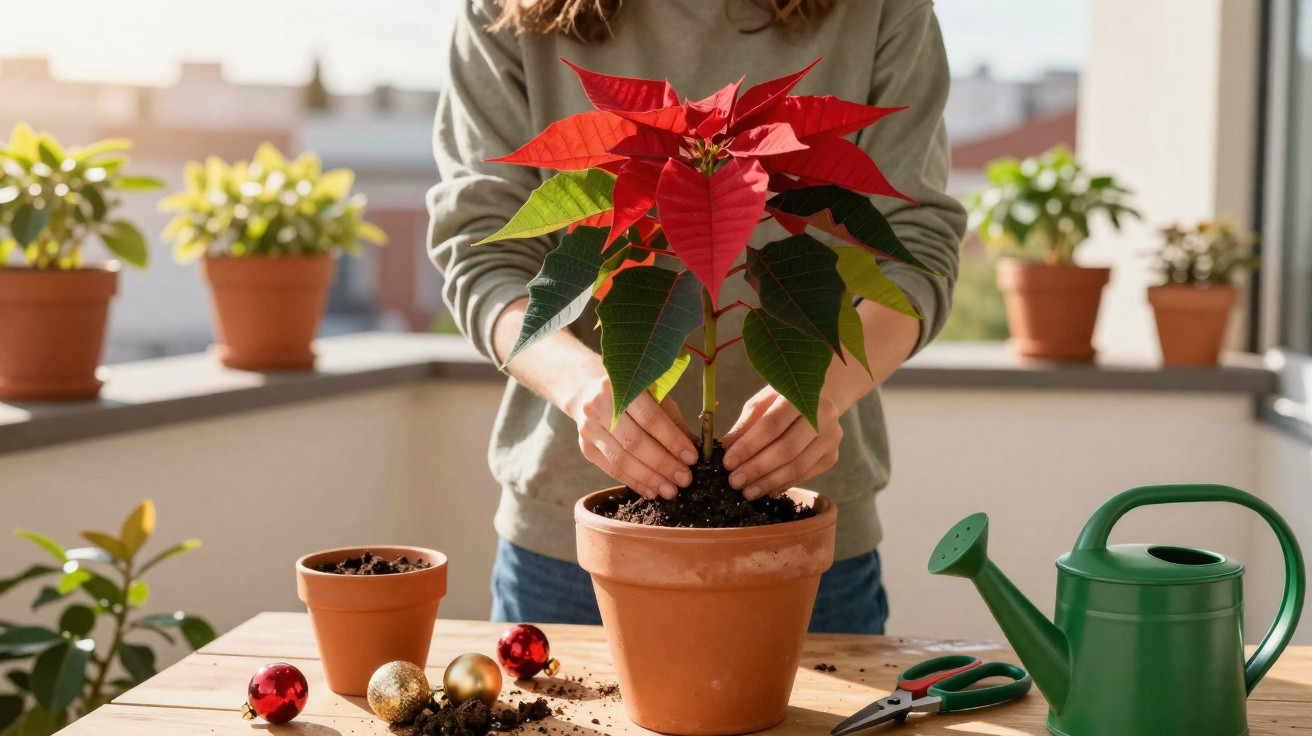
The red sheen has faded, the colourful bracts have lost their colour, and a few leaves are already lying on the windowsill. By early March at the latest, many people throw their poinsettia away. Yet this is precisely when its future is decided: whether it survives summer as a strong houseplant and balcony plant, or quietly dies off.
What the poinsettia really is – and why it is struggling now
Botanically, the poinsettia is called Euphorbia pulcherrima. In the wild, it grows as a shrub rather than as disposable festive decoration. In a pot, it generally reaches 30 to 60 centimetres in height and a similar spread. Its colourful “petals” are actually modified leaves known as bracts.
A poinsettia is not a single-use Christmas decoration, but a perennial houseplant that can survive for years with proper care.
During winter, the plant is exposed to several stresses: dry centrally heated air, draughts, excessive warmth and too much water. This is why it often looks tired in February and March. Its fate is largely determined over two months: March and April.
The crucial March mistake: ignoring its dormant period
Towards the end of winter, the poinsettia enters a resting phase. It slows its metabolism and prepares for fresh growth and its next “Christmas display”. Treating it as though it were still December will usually cause problems.
What a poinsettia really needs in March
- Position: a bright spot away from direct sunlight, preferably cool at 13 to 16 degrees
- No central heating: keep it away from radiators and draughts
- Greatly reduce watering: water only when the compost is almost completely dry
- Avoid waterlogging: empty the saucer or outer pot after watering
- Clean it gently: carefully remove dried leaves while wearing gloves
The main trap in March is that many people continue watering “as usual” because they fear the plant will dry out. In reality, this often drowns it. The roots rot, leaves drop, and the poinsettia eventually appears to have “suddenly” died.
In March, success depends less on watering than on restraint: too little water is better than too much even once.
There is another important point: do not cut it back heavily yet. Severe pruning during dormancy puts too much strain on the plant. Remove only brown, soft or entirely dried-out parts, and wear gloves because the milky sap can irritate skin.
April: the right restart makes the difference
At some point in April, small, fresh light-green shoots will appear on the woody stems. This is the sign that the poinsettia is waking up and now needs different care from the routine it required in March.
The key step: repot instead of carrying on as before
This is the second major turning point. Many people leave their poinsettia in its old, depleted compost, with the result that it remains weak throughout summer.
For a successful spring restart:
- Choose a new pot: go up by just one size and make sure it has a drainage hole
- Use fresh compost: select a loose houseplant mix, ideally with a little sand, expanded clay or perlite to improve drainage
- Loosen the roots: gently break up an old, heavily compacted root ball and remove any rotten roots
- Water only moderately: moisten it thoroughly once after repotting, then allow it to dry out again
The poinsettia can now enjoy slightly more comfortable conditions: 18 to 20 degrees and a very bright position, but not a scorching sunny window. Even in April, midday sun directly through glass can scorch the leaves.
A simple finger test is enough for watering. If the top layer of compost feels dry, water with room-temperature, preferably low-lime water. If it is still slightly moist, wait a few more days.
From sad winter decoration to a vigorous summer plant
From late April onwards, the poinsettia begins growing properly. With a little care, it becomes an attractive green plant that can offer far more than simply decorating a table in December.
Poinsettia summer care at a glance
| Period | Care measures |
|---|---|
| Late April – May | Water regularly but sparingly; apply liquid fertiliser for flowering plants every 2–3 weeks |
| June – August | Move outdoors to a partly shaded spot and protect from rain and strong sun |
| September | Bring it back indoors before night-time temperatures fall below 13 degrees |
Once there is no longer any risk of frost, the pot can be moved onto a balcony or terrace. A lightly shaded position suits the poinsettia especially well, such as an east- or west-facing balcony, or behind other plants that filter some of the sunlight.
In summer, the poinsettia reveals its real strength: a dense, exotic-looking bush with rich green foliage.
Outdoors, the compost dries more quickly than it does on a windowsill. This means watering smaller amounts more often rather than flooding the pot. Fertiliser every two to three weeks supports leaf growth and encourages a compact shape.
How to make the poinsettia festive red again in autumn
Anyone who has successfully taken their plant through summer can take the next step in autumn: encouraging new colourful bracts. The poinsettia responds to day length, and the longer the night, the more strongly it develops its “Christmas colouring”.
The method is simple: from around the beginning of October, give the poinsettia roughly 14 hours of darkness every day for eight to ten weeks. Even a few hours of extra light can delay the effect.
A practical routine:
- In the evening at about 18:00, move it into a dark room or cover it with a lightproof cardboard box
- In the morning at about 08:00, return it to its bright daytime position
- Do not switch on lights during the dark period or make a quick “check-up” using your phone light
Those who follow this fairly consistently will be rewarded with new colourful bracts, usually in time for Advent. The more vigorously the plant has grown during spring and summer, the more impressive it will look in winter.
Common misconceptions: what really harms a poinsettia
Many persistent myths surround the poinsettia. Several are particularly risky in spring.
- “It needs lots of water or it will dry out.”
The opposite is true: during its March resting phase, excessive moisture is the number-one killer. - “If it loses leaves, it is beyond saving.”
Leaf loss is a sign of stress, but it does not mean the plant is dead. If its root system is still sound, it can recover. - “As soon as it becomes warm, it can go into full sun.”
Its delicate leaves scorch quickly. Partial shade and gradual acclimatisation to outdoor conditions are much safer.
Toxicity is another consideration. Poinsettias belong to the spurge family. Their white sap can cause skin irritation and may cause nausea in pets in the worst cases. If there are children or animals in the home, it is best to place the pot out of reach and wear gloves when cutting the plant.
Why the effort is worthwhile – especially in small flats
Shop-bought poinsettias are often thrown away after only a few weeks. Keeping one going through spring not only saves money but also provides a versatile houseplant. Particularly in small flats, a well-cared-for poinsettia brings plenty of greenery to a windowsill or balcony during summer without being especially demanding.
Once it has made it through the critical month of March, the hardest part is already over. The apparently tired winter plant can then become a resilient, decorative companion that lasts for many years and can show its potential anew every year.
Comments
No comments yet. Be the first to comment!
Leave a Comment