
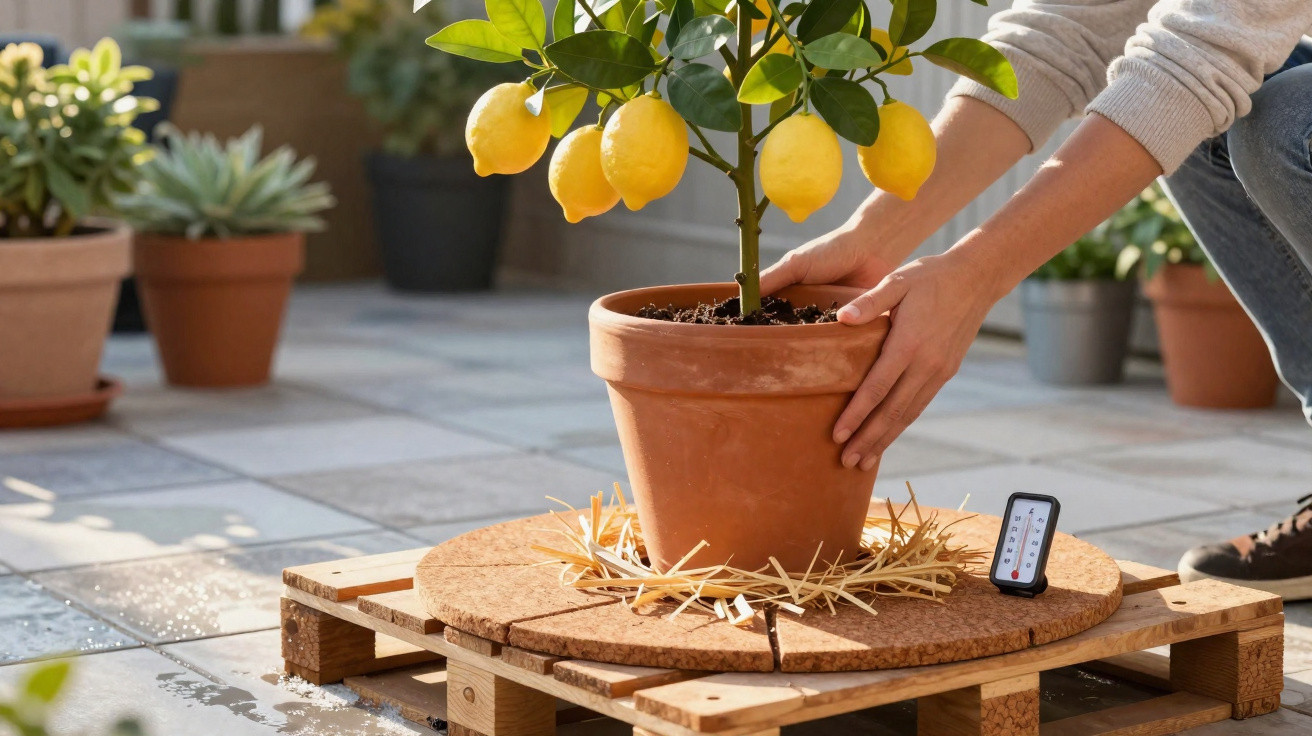
After winter, many amateur gardeners breathe a sigh of relief as soon as February has passed. Their potted lemon tree is putting out fresh growth, the first buds are appearing and everything seems safe. Yet this is exactly when danger strikes: late frost rising from below, invisibly travelling through a balcony or patio into the root ball. An inconspicuous item that is easy to improvise beneath the pot can prevent this frost shock – and often determines whether the plant lives or dies.
Why March becomes a trap for a potted lemon tree
The usual sequence is familiar: days grow longer, temperatures rise and the potted lemon tree is placed outdoors again. Daytime temperatures reach 12 to 15 degrees, and the balcony feels pleasantly warm. Then, on clear nights, the thermometer can suddenly fall to minus 1 or minus 2 degrees. That may not be disastrous for many plants, but it is for a container-grown citrus tree.
The major misconception is that gardeners protect only what they can see: the crown, leaves and flowers. A fleece cover, a partly sheltered position and slightly less watering – job done. However, the real vulnerable point lies elsewhere: around the roots, precisely where the pot rests on cold stone, tiles or concrete.
The cold hammer does not come solely from the air, but through the ground – straight through the pot and into the roots.
Concrete, stone and tiled patios retain the night's cold, then slowly pass it on to the base of the pot. This chills the root ball from underneath, even when the air has turned mild again. The plant can still look healthy one day, only for its leaves to droop, turn black or fall off two days later.
The inconspicuous item beneath the pot that stops the flow of frost
The answer is simple, yet remarkably effective: an insulating board placed under the pot. It acts as a stop sign for the cold, creating a straightforward thermal barrier between the pot and the icy patio.
Which base provides genuine protection
Materials that insulate well without becoming waterlogged are best suited to the job:
- a thick polystyrene board, such as one from packaging
- solid cork or a thick cork mat
- a wooden board with an additional layer of cork or foam
For the insulation to work properly, it needs to meet a few minimum dimensions:
| Criterion | Recommendation |
|---|---|
| Board thickness | 2 to 5 centimetres |
| Overhang beyond the pot | at least 1 to 2 centimetres on every side |
| Period of use | from late winter until around mid-May |
This small plinth prevents direct contact between the pot base and the cold surface. Specialists describe this as interrupting the “thermal bridge effect”: cold can no longer penetrate the root area as severely or as quickly.
Keep drainage clear so water can still escape
One common mistake is allowing the base to cover the pot's drainage hole. Water then collects in the container, the compost stays wet and frost causes twice the damage. A simple trick makes it possible to combine insulation with unrestricted drainage.
A practical DIY version:
- Cut three corks in half lengthways.
- Space the halves evenly beneath the base of the pot.
- Put the pot, resting on the cork halves, onto the insulating board.
This creates a slim layer of air between the pot and the board. The pot remains stable, water can drain away freely, and the air gap further improves the insulating effect.
Five minutes of DIY work, almost no cost – but a huge increase in frost protection for the lemon tree.
How a “cold balcony” damages the root ball
Agricultural researchers have highlighted this for years: plants in pots are far more sensitive to cold coming from below than plants growing in the ground. A container has no protective soil layer, no deep root network and very little capacity to retain warmth.
A typical example is a south-facing balcony that heats up strongly during the day. At night, the warmed surface initially releases heat – until it eventually becomes very cold itself. With the pot base sitting directly on it, the inside of the container responds much faster than garden soil would. The result can be:
- fine root tips freezing
- a sharp reduction in water uptake
- leaves appearing dried out even though the compost looks moist
- sections of the crown dying back
A lemon tree can tolerate temperatures of around minus 6 to minus 7 degrees for a short time when it is otherwise well protected. Together, an insulating base and light protective fleece can quickly provide a buffer of around three degrees. This helps the plant through many typical March nights when temperatures dip only just below freezing.
Layered lemon tree protection until after the Ice Saints
The insulating board under the pot is the foundation. It should remain in place for as long as late frost is possible – traditionally until after the Ice Saints in mid-May. On particularly critical nights, this basic protection can be extended further.
How to combine several protective layers
A few simple measures allow you to build up protection around the lemon tree:
- Position the pot on an insulating board with an air gap.
- Move the pot close to a sheltered, south-facing house wall.
- When frost is forecast, drape winter fleece over loose canes or plant supports without pressing it onto the leaves.
- Wrap the pot itself in bubble wrap, then conceal it with hessian or a decorative fabric.
This combination keeps temperatures around the roots more even and protects the delicate young shoots. One important point: do not water excessively “out of sympathy” before very cold nights. Waterlogged compost becomes colder than a lightly moist, airy root ball.
Common mistakes that cost potted lemon trees their spring
Much of the damage seen in March and April stems from a handful of repeated mistakes. Once you know them, they are easy to avoid:
- Putting the pot directly on stone or tiles: no insulation means full cold transfer.
- Covering only the crown with fleece: the root zone remains unprotected, despite being the most sensitive part.
- Watering too heavily before frosty nights: wetness intensifies the cold effect and encourages root rot.
- Moving plants outside early into sunny but exposed spots: day-to-night temperature swings become extreme.
- Leaving a saucer filled to the brim with water: this creates a cold “lake” directly beneath the roots.
Once you understand that the critical area is not the foliage above but the base of the pot below, your priorities for protection change automatically.
How to spot frost damage – and what can still be saved
Sometimes an unexpected frost catches the plant before protection is in place. In that case, inspect it closely for these signs:
- Leaves turn grey-green, then later brown and brittle.
- Young shoots droop and snap easily.
- The bark on the lower trunk may develop small cracks.
If only leaves and very young shoots have been damaged, the lemon tree may recover with a little patience. After a few days, prune back dead, black shoot tips on a dry day. If the bark around the lower trunk is extensively cracked or blackened, the damage is often permanent.
Why the effort pays off – even on a small balcony
Lemon trees need time before they fruit reliably. Every spring setback means losing a year of growth. Combining an insulating board, a little clearance from the ground and targeted light protection in March and April costs almost nothing, but can save years of establishment.
Anyone who has watched an otherwise healthy tree collapse completely after a single frosty night will never underestimate late frost again. Temperature changes are especially extreme on balconies and roof terraces compared with garden soil. There, a small, unobtrusive insulating base beneath the pot is something like life insurance for a lemon tree.
The same method can be used for anyone with several containers of Mediterranean plants, such as olives, oleanders or kumquats. Nearly all of these woody plants react sensitively when their root area is chilled by cold surfaces. Several insulated boards, or one continuous insulated base, can protect an entire group of plants at once and significantly extend their outdoor season.

Comments
No comments yet. Be the first to comment!
Leave a Comment