
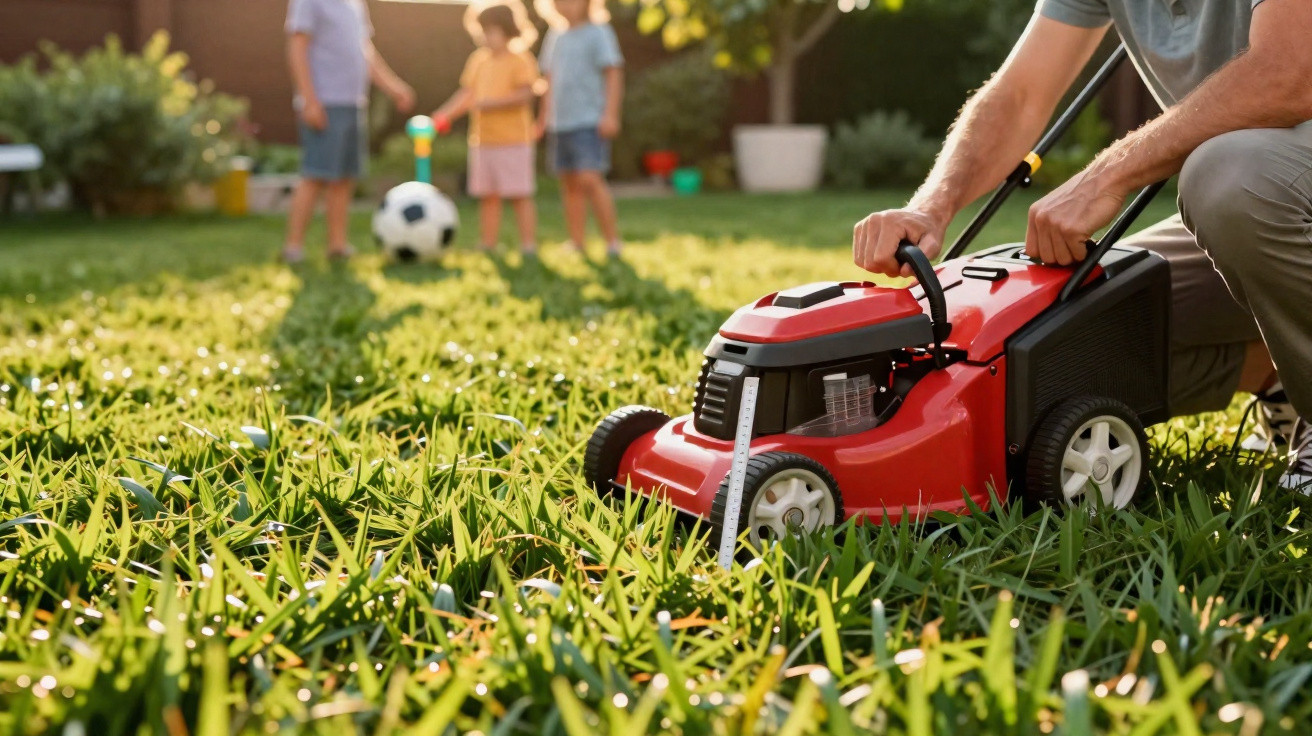
Often, the answer is simply a small lever on the lawnmower.
Anyone faced with a patchy, thin lawn will usually think of fertiliser, watering or the wrong grass seed. Yet in many cases, one inconspicuous detail makes the difference between a dream lawn and a patchy surface: the correct mowing height. Being just 1–2 centimetres out can weaken roots, encourage weeds and dry out the soil.
Why mowing height determines your lawn’s fate
Every blade of grass is a miniature solar panel. Its leaf area captures light and sends energy down to the roots. Cutting it too short removes this “solar surface”. Roots then recede, the soil warms up more quickly, and moss and weeds take advantage of the gaps.
“The rule of thumb is never to remove more than one third of the current height in a single cut.”
This so-called one-third rule protects the growing point in the middle of each blade. If it is cut off, the lawn may look “English short” for a day, but it recovers poorly and becomes sensitive to heat, drought and foot traffic.
How often you mow matters too. A lawn growing vigorously is better served by several light cuts than by a drastic trim every fortnight. In spring, intervals of four to seven days may be enough; sometimes mowing twice a week makes sense when the grass is growing by noticeably more than 2.5 centimetres.
The ideal mowing height for different lawn types
Not every garden needs the same appearance. Whether it is a family lawn, an ornamental area or a shady corner, the best lawnmower setting varies considerably.
Family and play lawns
For an everyday lawn where children play and garden loungers sit, a height of around 3–5 centimetres is ideal. Within this range, the grass remains resilient, tolerates foot traffic and will generally close small gaps by itself.
- Below 3 cm: the lawn may look smart, but it suffers quickly in hot weather.
- 3–4 cm: a good balance between appearance and resilience.
- 4–5 cm: ideal for heavy use or mild drought.
Ornamental and prestige lawns
Those aiming for a visually flawless, very short lawn will generally cut between 2 and 3 centimetres. However, this requires excellent nutrient provision, regular watering and little foot traffic. During hot spells, the mower should be set one level higher here too, closer to 5 centimetres.
Lawns in the shade
Different rules apply in shaded areas. Each blade needs more leaf area there to capture sufficient light at all. Mowing heights of 5–6 centimetres throughout the year have proved effective. Cutting too short in these areas risks bare patches and mats of moss.
Rough ground and lightly maintained areas
For verge strips, orchards or large areas used only occasionally, 5–8 centimetres works far better. The soil stays cooler, the grass experiences less stress, and mowing is needed less often.
How different grasses respond to mowing
Many seed mixtures contain several grass species. If you know the exact varieties, you can fine-tune the cutting height further:
| Lawn type | Recommended mowing height |
|---|---|
| Cool-season grass (e.g. smooth meadow-grass) | 6–9 cm, towards the upper limit in summer |
| Fescue mixtures | 7.5–10 cm |
| Perennial ryegrass | 5–7.5 cm |
| Warm-season types such as Bermuda | 2.5–5 cm (hybrids closer to 2.5–3.8 cm) |
| Zoysia | 1.3–2.5 cm, only with very good care |
| Buffalo, Centipede | 2.5–5 cm |
| St Augustine | 6–7.5 cm |
| Creeping bentgrass (golf greens) | 1–1.5 cm, only with professional equipment |
In a typical home garden, hardly anyone knows the exact seed mixture. If in doubt, treat the area as a standard family lawn: cut it to 3–5 centimetres, leaning towards the higher end in very hot weather.
Matching mowing height to the season
Spring: a dense carpet rather than a patchy lawn
In spring, the lawn is full of energy. Cutting towards the lower end of the recommended range at this time encourages new side shoots. This produces a denser, richer carpet of grass. The one-third rule still applies, however: a drastic close cut after winter weakens the blades unnecessarily.
Summer: leave it longer
During hot periods, it pays to raise the setting to at least 5–6 centimetres. Longer grass blades shade the soil, reduce evaporation and make the lawn far less likely to scorch. Mowing intervals can also be slightly longer, provided the grass does not shoot up too much.
Autumn and winter: reduce the height moderately
In autumn, you can gradually lower the cutting height again a little. Just before winter, the lawn does not need cutting back to “zero”; instead, give it a few mows at a medium height when the ground is neither frozen nor waterlogged. This helps prevent fungal problems and rot.
Newly seeded lawns need extra protection
Freshly laid or sown lawns are particularly sensitive. The first mow should only take place once the blades have reached roughly 8–10 centimetres. They should then be cut back to 5–6 centimetres. Running over young grass too early is more likely to pull it out than cut it.
For overseeded areas, work in two stages: first reduce the grass from around 8 to 5 centimetres, then later, once the lawn has filled in, from 5 to 3 centimetres, provided the grass type can tolerate this.
What to do when the lawn has got completely out of hand
After a long holiday, grass can stand as tall as a small meadow. Setting the mower straight to a short cut causes major damage. Instead, mow several times with only a few centimetres between each height, gradually working down to the target level. Where grass exceeds 15–20 centimetres, use a brushcutter or scythe mower first, then bring in the standard lawnmower.
Setting and checking lawnmower cutting height
The scale on a lawnmower may look dependable, but in practice it is often wrong by 1–2 centimetres. This simple method provides clarity:
- Place a piece of cardboard or a board on the lawn.
- Set the mower and run it briefly over the cardboard and the adjoining grass.
- Use a ruler to measure the actual grass height.
- Adjust the setting in small steps until you reach the desired height.
Another important point: never alter the height while the machine is running. The mower must be completely stopped before moving the lever.
Why sharp blades decide between green and brown
Blunt blades tear grass rather than cutting it cleanly. The cut ends become ragged, turn yellow and offer an entry point for fungal diseases. Many manufacturers recommend sharpening blades every 20–25 operating hours – so, with intensive use, at least once per season.
“A clean cut makes lawn tips look richly green; a torn cut leaves them straw-like and brown.”
If you do not want to sharpen them yourself, you can take the blades to a specialist retailer or a DIY-store service desk. It is important to refit them correctly and ensure they are properly balanced, otherwise vibrations can occur and the bearings may suffer.
Do not mow in every type of weather – and mulch in moderation
Wet grass clumps together, blocks the mower and is easily flattened. If there is no alternative mowing day, raise the cutting height slightly, use a grass collection box and avoid using mulching functions. Mulching works best when the grass is slightly dry and there is only a small amount of clippings.
Regular mulching can reduce the need for fertiliser, but it also means mowing genuinely often and following the one-third rule strictly. Otherwise, too much material remains on the lawn and forms a thatch layer.
Common mistakes – and how a small adjustment solves them
- Treating the lawn like a golf green without professional equipment: stay at 3–5 cm instead.
- Cutting it drastically after a long break: reduce the height over several stages.
- Mowing shaded areas as short as sunny ones: deliberately set these zones 1–2 cm higher.
- Trusting the mower scale blindly: measure the mowing height to be sure.
If you pay attention to these adjustments, you will often need neither expensive specialist fertilisers nor complete reseeding. Usually, a sharp blade, a dry mowing day and the right lawnmower setting are enough to turn a tired area into a thick, lush summer lawn.




Comments
No comments yet. Be the first to comment!
Leave a Comment