
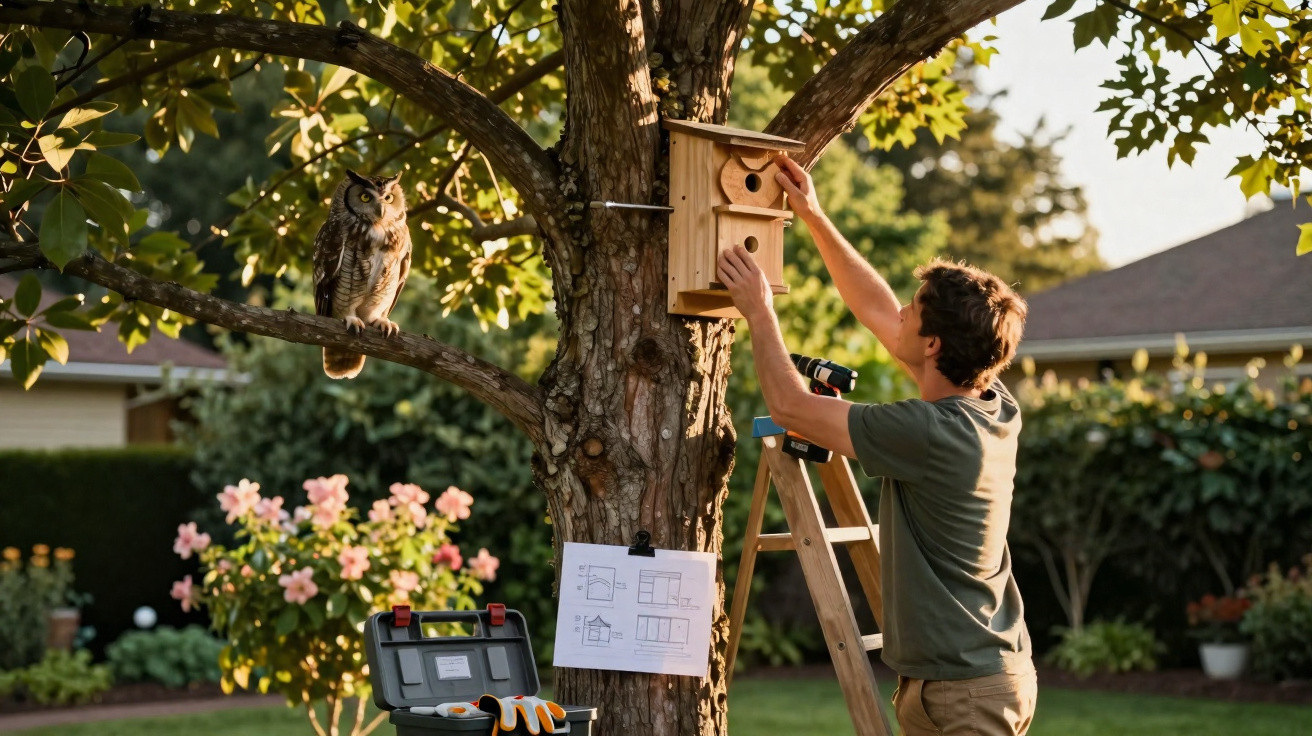
Anyone with a garden can make a difference with one simple step.
Owls seem like creatures from another world: silent in flight, with fixed eyes and mysterious calls after dark. Yet many species are struggling as nesting sites disappear. This is not only happening in France; across German-speaking regions, old trees, barns and field hedges are vanishing too. That is where an unexpectedly straightforward action can enable private individuals to provide meaningful help.
Why owls are urgently needed in our landscape
Several owl species are still considered relatively common in many parts of Europe. Their calls can often be heard at dusk in rural areas during spring. Specialists sometimes refer to tens of thousands of breeding pairs within a single country.
However, this apparent abundance can be misleading. Traditional nesting places are steadily being lost: old fruit trees are cut down, barns are refurbished, lofts are insulated and field hedges are removed. For owls, this means fewer cracks, holes and cavities in which they can nest safely.
Owls depend on such hiding places because, unlike songbirds, they do not build exposed nests in branches. They require sheltered cavities or recesses that keep predators away and protect their young from wind and rain.
Owls do an enormous amount of work out of sight: a breeding pair can eat hundreds of mice each year – providing natural pest control from which farmers and garden owners benefit directly.
When the nights become louder: the start of the breeding season
For many species, the main breeding period begins in late March and early April. Males make their presence known vocally. Their calls tend to be low and drawn out, whereas the calls of females are often shorter and more piercing.
Pairs form at this stage and begin searching for suitable breeding locations. If they cannot find one, breeding may fail altogether in the worst case, or the birds may resort to insecure niches where young birds are more easily taken by predators.
What a garden can really achieve
Anyone with a garden, courtyard, larger balcony or business premises can help at precisely this sensitive time. The key is a specialist nest box designed for owls.
An owl box effectively replaces a missing tree hollow or gap in a barn. It gives the birds a quiet place to breed and rear their young. Females generally lay three to four eggs. Incubation lasts just under a month, during which they need complete security from disturbance and predators.
The one item that genuinely helps owls
The most important element is a sturdy nest box. With a little skill, it can be made at home or bought ready-made. Its dimensions, materials and entrance opening are crucial.
- A durable wooden box with a flat roof offers protection from rain.
- The wood inside should be left untreated so that the birds can grip it.
- The entrance needs to meet minimum dimensions, but must not be too large.
- A few centimetres of bedding made from straw or wood shavings make the box more appealing.
Positioning this box in the right place creates valuable habitat in a single move. For the birds, it means less stress while breeding, better survival prospects for their young and a secure refuge during poor weather.
How to build a suitable owl box
The ideal nest box depends on the species, but a number of basic principles are easy to follow. DIY enthusiasts need only simple materials available from a builders’ merchant.
Key dimensions and details
For small to medium-sized species, a base roughly the size of a shoebox is usually sufficient, with the box slightly taller than it is wide. Experts often cite an entrance diameter well above one centimetre, although the figure in the original guidance appears more likely to be a typographical error – standard boxes for owls and smaller owls generally have an opening of around 10 to 15 centimetres, allowing the birds to pass through easily.
What matters is that the opening is large enough for the intended species, yet small enough to keep larger predators out. Anyone unsure should follow recommendations from wildlife conservation organisations for the species found locally.
| Component | Recommendation |
|---|---|
| Material | Untreated, weather-resistant wood (at least 1.8 cm thick) |
| Roof | Slightly overhanging, optionally covered with roofing felt or metal sheeting |
| Interior | Rough wood, no varnish, with a little bedding such as straw or wood shavings |
| Opening | Adjust the size for the target species; do not make it too wide, so martens cannot enter |
| Cleaning | A hatch or removable roof for an annual inspection |
Keeping the box dry and secure
Slight waterproofing inside prevents standing water. Some people making their own boxes partly line the base with plastic sheeting, while others drill two small drainage holes. The key point is that water must not remain in the box for long periods.
Straw or coarse wood shavings create a soft nest and level out minor unevenness. It is better to avoid acidic conifer shavings, as the dust they produce can be disruptive in a confined cavity.
Do not want to use a saw? Ready-made boxes are a good alternative
Not everyone feels ready to pick up a saw. In that case, it is worth looking in well-stocked pet shops, builders’ merchants or online retailers specialising in wild birds.
These outlets sell pre-made owl boxes, sometimes clearly labelled for specific species. When buying one, check for:
- timber thickness of just under two centimetres at a minimum
- neat screw fittings with no sharp edges
- a weatherproof roof
- a way to clean the box
- clear information about the species for which the box is intended
If in doubt, ask specifically for models for smaller owls. Staff in specialist shops usually know which species are common in the area and can advise which box is suitable.
The right location: height, direction and quiet
The minimum requirements for a suitable site are peace and quiet, plus some distance from heavily used paths. A tall tree, barn gable or house gable is ideal.
- Height: Five to eight metres is considered sensible for many species, although three to four metres is often possible in gardens.
- Direction: Avoid constant driving rain, so east or south-east is preferable to the west-facing weather side.
- Clear approach: There should be enough room in front of the entrance for birds to fly in, with no dense branches directly in the way.
- No floodlighting: Keep the box away from bright lights, motion sensors and permanent illumination.
Once installed, the box should be disturbed as little as possible. Repeated checks, or opening it during breeding, may cause adult birds to abandon their young.
What owls do for people and nature
Owls may seem mysterious, but they are highly effective hunters. Their diet consists mainly of mice and other small mammals, with larger insects or small birds also taken occasionally.
For farming, a strong owl territory means less crop damage caused by mice. For householders and gardeners, it means fewer gnaw marks in sheds, garages and compost heaps. Providing breeding sites for these birds therefore supports natural pest control.
Anyone wanting to keep mice under control does not automatically need poison. More owls in the area are a quiet but highly effective ally.
How to tell whether the box has been occupied
Many people ask: will anything actually move in? The ground below the box provides the answer. Typical signs include:
- small pellets, made up of regurgitated fur and bone remains
- white droppings on the trunk or wall below the entrance
- feathers from prey birds, depending on the species
Sounds at dusk or during the night, such as the quiet squeaking of young birds, can also indicate successful use. Please do not look inside with a torch – light and disturbance could endanger the breeding attempt.
Common mistakes that can harm birds
Even well-intentioned efforts can sometimes have the opposite effect. Frequent problems include mounting boxes too low, having permanent lighting nearby, or using an entrance through which martens and cats can easily gain access.
Anyone putting up new boxes should also avoid installing whole rows just a few metres apart. Many owl species do not tolerate excessive competition immediately nearby and will avoid overcrowded locations.
Doing more than simply putting up a box
A nest box is an important building block, but the surrounding environment matters just as much. Allowing small wild areas in the garden creates hunting grounds and shelter for prey. Long grass, piles of branches and untidy corners give mice cover – and in turn provide food for owls.
Avoiding poison bait and certain pesticides also plays a part. When mice are poisoned, the active substances often enter the food chain. Owls that eat these animals can die or raise weakened young.
For those with children, the subject can be a way to bring local wildlife closer to them. A box built together, the first pellets found, or an unexpected owl call in the dark can remain memorable for a long time – and strengthen awareness of species we usually hear but rarely see.
Comments
No comments yet. Be the first to comment!
Leave a Comment