
Nearly 500,000 years ago, early humans in what is now southern England were already able to plan several moves in advance. Their survival relied on more than physical strength: it also demanded preparation, practical skill and intelligent use of nearby resources.
Stone implements were vital in everyday life, serving to cut meat, work wood and process animal carcasses. Their sharp cutting edges, however, eventually became blunt.
A rare recent find shows that early humans addressed this challenge in an unexpected manner: they transformed elephant bone into a precision implement.
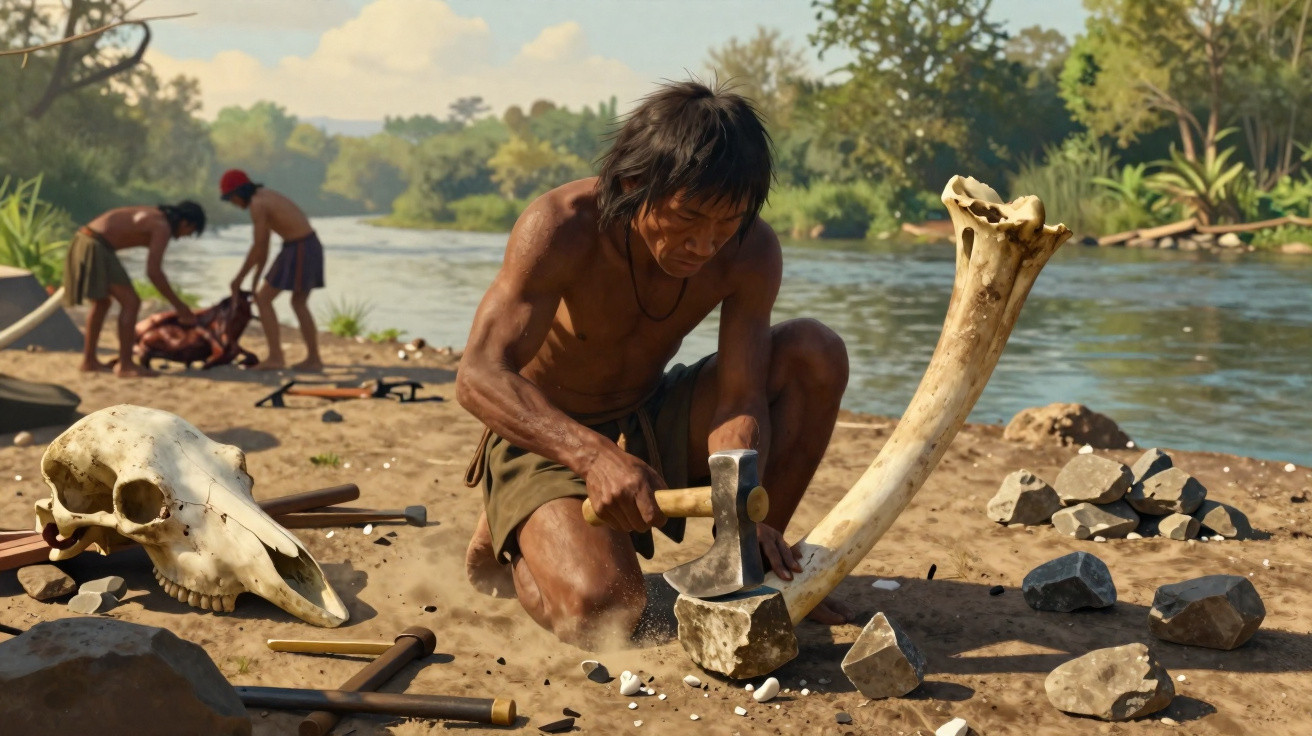
Archaeologists at Boxgrove have found a hand-held hammer fashioned from elephant bone, deliberately worked and used repeatedly to resharpen stone tools.
Close examination by researchers from University College London (UCL) confirms that it was not a makeshift item.
Rather, it demonstrates careful forethought, extensive understanding of materials and a notably advanced toolmaking method from long before modern humans emerged.
Elephant bone tools at Boxgrove
Elephant and mammoth remains are uncommon in prehistoric southern England. The discovery of an elephant-bone tool in this setting therefore points to a purposeful selection.
Elephant bone is stronger and tougher than the bone of most animals. Its cortical bone - the hard, dense external layer - withstands fracture and copes well with repeated impacts. These qualities made it especially suitable for detailed tool work.
The implement is approximately 11 cm long and sits easily in the hand. Its triangular form was intentional rather than accidental. Before it was used, careful flaking altered the edges and made the fragment smaller.
Microscopic analysis reveals traces created through repeated impacts on stone. Small flint fragments are still lodged in grooves across the bone’s surface, demonstrating frequent contact with stone implements.
The evidence indicates that it functioned as a soft hammer, or retoucher. Soft hammers deliver force in a more controlled way, which is essential during the final stages of sharpening stone tools.
How elephant bone tools kept stone edges sharp
Stone handaxes became dull through meat cutting and animal processing. Renewing their edges involved removing tiny flakes from their surfaces.
Using a hard stone hammer could crack the handaxe or spoil it. Bone provided softer contact and greater precision.
The elephant-bone retoucher was used to strike stone edges at shallow angles. A succession of gentle blows detached small flakes, restoring the cutting edge without harming the tool’s overall structure.
Patterns of wear suggest that it received dozens, or perhaps hundreds, of strikes over time, indicating repeated use rather than a one-off purpose.
The ingenuity of early human ancestors
Microscopic scoring also shows that the tool moved across a surface before striking. These marks indicate deliberate hand movements and a secure grip. Managing the angle, pressure and direction of each blow required planning and motor control.
“This remarkable discovery showcases the ingenuity and resourcefulness of our ancient ancestors,” said Simon Parfitt from the UCL Institute of Archaeology.
“They possessed not only a deep knowledge of the local materials around them, but also a sophisticated understanding of how to craft highly refined stone tools.”
“Elephant bone would have been a rare but highly useful resource, and it’s likely this was a tool of considerable value.”
Early humans planned for survival
The research indicates that Boxgrove’s early humans used both hard and soft hammers. Hard flint hammers were used close to raw-material sources to shape rough stone blanks. Bone and antler hammers were then used to refine edges, often near areas where animals were butchered.
This approach demonstrates planning over both distance and time. Choosing elephant bone, working it in another location and carrying it for later use all suggest foresight. Some implements were not simply for immediate tasks; they were maintained, transported and used again and again.
Traces on the bone show it was shaped while still fresh. Unlike dry bone, fresh bone bends slightly when force is applied.
That flexibility permits more controlled shaping. The findings suggest the bone was prepared soon after the animal died, although not necessarily straight away.
“Our ancient ancestors were sophisticated in their use of tools,” said Dr. Silvia Bello, a researcher at the Natural History Museum in London.
“Collecting and shaping an elephant bone fragment and then using it on multiple occasions to shape and sharpen stone tools shows an advanced level of complex thinking and abstract thought.”
“They were resourceful gatherers of available materials, and savvy about how best to use them.”
A broader toolmaking legacy
Boxgrove belongs to the Acheulean stone-tool tradition, a technology defined by handaxes that endured for more than a million years throughout Africa, Asia and Europe.
Later Acheulean implements became thinner, more symmetrical and sharper. Such advances depended on the use of soft hammers. Bone and antler hammers made accurate flake removal and finer shaping possible.
Elephant-bone retouchers form part of this technological development. The Boxgrove evidence indicates that early humans had mastered sophisticated knapping techniques earlier than was previously thought.
Elephant-bone tools occur far earlier in Africa, particularly at Olduvai Gorge. In Europe, examples from before the arrival of modern humans are still rare.
Boxgrove now provides the oldest unambiguous European example of elephant bone being used for precision knapping.
Reassessing early human skill
Just a small number of elephant-bone fragments have been recovered at Boxgrove. This rarity reinforces the case for deliberate selection and prolonged use. Taking such a tool across the landscape would have required both effort and intention.
The elephant-bone retoucher reveals problem-solving that went beyond basic survival. Half a million years ago, everyday life was shaped by skill, planning and knowledge of materials.
Early humans adjusted to colder climates through adaptable strategies and complex toolkits. One bone implement now offers a striking account of human ingenuity from long before written history.






Comments
No comments yet. Be the first to comment!
Leave a Comment