
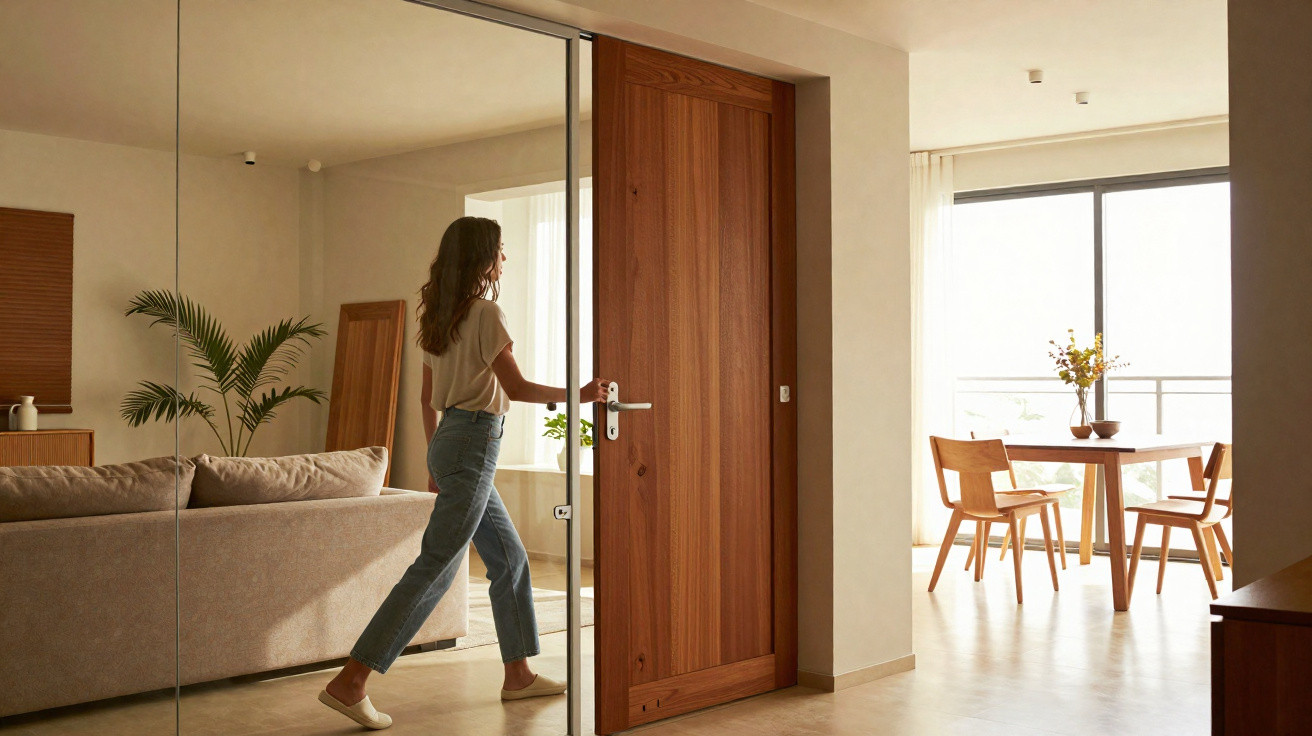
In contemporary residential schemes, the glass door is increasingly taking the place of traditional solid wood. Available in sliding and pivoting versions, with aluminium or steel frames, it can transform the atmosphere of a home entirely. Rather than simply closing off one room from another, it becomes a focal point: it admits daylight, brings spaces closer together and, when paired with film, frosted glass or carefully selected curtains, preserves privacy. Ultimately, the home feels lighter, more connected and better integrated with outdoor spaces such as the balcony, back garden and garden.
How does a glass door make rooms appear larger?
Unlike solid wood, glass allows light to travel between rooms, making the interior feel more spacious and uninterrupted. With a sliding door between the living room and balcony, the eye reads both areas as one setting, with continuous flooring, shared lighting and less of a sense of division between zones.
In narrow corridors, replacing a timber leaf with translucent glass produces a lighter, airier result. In open-plan kitchens, a glass door acts as a movable partition: when open, it connects the spaces; when closed, it contains cooking smells and noise without completely separating the person cooking from those in the living room.
How does a glass door improve movement between rooms?
Sliding glass models are particularly helpful for circulation because they do not need clearance for the door leaf to swing. They run alongside the wall, freeing up usable room for furniture and walkways, which is especially important in halls, corridors and compact living rooms.
Visibility through the glass also makes moving around safer, particularly where children, older people or pets are present. In busy areas or spaces linked to the back garden, the outdoors no longer feels like a “forgotten background” and instead becomes an active part of everyday life, encouraging regular use.
What are the main types of glass door for each room?
Different glass door styles suit different functions, home sizes and design approaches. Knowing where each option works best makes it easier to plan connected spaces and make the most of natural light.
Below are several common models and the situations in which architects and joiners most often recommend them:
- Sliding doors: excellent for small spaces, as they keep walls available for furniture and provide a contemporary look. They are ideal between a living room and balcony, a kitchen and utility area, or as access to an outdoor entertaining area.
- Pivoting glass doors: widely used for main entrances where visual impact is desired. They rotate on an axis unlike a standard door, creating a more imposing feel.
- Doors with metal frames: combine transparency with a distinctive outline reminiscent of industrial design. They work well in a home office, between the living room and kitchen, or along corridors.
- Frosted or etched glass doors: suited to bathrooms, walk-in wardrobes and offices, providing privacy while retaining brightness.
What should be considered when choosing and fitting a glass door?
Despite its lightweight appearance, a glass door requires technical care to ensure safety and long-term performance. Selecting the right thickness and quality fittings is essential and, in homes with children or older people, toughened or laminated glass should be used to reduce risks if breakage occurs.
Thermal and visual comfort should also be considered, particularly on façades exposed to strong sunlight. Solar-control glazing, specialist films and the combined use of curtains or blinds can help manage heat and brightness. In this way, replacing solid wood with glass offers a practical route to making rooms look larger, improving circulation and modernising the home without major structural work.





Comments
No comments yet. Be the first to comment!
Leave a Comment