
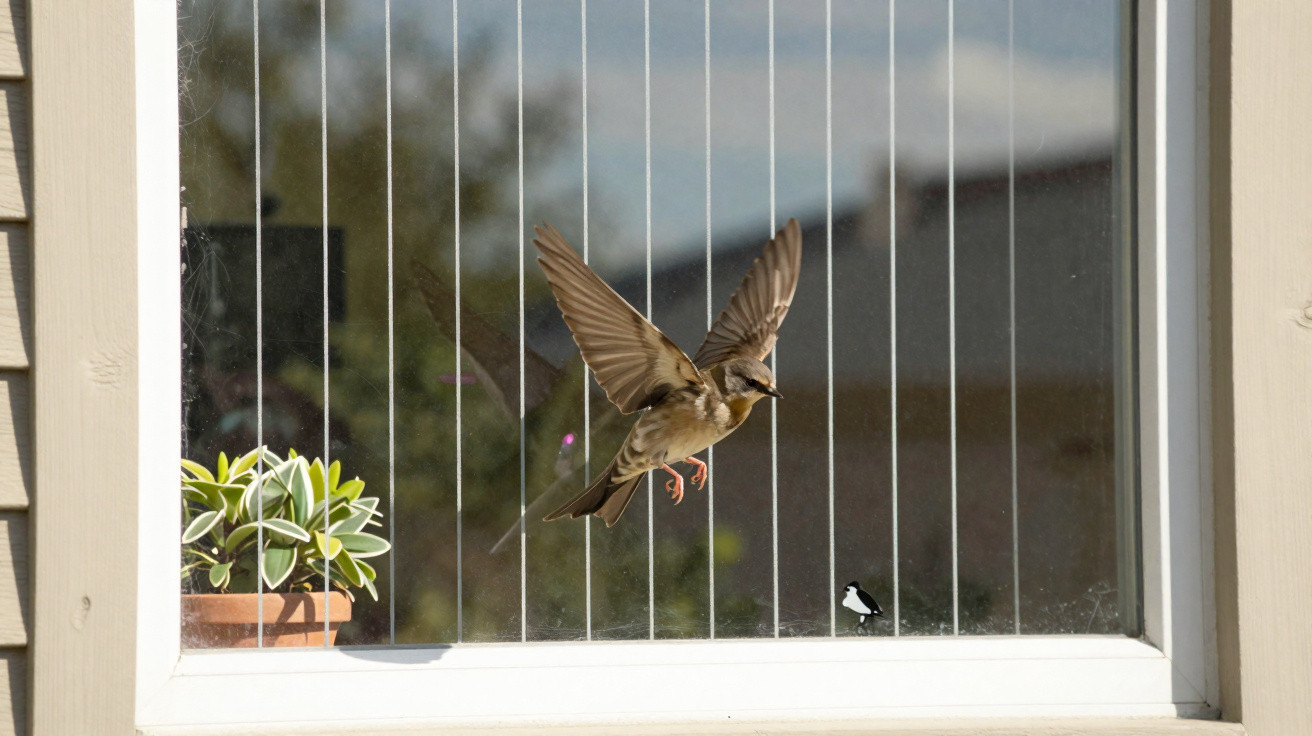
Painting white lines on windows is a method used to cut down on bird strikes against glass. These markings disrupt reflections of the sky, trees and greenery, enabling birds to recognise a physical obstruction rather than mistaking the surface for an extension of their surroundings.
Why can birds not detect some windows?
Glass may mirror trees, clouds and green spaces so clearly that a bird in flight mistakes the reflection for open air. Windows through which vegetation is visible on the other side can likewise appear to offer an unobstructed route, raising the likelihood of a collision.
This happens mainly because birds do not naturally understand the idea of a transparent barrier. Marking part of the surface makes it visually distinct, breaking the illusion and allowing the window to be identified more easily before the bird reaches it.
How do white lines on windows help prevent collisions?
White markings on glass work by forming a pattern that birds can identify as an obstacle. Simply drawing one strip across the middle of a window is not enough:
- The markings must extend across a substantial proportion of the surface;
- Spacing should be about 5 centimetres or less;
- Light-coloured lines provide effective contrast on many kinds of glass;
- Evenly spaced white dots may also be effective;
- The pattern must avoid leaving large areas that appear open;
- The application needs to remain visible in varying light conditions.
Why must the markings be applied outside?
The outside of the glass is the most important place to apply them. If lines or stickers are placed only on the inside, reflections on the outer surface may still obscure the markings, meaning a bird primarily sees reflected trees and sky.
Placing the pattern directly on the exterior ensures that the line is visible before the reflection, visually disrupting the image that could mislead the bird. Temporary materials designed for glass, including certain liquid chalk markers or removable paint, make upkeep easier without requiring a permanent change to the window.
What alternatives to lines can be used?
The approach is not limited to white paint. The aim is to make the surface visible and remove large unmarked transparent or reflective areas, so a range of options can follow the same principle:
- Rows of small dots spread across the glass;
- Stickers positioned close together;
- Exterior tape arranged in regular patterns;
- Vertical cords fitted in front of the window;
- Insect screens installed externally;
- High-contrast designs made with removable paint.
A single bird silhouette will not usually solve the problem
Using only one sticker shaped like a hawk or another bird leaves nearly the entire surface looking unobstructed. To a bird in motion, the gaps around it still seem large enough to fly through, which is why the placement and spacing of markings matter more than the design selected.
White lines on windows are effective precisely because they turn the whole problem area into a recognisable visual barrier. Applied to the outside with narrow gaps between them, they lessen deceptive reflections without replacing the glass, and can be adapted using dots, tape or other visible patterns.






Comments
No comments yet. Be the first to comment!
Leave a Comment