
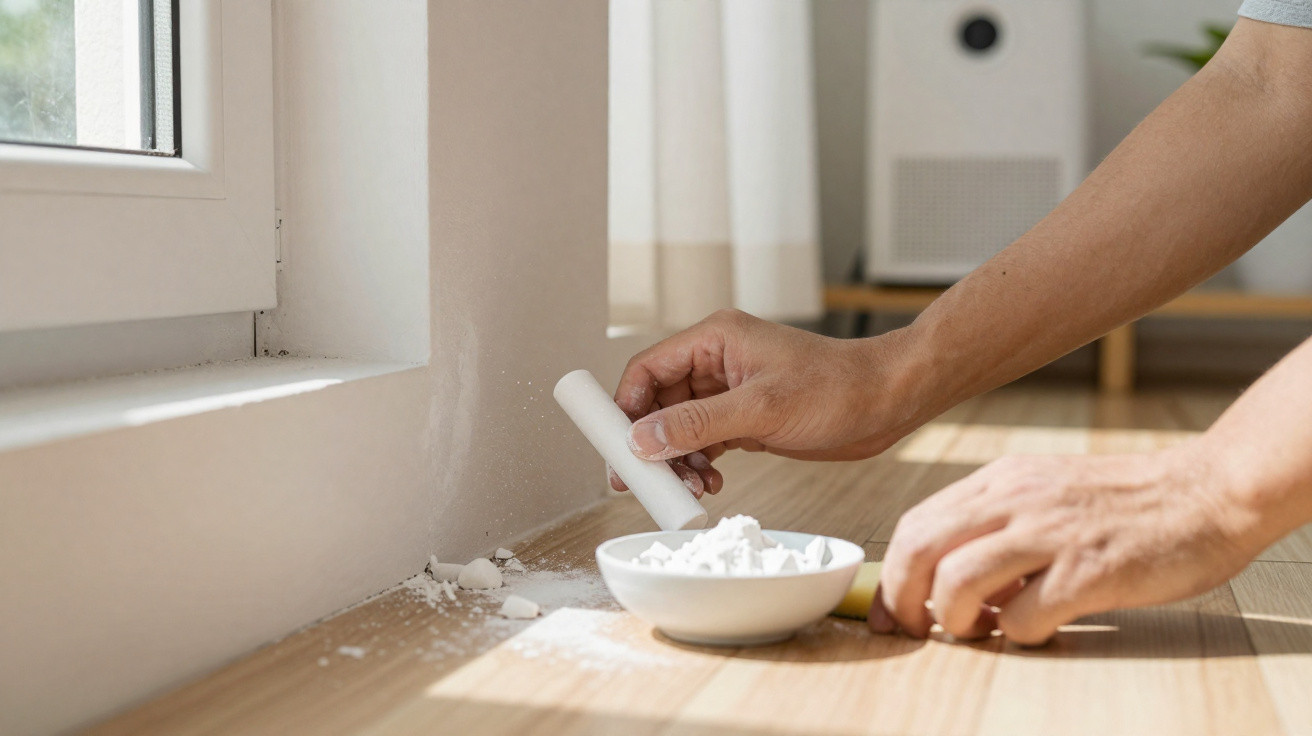
A little white chalk can help manage excess moisture in small areas of the home, especially inside cupboards, along skirting boards and in corners with limited airflow. This tip uses the material’s porous structure to hold some moisture from the surrounding air, but it has an important limitation: chalk will not remove an established stain on its own or resolve leaks, water ingress or damp rising through a wall.
How does chalk help tackle damp near walls?
This approach does not involve rubbing chalk directly onto the stain. Instead, several pieces are grouped together and placed close to the affected area, where they act as a small absorbent material. In enclosed, low-volume spaces, such as a cupboard placed against a cold wall, the method may help draw out some of the moisture in the air.
How do you prepare a homemade chalk treatment?
To use this technique, gather around 10 to 15 pieces of white chalk and make a small bundle. It can be positioned where condensation usually forms or inside furniture that has a damp smell. You will need very few materials:
- set aside 10 to 15 pieces of white chalk;
- group them into a small bundle;
- secure them with string, an elastic band or tape;
- place the bundle near the skirting board or in a poorly ventilated corner;
- in cupboards, keep the bundle on a dry container or support;
- check regularly whether the material has become damp.
Once the chalk changes in appearance or feels damp to the touch, its ability to keep absorbing water is reduced. As a practical guideline, inspect the bundle every two weeks and replace it with dry pieces when needed, particularly during cold or rainy periods.
Can chalk remove a stain already on the wall?
Not in the same way as a cleaning product or a repair treatment. Chalk against damp works best as an additional measure for reducing airborne moisture in small spaces. If the wall already has darkened paint, bubbling, flaking, salt deposits or mould, the type of issue must be identified before the finish is restored.
What can you do to prevent damp from returning?
The first step is to find where the water is coming from. Condensation tends to occur in cold, poorly ventilated places, while water ingress may be connected to roofs, façades, pipework or defective waterproofing. There is also rising damp, which travels up from the ground through the wall materials. Each case requires a different solution.
Some household measures are particularly helpful where the issue is linked to condensation and inadequate air circulation:
- open doors and windows every day to refresh the air;
- keep furniture about 5 centimetres away from the wall if condensation develops behind it;
- avoid drying large loads of washing in enclosed rooms;
- use suitable extraction in bathrooms and kitchens;
- check for leaks before repainting an affected area;
- do not simply cover recurring stains with another coat of paint.
When is the chalk trick no longer enough?
White chalk is most useful in cupboards, corners and small areas with moderate humidity in the air. A wall that remains wet, has swollen paint or develops stains again after cleaning suggests that water is continuously reaching the surface. In this situation, placing more chalk near the skirting board will not stop the source of the problem.
For this reason, this homemade treatment should be viewed as support for controlling mild damp and condensation, rather than as waterproofing. Finding leaks, improving ventilation and fixing building defects are still the measures that can prevent water from damaging plaster and paint again. Once the cause has been addressed and the surface has dried, the existing stain can be cleaned and the finish repaired according to the wall’s condition.



Comments
No comments yet. Be the first to comment!
Leave a Comment