
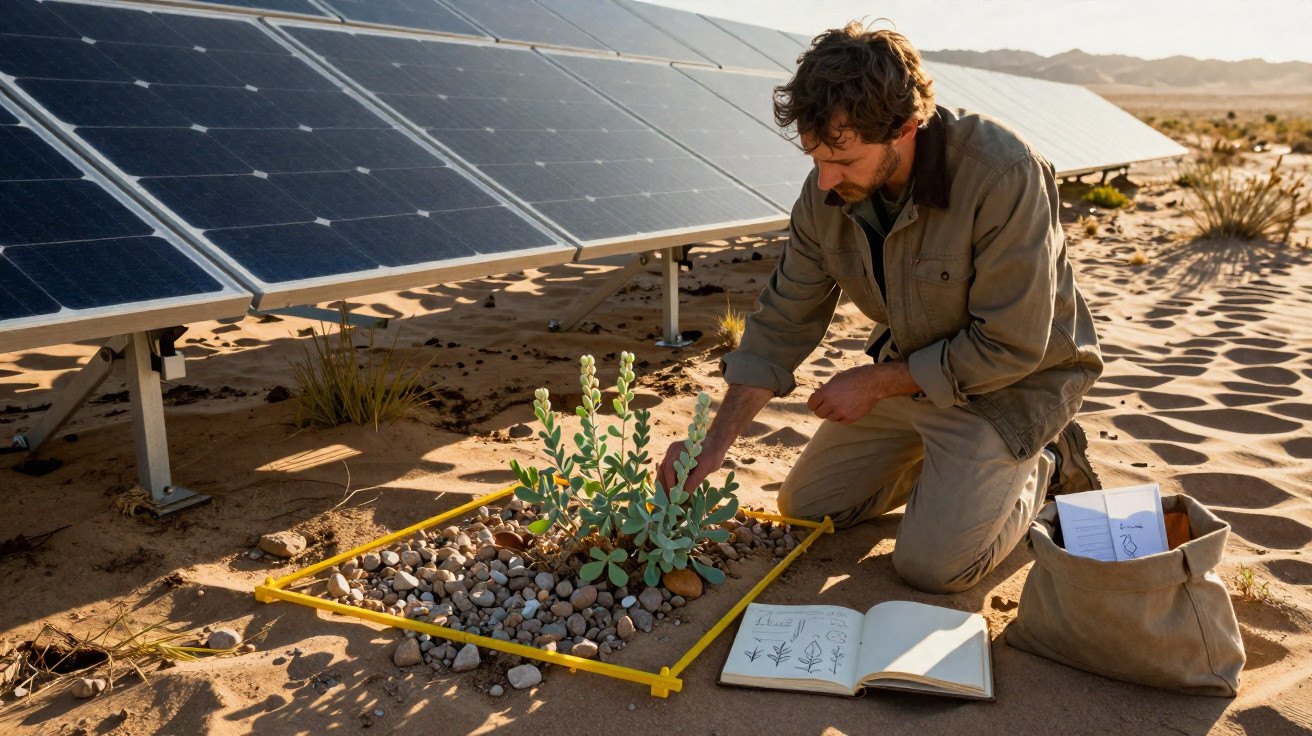
A rare Nevada desert plant known as threecorner milkvetch rose from only 12 documented plants to 93 after a major solar power development was constructed nearby.
Instead of removing all vegetation, the scheme was planned to let the species survive and increase beyond its previous numbers.
Counts in the sand
Surveys at the Gemini Solar Project, close to Las Vegas in the Mojave Desert, recorded threecorner milkvetch - a small, ground-hugging wildflower from the pea family - before construction and again afterwards.
Ecologist Tiffany J. Pereira of the Desert Research Institute (DRI) used those maps to follow the increase through the rows of solar panels.
Pereira’s paper recorded 12 threecorner milkvetch plants before construction and 93 after the site began operating in 2024.
The increase resulted from retaining soil and seeds in place, rather than through irrigation or transplanting plants.
Meet threecorner milkvetch
Threecorner milkvetch grows close to the ground and is seldom visible unless winter rainfall arrives at the right moment.
Botanists classify it as Astragalus geyeri var. triquetrus. It persists through a seed bank: seeds stored in the soil that can grow in future seasons.
Nevada categorises the plant as Critically Endangered and Fully Protected, meaning that ground disturbance can destroy an entire population.
Its delicate life cycle makes the Gemini survey results more than a curiosity, demonstrating that a development can avoid destroying a rare species.
Shade changes moisture
Shifting shade beneath the panels reduced soil temperatures and slowed evaporation after rainfall.
This additional moisture formed a microclimate - a small area with different temperature and moisture conditions - over much of the array.
Beyond the fence, sunlight and wind were more severe, causing nearby plants to lose moisture more quickly and remain smaller.
However, excessive shade can limit growth too, helping explain why plants seldom appeared in the darkest areas.
Where plants showed up
In the 2024 survey, technicians located most plants in the open spaces between panel rows.
These gaps received partial shade and additional runoff, allowing seedlings to retain enough light while the ground stayed moist for longer.
“Ninety-four percent of the threecorner milkvetch plants found at Gemini grew in the interspaces between panels,” wrote Pereira.
Should later surveys continue to find the same pattern, project designers may need to use taller panels or wider spaces to safeguard habitat.
Bigger plants, more fruit
Within the solar development footprint, plants were taller and broader, with each producing considerably more flowers and fruits.
Greater moisture enabled stems to continue growing during spring, giving flowers more time to become seed pods.
Tagged plants monitored by the DRI team started fruiting nearly 3 weeks earlier, producing eight times more flowers and ten times more fruits.
“Survivorship between the two populations, however, was not significantly different,” wrote Pereira after comparing tagged plants on and off-site.
Seeds built for waiting
The large number of new fruits matters only if the seeds can withstand heat, time and animals feeding on them until rain returns.
Laboratory testing found 100% seed viability and confirmed physical dormancy: a hard seed coat that prevents water entering until it is scratched.
After technicians nicked this coat, the seeds absorbed water rapidly, consistent with a desert survival strategy based on waiting for infrequent storms.
Where viable seeds remain in the ground, a single wet spring can replenish future populations even if mature plants die.
Building without stripping soil
Before panels are installed, construction teams normally choose whether to preserve the desert surface or level it.
Many developers continue to use blade and grade, which removes plants and flattens the terrain, because the method seems predictable.
Gemini adopted lower-impact methods and restricted grading, with machinery working around vegetation rather than scraping it all away.
This gentler approach preserved natural drainage routes, an important factor when stormwater flows forcefully across a desert construction site.
Ecovoltaics in practice
In renewable energy, ecovoltaics - designing solar facilities to support native habitat - regards vegetation as part of the development.
Living ground cover cools and stabilises soil, helping to reduce dust and limit erosion.
Additional plants can also nourish soil microbes and store more carbon underground, while flowers provide food for pollinators within fenced areas.
Maintaining functioning habitat does not remove the land-use impact, but it can prevent a solar site becoming lifeless ground.
Threecorner milkvetch lessons
A favourable year can make any desert development look successful, since rainfall determines when dormant seeds emerge and grow.
Pereira and the DRI team monitored plants for just one growing season, while the 2024 survey covered substantially less land than the 2018 survey.
Long-term monitoring must assess dry years and heavily shaded areas, where limited emergence could reduce available habitat.
A federal study projected that solar could provide 40% of US electricity by 2035, increasing the importance of careful site selection.
The increase in Gemini’s milkvetch population indicates that solar panels can generate energy without invariably removing life when builders respect the soil and seasonal timing.
Future developments can adopt the same method, although they will require lengthy records from wet and dry years to establish that it endures.
Photo: Tiffany Pereira



Comments
No comments yet. Be the first to comment!
Leave a Comment