
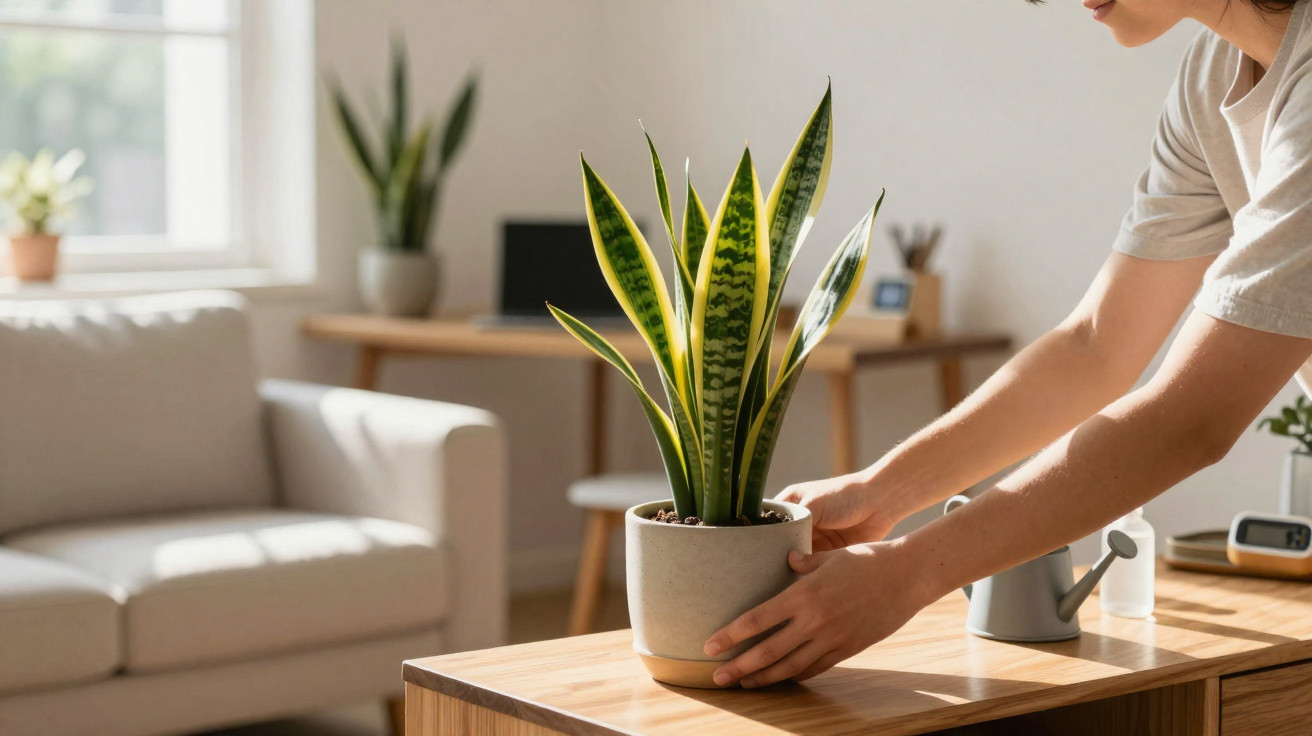
Sansevieria trifasciata, widely known in Brazil as the Saint George's sword or mother-in-law's tongue, has become the versatile houseplant found in living rooms, bedrooms and offices everywhere. It suits modern décor, requires very little attention and remains resilient even when a busy routine means it is forgotten for a few days. For this reason, it is a favourite among people with limited time who still want to bring a touch of greenery into their home.
What is Sansevieria trifasciata and why is it so popular for interiors?
Sansevieria trifasciata is a succulent with tough leaves, native to Africa, that has adapted very well to Brazil's climate and to urban indoor settings. Its nickname, mother-in-law's tongue, refers to its long, pointed foliage, which may remain relatively short or grow quite tall depending on the variety and the care it receives.
Some varieties have yellow-edged leaves, while others are entirely green or striped in different shades, making them more visually interesting in a decorative scheme. This range makes it possible to experiment with styles and combinations, from minimalist to more tropical settings, in both compact flats and larger houses.
How does mother-in-law's tongue support air quality and indoor comfort?
Since the 1980s, some studies, including NASA research in enclosed environments, have suggested that Sansevieria trifasciata may help reduce compounds such as benzene and formaldehyde in the air. These compounds are common in paints, furniture, plastics, cleaning products and many other materials used in everyday homes.
Another notable characteristic is that mother-in-law's tongue continues gas exchange at night, releasing oxygen when many plants reduce this activity. It can also provide small improvements to indoor comfort, as outlined below:
- It helps filter volatile compounds released by household items.
- It makes a modest contribution to air humidity in air-conditioned rooms.
- It releases oxygen at night, making it a common choice for bedrooms and home offices.
How can Sansevieria trifasciata be used in home or office décor?
When planning an interior, the mother-in-law's tongue is often recommended for strategic spots because of its upright leaves and minimal maintenance requirements. Entrances, hallways and neglected corners work particularly well with taller pots, creating immediate visual impact without taking up much room.
In a living room, it works well beside armchairs, shelving units or sideboards, contrasting the straight lines of furniture with the species' erect foliage. In offices and home offices, it is often placed near a desk, in reception areas or beside windows, softening an environment that can otherwise feel cold and technical.
What are the essential day-to-day care requirements for mother-in-law's tongue?
Looking after mother-in-law's tongue is straightforward, which explains its popularity with beginners. It adapts well to partial shade and indirect light, tolerates occasional missed watering and prefers well-drained soil, as too much water can cause its roots to rot.
- Moderate watering: allow the soil to dry before watering again; when in doubt, water less.
- Indirect light: avoid intense direct sun during the hottest hours, as it can scorch the leaves.
- A pot with drainage: choose containers with holes and a light growing medium that does not retain water.
- Leaf cleaning: wipe the leaves with a slightly damp cloth to remove dust and retain their shine.
In many homes, Sansevieria trifasciata is also linked with the idea of protection and balance, which is why many people position it close to the front door. Regardless of these beliefs, by 2026 it has established itself as a practical way to combine attractive décor, easy care and a small boost to comfort in enclosed spaces.

Comments
No comments yet. Be the first to comment!
Leave a Comment