
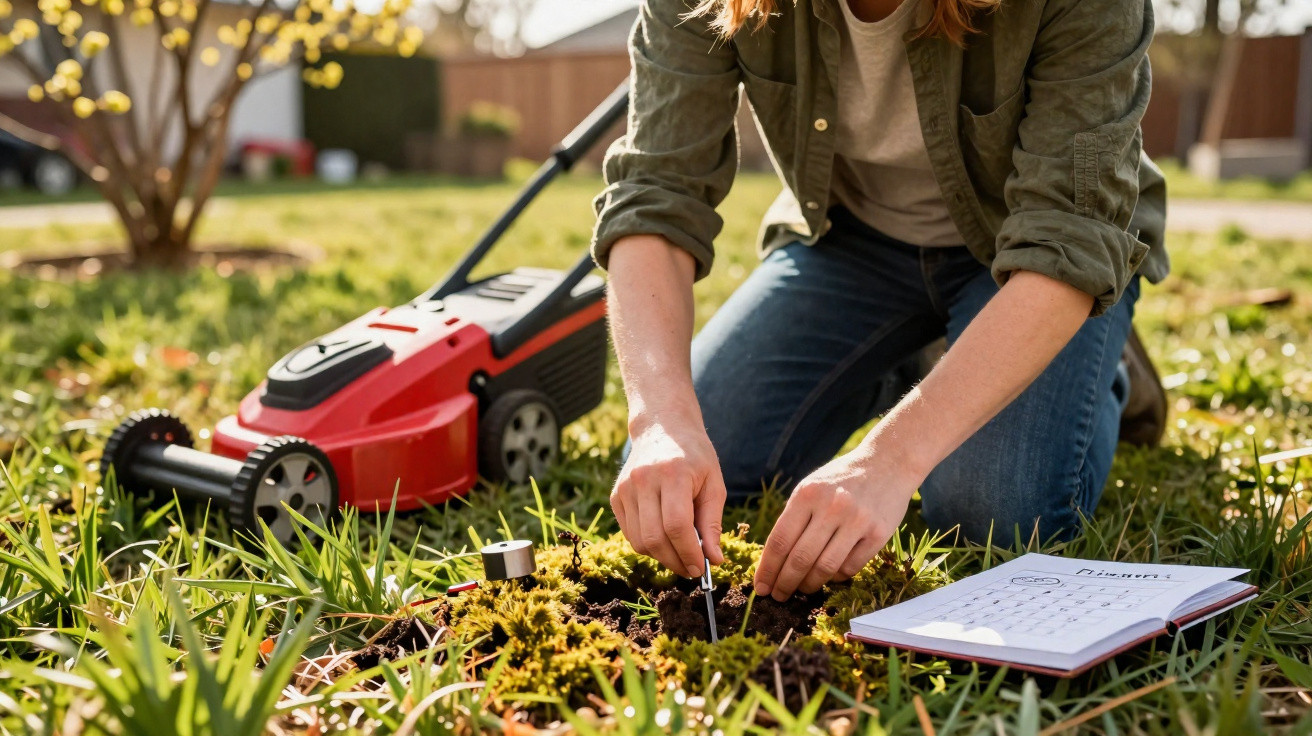
The lawn feels springy underfoot, is dotted with moss and yellow patches, and garden centres are piling up discounted scarifiers. It is tempting to start straight away. However, scarifying at the wrong time or using poor technique can damage your lawn rather than improve it – leaving you with an almost bare area just days later.
Why moss in the lawn is not the real problem
Many people spot moss and immediately think: “That has to go, and the scarifier is the answer.” Yet that approach targets only the symptom, not the cause. Moss thrives in damp, slightly acidic soil with too little air in the upper layer. These conditions can develop quickly after long, wet winters.
There is also a second, frequently underestimated lawn killer: thatch. This is a layer of partly decomposed clippings, root fragments and other plant debris that builds up between the soil and the grass blades.
Moss is a warning sign: the soil is no longer breathing properly, water drains poorly, and the lawn is gradually being suffocated at the surface.
Common signs that thatch is becoming excessive include:
- The lawn feels like a sponge or mat when you walk across it.
- After rainfall, water remains on the surface for several minutes.
- Moss patches take over whole sections, while the grass looks thin and lacking vigour.
- Vigorous raking with a metal rake brings up large amounts of dead material.
Reaching for the scarifier without thinking in this situation is often a crucial spring mistake.
The spring trap that can ruin your lawn within days
The most widespread misconception is: “The earlier and more vigorously I scarify, the better the lawn will be.” It is precisely this combination of poor timing and overly aggressive treatment that destroys many lawns within a few days.
The dangerous combination is soil that is too cold or too wet, together with a scarifier set too deeply. Lawn care then becomes radical treatment – and the grass has no strength left to recover.
Scarifying too early: when the lawn is still dormant
March can bring the first mild days, but soil life is often still in winter mode. Grass needs soil temperatures of around 8 to 10°C before its roots begin growing again. Scarifying before then pulls out weakened grass plants without allowing new shoots to replace them.
The result is brown areas, bare patches and exposed soil that weeds and moss quickly recolonise. Rather than merely looking ragged for a short time after scarifying, the lawn can remain that way for weeks.
Soil that is too wet and blades set too low: double damage
The condition of the soil is the second part of the problem. If puddles are still present or the ground squelches as you walk on it, the scarifier blades compact the surface even further. At the same time, they can tear out entire pieces of turf.
It becomes particularly problematic when the blades cut more than 2–3 millimetres into the soil. The machine then catches not only thatch and moss, but healthy roots too. Within days, the appearance changes completely: an area that had still been reasonably well covered with grass is now dominated by gaps.
How to tell when it is genuinely time to scarify
Calendar dates are only a rough guide. A few straightforward checks in the garden matter far more.
| Criterion | Ready for scarifying? |
|---|---|
| Soil temperature | At least 8–10°C; grass is visibly growing and has already been mown 2–3 times |
| Soil moisture | The surface is slightly damp, with no puddles and no squelching when walked on |
| Age of lawn | At least 1 year old; preferably 2–3 years old before vigorous treatment |
| Amount of moss and thatch | The metal-rake test reveals large quantities of loose debris and moss |
In the UK, the suitable window will commonly fall between mid-March and May, though it may be later in colder areas or following an especially cold winter.
Step by step: scarify without scalping your lawn
Choosing the timing wisely is only part of the job; the method needs just as much care. It determines whether the lawn recovers or remains weakened.
Preparing the lawn for scarifying
- Apply a moderate feed one to two weeks beforehand so that the lawn can build up strength.
- The day before scarifying, mow fairly short, to around 3–4 cm, and collect the clippings thoroughly.
- Work only on a day when the soil is neither waterlogged nor dust-dry.
Many scarifiers are factory-set with the blades too low. A shallow depth of approximately 2–3 millimetres is enough. The purpose is to score the surface, not cultivate it.
The correct scarifying technique
Move across the lawn at a calm, even pace. Abrupt changes of direction pull out more grass than necessary. In heavily thatched areas, a second pass at right angles to the first direction can be worthwhile.
If you can see more bare soil than green after scarifying, you have worked too deeply – or intervened too early in the year.
It is essential to remove all material pulled out immediately. Use either a lawn rake or the mower’s collection box. If thatch is left behind, it decomposes poorly and forms the next problem layer.
The overlooked next step: soil care rather than iron sulphate
After scarifying, many people instinctively use moss killers based on iron sulphate. Although this turns moss black and causes it to die, it can make the soil more acidic over time. That is exactly what encourages moss to return.
After scarifying, the soil needs treatment that makes it less acidic – not something that worsens the problem.
A lime-based soil conditioner such as dolomite is a better option. It raises the pH slightly and helps counter excessive acidification over the long term. This makes conditions less favourable for moss without scorching the lawn.
Then follow three steps that determine the success of the entire process:
- Overseed bare areas with a lawn-repair seed mix.
- Cover lightly with fine growing medium or sand so the seed does not dry out.
- Water moderately but regularly until the young grass is well established.
For the first few days after scarifying, keep foot traffic on the lawn to a minimum. Children playing football on the recovering area will noticeably delay its recovery.
Common garden scenarios – and the outcome
A frequent example is someone scarifying in early March when the air temperature is 6°C, the soil is still cold and it is also slightly waterlogged. The blades pull up large clumps of turf and break many roots. Within a week, brown patches dominate and show little sign of greening up again. Moss and weeds later make full use of the gaps.
Another scenario is setting the scarifier to be “properly thorough”. The blades cut 5 millimetres deep, and immediately afterwards the lawn looks as though it has been harvested. Even in good weather, it takes weeks to regain a reasonably continuous cover. During dry spells, the gaps remain open for even longer.
How to stop moss becoming a lawn problem in the first place
Following a few basic principles means you need to scarify less often and are less likely to ruin the lawn.
- Avoid mowing too low: a cutting height of 4–5 cm protects the turf.
- Mow regularly so that excessive coarse clippings are not left behind.
- Occasionally loosen compacted areas with a garden fork and apply a light dressing of sand.
- In shaded spots, overseed with shade-tolerant mixes instead of treating them like grass in full sun.
Moss often shows where the site is simply unsuitable for a perfect lawn: dense shade, constant dampness or heavy soil. Even flawless scarifying brings only temporary improvement in these areas.
Why terms such as thatch and pH matter beyond gardening jargon
Thatch may sound harmless, but in a lawn it describes a dense web of plant matter that water struggles to penetrate. Beneath it, there is often compacted soil where roots receive very little air. Ignoring this leads to surprise at waterlogging and yellow patches after every downpour.
The pH value indicates how acidic or alkaline soil is. Most lawn grasses prefer conditions ranging from slightly acidic to neutral. When acid rain, intensive mowing and unsuitable fertilisers make the soil too acidic, moss is far more comfortable than grass. A carefully targeted application of lime can shift this balance back in favour of grass.
What successful spring scarifying achieves in the long term
Avoiding the spring mistake and working at the right time and depth delivers two benefits. The lawn regrows more densely, its root system becomes stronger, and it can withstand dry periods better. At the same time, many troublesome areas, including springy patches and persistently damp corners, disappear.
Scarifying remains an intervention, not a spa treatment. Combined with moderate feeding, suitable mowing and considered watering, it can make a lawn more resilient. Those who move away from impulsive action days and learn to read the condition of the soil can avoid the typical spring disaster: a lawn that appears cared for, but has actually been severely damaged.





Comments
No comments yet. Be the first to comment!
Leave a Comment