
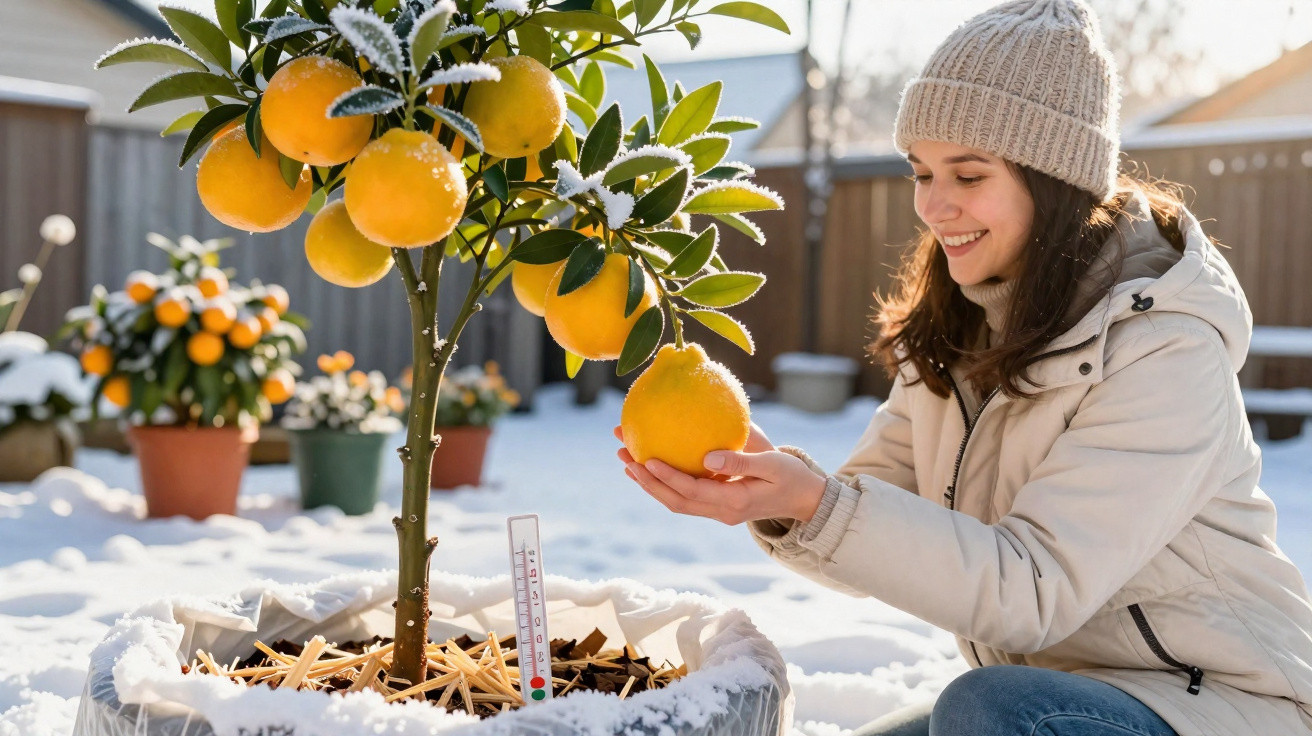
Many amateur gardeners know the disappointment: they buy a citrus tree full of anticipation, the first winter brings a hard frost, and the dream of growing a lemon tree at home ends in black, mushy foliage. Yet some citrus plants cope remarkably calmly with icy temperatures – provided you select the right varieties and meet their needs.
What frost ratings really mean for citrus
Plant labels often make claims such as “hardy to –12 °C”. As a rule, this figure applies to a well-established tree that is several years old, growing in a sheltered site with free-draining soil – and to brief periods of frost rather than weeks of bare, freezing weather.
There is another consideration: wood, leaves and fruit all have different levels of sensitivity. A Yuzu tree may keep its trunk intact in double-digit sub-zero temperatures, while its fruit can be damaged much earlier. With kumquats, for example, the fruit quickly becomes soft and unattractive at around –5 °C, even though the plant itself may survive.
Citrus hardiness primarily refers to the plant surviving – it does not automatically mean that the fruit remains healthy in severe frost.
Broadly, citrus species can be divided into three groups:
- Very frost-hardy species – down to around –15 °C and lower in well-drained soil
- Moderately frost-hardy species – roughly –10 to –12 °C
- Sensitive classics – affected from as little as –3 to –5 °C
The familiar potted lemon tree clearly belongs in the final group. Anyone wanting genuinely outdoor citrus in the German climate needs to choose different candidates.
The hidden star: the exceptionally tough trifoliate orange
The hardiest citrus relative for the garden is not a typical fruiting plant, but a genuine survivor: Poncirus trifoliata, commonly known as the trifoliate orange or bitter orange. Garden literature often lists it as a rootstock for grafted citrus.
| Scientific name | Poncirus trifoliata |
|---|---|
| English name | Trifoliate orange, bitter orange |
| Size | 3–5 m tall, 2–4 m wide |
| Position | Sun, sheltered from wind, well-drained soil |
| Frost tolerance | Down to around –20 °C in free-draining soil |
| Foliage | Deciduous, very thorny |
This shrub or small tree sheds its leaves in winter, making it more resilient. Its long, rigid thorns look almost prehistoric, while the yellow fruit is attractive but extremely bitter and of little interest as eating fruit. In return, the shrub is ideal as a reliable indicator of local conditions.
If the trifoliate orange dies back completely in your garden, no other citrus will have a lasting chance outdoors there.
Anyone with sufficient space can therefore plant one of these shrubs in the coldest part of the plot. If it survives there, frost-hardy citrus varieties should do well in more sheltered spots.
Edible citrus varieties that cope surprisingly well with frost
Fortunately, there is no need to stop at a “test shrub”. Several citrus species produce real fruit while tolerating substantially more cold than the conventional lemon tree.
Yuzu: a fashionable fruit with a frost advantage
Yuzu (Citrus junos) has long been familiar in high-end cuisine. For gardeners, its unexpectedly good winter hardiness is its major attraction: around –12 °C is realistic when the site is suitable.
It grows in a fairly bushy form and produces medium-sized, yellow, intensely fragrant fruit. Yuzu ripens late, often not until late autumn or early winter. Its juice adds a blend of grapefruit, mandarin and lime flavours to cooking, making it ideal for marinades, desserts and drinks.
Ichang lemon: a hybrid with a survival instinct
The so-called Ichang lemon originated from a cross involving the exceptionally hardy trifoliate orange. It withstands severe winters far better than an ordinary lemon tree and, depending on the selection, can tolerate temperatures in the region of –12 °C.
Its fruit is large, deep yellow and very juicy, with a bold, acidic flavour. Anyone who enjoys making marmalade or preparing homemade lemonade will have plenty to use – without having to worry every year about whether the tree will survive.
Satsuma mandarins: seedless classics with extra cold tolerance
The Satsuma mandarin tree (Citrus unshiu) is particularly appealing for families. It tolerates temperatures just below –10 °C and produces seedless fruit that can usually be harvested in autumn. As a result, the fruit is often no longer on the tree when the harshest winter frost arrives.
Outdoors in mild parts of southern Germany or in sheltered urban courtyards, a well-established Satsuma tree can crop reliably for years.
Kumquat ‘Meiwa’: small fruit, impressive toughness
The ‘Meiwa’ variety is among the more resilient kumquats. Once properly established, it can handle roughly –8 to –9 °C. Its fruit is small and rounded, and is eaten with the peel on – the peel is sweet, while the flesh is aromatic and tart.
‘Meiwa’ is especially easy to grow in a container. In a warm spot against the house, the plant can remain outdoors for the season in many parts of Germany if given light winter protection.
Caviar citrus hybrids: interesting options for frosty locations
So-called caviar citrus is actually a type of Australian finger lime. Some breeding lines combine it with more frost-hardy parents, and certain hybrids tolerate around –10 °C. Because the range is wide, it is worth checking the individual variety description carefully.
With exotic citrus hybrids, always look for specific frost ratings – descriptions such as “moderately hardy” are too vague.
Mandarins, clementines and lemons: how far can they go – and how should they be protected?
Small citrus trees are often added to a shopping trolley on impulse at the garden centre. Many originate in warmer regions and have only limited frost tolerance. A standard mandarin tree manages around –8 °C, while clementine trees sit slightly below this at approximately –7 °C.
In sheltered locations with a wine-growing climate or in calm inner courtyards, this may just work outdoors. In most German-speaking regions, however, gardeners are much safer growing these species in larger pots that can be moved for winter.
The popular “standard citrus” varieties – namely:
- Lemon tree (the classic kitchen companion)
- Sweet orange
- Grapefruit
are considerably more sensitive. Even a brief spell at –5 °C can quickly cause leaf drop, bark damage or frozen shoots. Outside true Mediterranean regions, they should therefore overwinter in a bright, cool setting, such as a conservatory, a frost-free stairwell window or a light, unheated room.
How citrus plants can survive winter more successfully
Anyone planning to grow citrus outdoors can achieve a great deal through good care and site selection. A few straightforward measures offer clear benefits:
- Choosing the site: A south-facing house wall, courtyard or sheltered garden corner is ideal. Heat builds up in these places, while cold winds reach the plants less directly.
- Preparing the soil: Citrus plants hate waterlogging. A layer of gravel or coarse grit in the planting hole, together with humus-rich but free-draining soil, prevents wet “concrete” conditions in winter.
- Mulching the root area: A thick layer of leaves, straw or bark chips protects roots from deep freezing.
- Protecting the canopy: When a cold snap is forecast, loosely wrapping the canopy in horticultural fleece helps. During severe frosty nights, an additional insulating layer of bubble wrap over the fleece is effective.
- Watering sparingly: Water very cautiously in winter so that the soil remains on the dry side rather than wet. Wet roots in frozen ground can quickly lead to total losses.
- No fertiliser in winter: Stop applying nitrogen from late summer onwards. Soft young wood is far more likely to die back in frost than mature shoots.
Which citrus species is worthwhile for whom
Those living in a fairly harsh area without somewhere frost-free for overwintering are safest with Yuzu, Ichang types, Satsuma mandarins or a trifoliate orange. In milder river valleys or urban heat islands, even clementines can be attempted with some confidence and effective winter protection.
Gardeners with a balcony or terrace and a bright winter home have more freedom of choice. They can combine the widest possible variety range in summer with protected conditions in winter. Kumquats and caviar citrus hybrids in particular are highly decorative in containers and produce small but distinctive fruit.
What “free-draining soil” and a “sheltered site” mean in practice
Many guides use these terms without explaining them clearly. In practical terms, free-draining soil means that water must not remain around the roots for several days after heavy watering or rain. Sand, grit or fine gravel in the planting hole helps to open up heavy clay soil.
A sheltered position means more than simply being “close to the house”. It is a corner where wind is slowed and stored warmth from the day is released again overnight. A south-facing wall retains solar warmth, while walls and hedges divert air currents. These are exactly the places where frost-hardy citrus shows its advantage, bringing a touch of Mediterranean character to gardens in which a conventional lemon tree would have given up long ago.
Comments
No comments yet. Be the first to comment!
Leave a Comment