
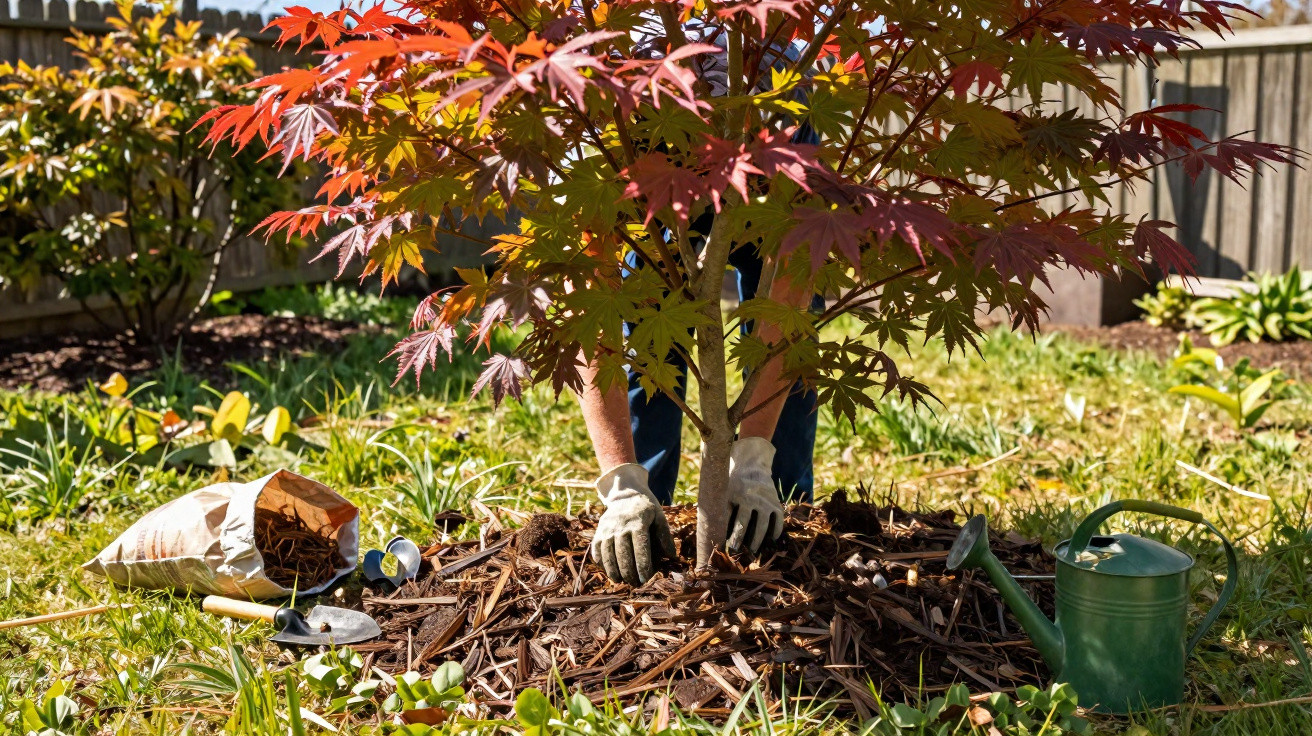
Many Japanese maples struggle along – yet one unobtrusive job in March can lay the foundations for a far more vigorous growing season.
Drying leaf edges, few fresh shoots and an overall tired appearance: this is how many Japanese maples look after several years in the garden. Keen gardeners often water them conscientiously and worry about their favourite tree. What is frequently overlooked is that the key is not extra water, but targeted soil care in March, which determines whether the maple remains weak or begins spring with renewed strength.
Why Japanese maples react so sensitively to soil conditions
Japanese maples (Acer palmatum) naturally grow in open woodland, where the soil is cool and rich in humus. Their fine, shallow roots are well protected beneath a layer of fallen leaves. In a typical home garden, this protection is often entirely absent: the ground is bare and compacted, warms up quickly, and can freeze again just as rapidly in spring.
The effects are easy to spot:
- stressed, shallow roots close to the surface
- frequent shifts between waterlogged and dry conditions
- brown leaf margins as early as early summer
- subdued growth and few new shoots
“Keeping the roots of a Japanese maple stable automatically promotes denser foliage, more even growth and less drought damage.”
This is precisely where the crucial March task comes in: applying a purposeful yet very simple ground cover around the tree.
The most important March care task: a protective root blanket
Once the ground has thawed in March, the maple’s root system begins to become active. At this point, a natural protective layer over the soil is especially beneficial. In gardening terms, this is known as a mulch layer: a loose covering of organic material spread around the trunk.
This ‘blanket’ provides several benefits that are particularly suited to Japanese maples:
- it keeps soil moisture more consistently stable
- it protects surface roots from late frosts
- it stops the soil from overheating quickly during the first hot spell
- it suppresses weeds that compete with the maple for water and nutrients
- it gradually supplies nutrients as the material breaks down
“A mulch layer in March recreates the natural woodland floor – exactly the environment in which Japanese maples prefer to grow.”
Step by step: how to mulch your Japanese maple properly
1. Prepare the soil around the trunk
Begin by clearing the area beneath the canopy. Remove weeds carefully, preferably by hand. Fine maple roots sit close to the surface and are easily damaged by vigorous hoeing.
- Clear self-seeded growth and stones from the area beneath the canopy.
- Gently loosen the soil to a depth of 2–3 centimetres, without stabbing or digging into it.
- Remove old, matted mulch remains or cushions of moss that hold back water.
This creates an airy, absorbent surface where moisture can spread more evenly.
2. Apply the correct mulch layer
The mulch should be neither too shallow nor excessively deep. A layer of around 5 to 8 centimetres is ideal: it keeps the soil cool and evenly moist without leaving the roots sitting in wet conditions.
One point is particularly important: keep the base of the trunk clear. Leave roughly ten centimetres between the bark and the mulch to prevent rot and fungal problems on the trunk.
Suitable materials include:
- composted pine bark or bark from other conifers
- well-rotted, aged leaf mould
- finely shredded, seasoned woody prunings
- mature garden compost applied in a thin layer, possibly mixed with pieces of bark
Dark stones in sunny positions, plastic coverings and thick layers of fresh grass cuttings are less suitable. They can retain heat, trap water or deprive the roots of oxygen.
Watering Japanese maples properly: how often they really need water
With a good mulch layer in place, you will need to reach for the watering can less often – but each watering should be more thorough. Rather than watering little and often, it is better to soak the root area properly twice a week. This allows water to penetrate deeper layers and encourages roots to grow downwards instead of remaining just below the surface.
During hot periods, watering needs increase. Depending on the site, three to four watering sessions a week may then be appropriate. There is a simple check: push a finger a few centimetres into the soil beneath the mulch. If it feels dusty and dry there, it is time to water.
“Mulch ensures that water reaches the place where the maple needs it – in the root zone below the surface, rather than merely wetting the top like a brief shower.”
Japanese maple in a pot: what requires particular attention
Japanese maples face even greater risks in containers. Their roots are tightly packed, the compost heats up more rapidly and it dries out quickly. A thinner mulch layer helps in two ways here: it shields the roots from heat and retains moisture in the pot for longer.
In a container, a layer of 3 to 5 centimetres will usually be enough. Water deeply until it runs from the drainage holes, but do not allow the pot to stand permanently in water collected in its saucer. Waterlogging causes root rot, even if the surface appears dry.
Towards late summer, you can carefully reduce the amount of water without allowing the tree to dry out. A small, controlled amount of stress encourages more intense autumn leaf colour in many varieties.
Common mistakes that unnecessarily weaken the maple
Much of the damage seen on Japanese maples is not caused by a ‘bad location’, but by minor care errors that build up over time. These include:
- repeated hoeing close to the trunk, which damages fine roots
- placing bark mulch directly against the bark, leaving the trunk damp
- completely uncovered, stony soil in summer
- continual alternation between waterlogging and drought
- dark gravel surfaces that reflect heat
Anyone who keeps these points in mind and spends one or two hours on soil care in March will improve the maple’s starting conditions for the entire year.
Why timing the task for March makes such a difference
Spring is a turning point for Japanese maples: buds swell, root growth accelerates, and the first warm days alternate with cool nights. At this stage, it is decided whether the tree settles into a stable rhythm or remains under constant stress.
Applying mulch in March stabilises the microclimate around the root zone before the first real heat arrives. At the same time, it lessens the impact of late frosts in the soil. The maple has to spend less energy on recovery and can direct it into fresh shoots and healthy foliage.
Extra tips for stronger Japanese maples throughout the year
Anyone wishing to support their Japanese maple even more can combine March mulching with several other straightforward measures:
- Provide light wind protection, particularly in very exposed positions.
- Water in the morning or evening, rather than in the midday heat.
- Avoid allowing heavy, clay-rich soils to become waterlogged – if necessary, improve them with sand and compost.
- Fertilise moderately and with purpose, ideally using mildly acidic organic fertilisers.
Nutrients in particular are often a source of confusion. Too little fertiliser results in pale leaves and weak new growth. Too much may seem to boost the maple at first, but it makes the tissue soft and more vulnerable to heat and frost. Slowly decomposing mulch has an advantage here: it releases nutrients gradually without overwhelming the tree.
Anyone who has watched a previously weakened Japanese maple flourish after one or two years of regular March mulching will no longer underestimate this simple measure. Spectacular interventions are often unnecessary; calm, consistent soil management is what this sensitive yet rewarding tree values most.
Comments
No comments yet. Be the first to comment!
Leave a Comment