
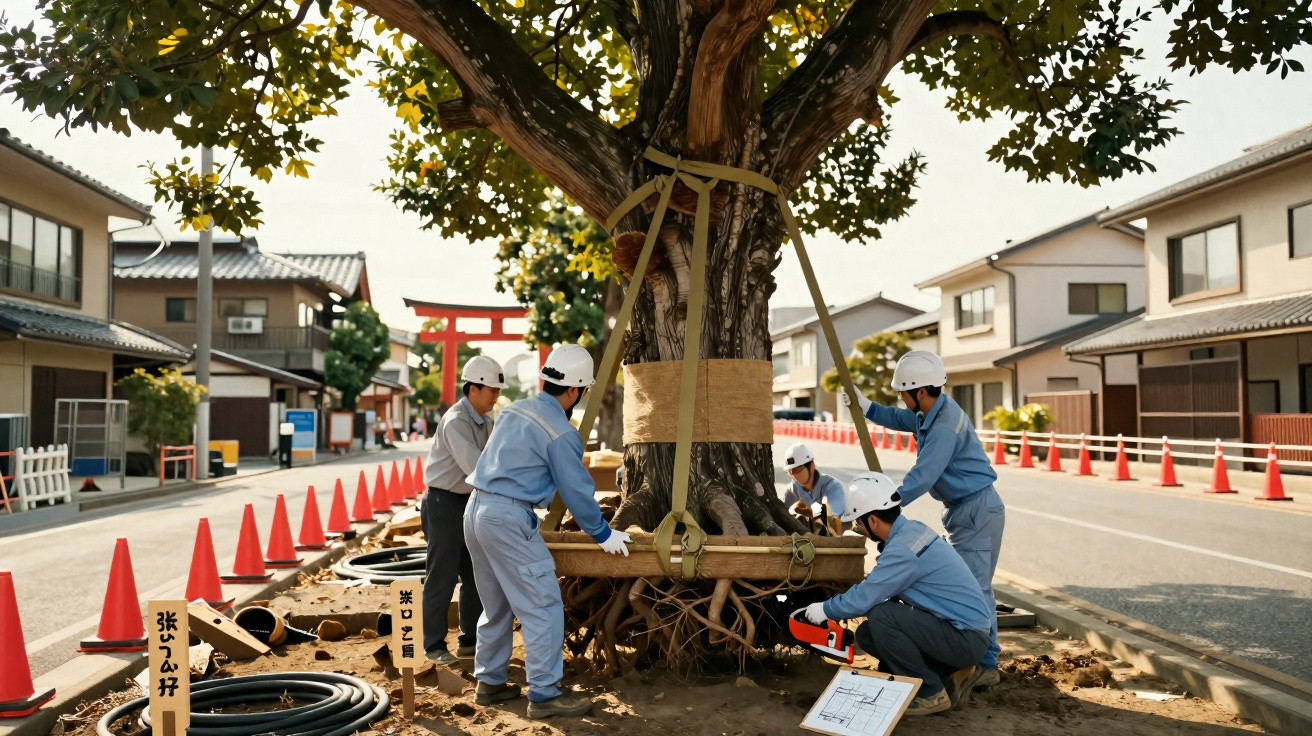
In Japan, ancient trees can be given an alternative solution when they stand on land earmarked for roads, buildings or other construction projects. In some schemes, arborists spend months preparing the roots before moving the specimen to a different site, retaining part of the landscape, biodiversity and local memory.
Why are some ancient trees preserved during construction work?
Mature trees provide shade, store carbon, support wildlife and form part of the character of streets, temples and gardens. Where a tree has historical, cultural or landscape value, relocating it may be considered before permission is granted for it to be felled.
This does not mean that every tree found on a construction site is moved. Its species, age, trunk condition, root spread, the distance to the new site and the cost of the work all decide whether relocation is technically feasible.
How does nemawashi work before transplanting?
Nemawashi is a traditional root-preparation method. The term can be understood as working on or arranging the area around the roots; in Japanese professional settings, it has also come to mean carefully preparing a change before putting it into effect.
- the ground surrounding the trunk is assessed before digging begins;
- some long roots are cut in a planned manner;
- fine roots are encouraged to develop closer to the trunk;
- moisture levels and the health of the canopy are monitored throughout preparation;
- the root ball is sized according to the tree’s species and scale.
Why are the roots prepared over several months?
A large tree relies on an extensive root network to take in water and nutrients. Removing it from the ground in one operation can destroy much of that system, leading to transplant shock, dehydration or reduced stability.
Gradual preparation encourages smaller roots to form within the section that will be transported. By the time the tree is lifted, the root ball retains more soil and more of the structures needed to support the tree as it adjusts to its new setting.
How is a large tree moved to another site?
Once preparation is complete, arborists excavate around the root ball and secure the whole mass so that it remains intact. Larger trees require machinery, cables, support frameworks and cranes able to spread the load without damaging the trunk or crushing the roots.
- the replacement site is prepared before the tree is removed;
- the root ball is wrapped to retain roots and moisture;
- vulnerable branches may be secured to prevent damage;
- the specimen is lifted and moved using specialist equipment;
- watering, support and monitoring continue after replanting.
Transplanting mature trees combines conservation with urban planning
Moving a centuries-old tree takes months of work and offers no absolute guarantee of survival. Soil conditions, weather, drainage and aftercare all affect recovery, so the decision must involve arborists, engineers and those responsible for the urban project.
Where the process is viable, transplanting mature trees demonstrates that a building project can be redesigned to retain living features within the landscape. Rather than viewing the specimen as an immediate obstacle, planning takes account of its roots, its history and the time it needs to keep growing elsewhere.

Comments
No comments yet. Be the first to comment!
Leave a Comment