
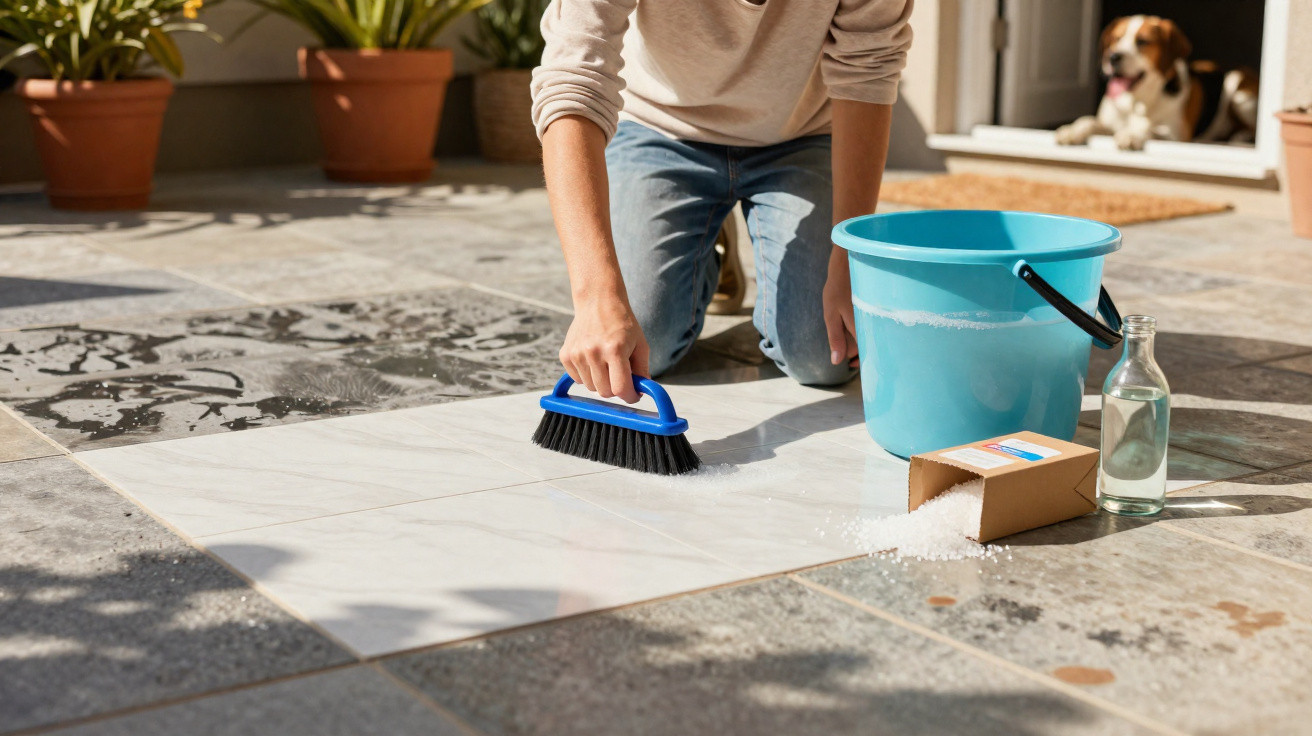
Many people instinctively reach for a pressure washer or harsh chemicals from the DIY shop. Yet a British DIY enthusiast demonstrates that there is a far simpler, quieter approach that is kinder to the environment, pets and the stone surface: two products from the cleaning cupboard, a little time and a sturdy scrubbing brush.
Why patios look so bad after winter
After months of rain, frost and limited sunshine, patio slabs develop a mixture of algae, moss, lichens and everyday outdoor grime. Anyone who leaves metal furniture outside will also recognise the unattractive rust marks around chair and table legs. Pale paving can quickly begin to look patchy and “tired”.
The usual response is to get out the pressure washer, apply chemicals and simply “blast everything away”. Over time, however, this can create fresh problems.
- The jet from a pressure washer removes jointing material and roughens the surface.
- Harsh cleaning products can damage joint mortar and certain natural stones.
- While the dirt disappears, the roughened surface attracts new grime more quickly afterwards.
Many people now rely on household products such as vinegar cleaner. It can genuinely work against limescale and some deposits, but it is still an acid. On sensitive stone, it may leave fine etched marks that only become visible later when the light catches them. The soil organisms around the patio are not particularly fond of repeated acidic treatment either.
“Anyone who uses high pressure and aggressive products every year will eventually clean their patio into disrepair.”
The simple two-product trick for clean patio slabs
The British DIY channel “Fix it with Fowlers” presents an alternative that sounds remarkably unremarkable: a bag of soda crystals, a dash of washing-up liquid, a scrubbing brush and some patience. For many standard patios, that is genuinely all that is needed.
What soda crystals do
Soda crystals, also known as washing soda, are a traditional household aid from before the age of specialist cleaners. They are an alkaline salt that dissolves grease and starts to loosen organic dirt. Importantly, they are not the same as bicarbonate of soda, and certainly not the caustic sodium-hydroxide drain cleaners.
- They break down greasy films and barbecue residue.
- They soften algae layers and embedded dirt.
- They are considerably less aggressive than many specialist cleaning products.
Ordinary washing-up liquid is added as well. Familiar from the kitchen, it breaks up grease and oil so they can be rinsed away more easily with water. On patios, this is particularly helpful for barbecue fat, soot and grime layers caused by exhaust fumes.
Step-by-step: how to use soda crystals and washing-up liquid
Preparation is almost more important than the cleaner itself. Anyone who simply pours it over the surface may later be frustrated by streaks.
- Clear the joints: Remove weeds and loose soil using a joint scraper or small spade.
- Sweep thoroughly: Use a stiff broom to clear away dust, sand and larger debris.
- Wet the slabs: Moisten the whole area evenly with a garden hose or watering can.
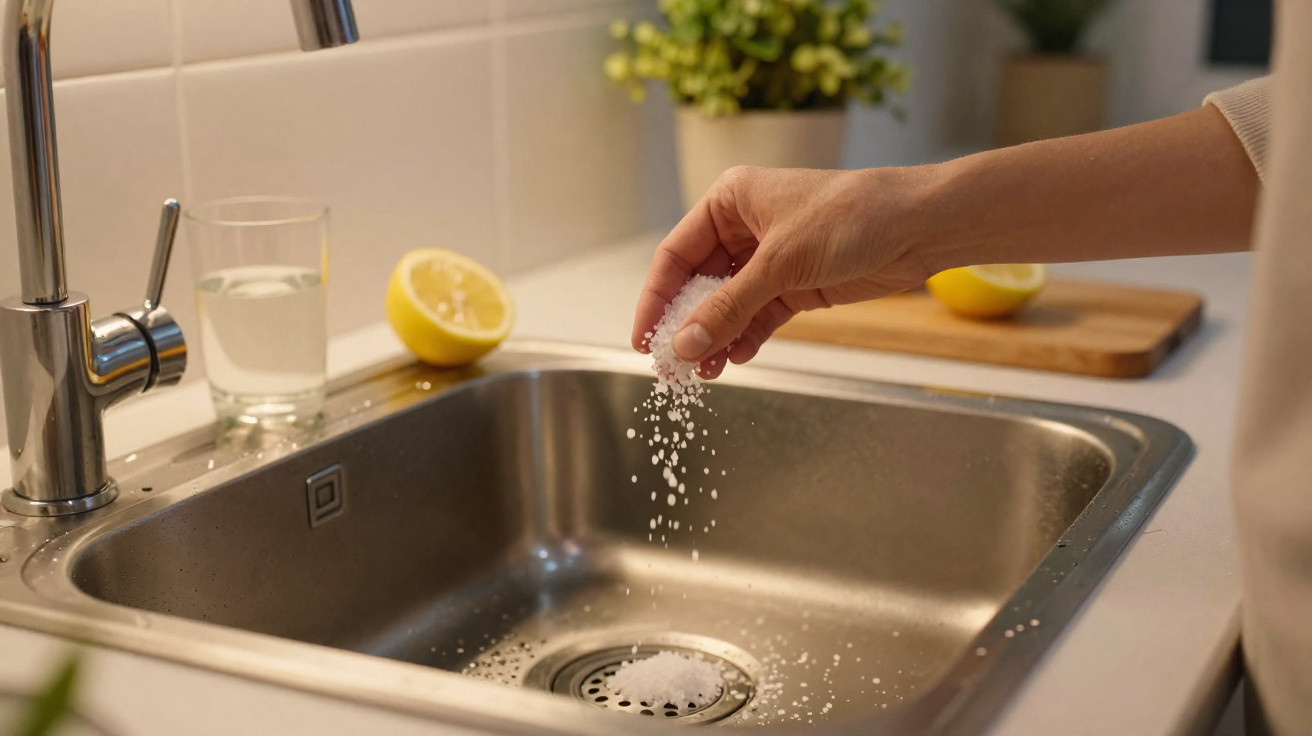
- Scatter soda crystals: Spread them lightly across the wet surface; there is no need for a thick layer.
- Add washing-up liquid: Apply several thin lines or a few squirts over the slabs.
- Scrub firmly: Work the mixture into the surface with a hard scrubbing brush, including the joints.
The next stage is slightly counterintuitive: do not rinse it away immediately, but allow it to work. The DIY enthusiast leaves the mixture on the slabs for up to 48 hours before rinsing once more with clean water. During this period, some of the deposits loosen by themselves.
“Giving the cleaner time saves effort later – the patio becomes cleaner without any noisy machine.”
Safety and common patio-cleaning mistakes
Soda crystals are regarded as relatively gentle for household use, but they are still distinctly alkaline. That means there is no need to spread half a kilogram at once. A light layer, or a bucket of hot water with a few tablespoons, is entirely sufficient for many domestic patios.
What homeowners should keep in mind
- Avoid contact with eyes and skin: Wearing short rubber gloves is sensible.
- Keep children and animals away: While the surface remains wet, it is best not to let anyone walk across it.
- Carry out a test patch: With sensitive natural stone, first test the method in an inconspicuous area.
- Rinse thoroughly: After the contact time, use plenty of water so that no residue remains.
One widespread mistake is combining several products: a little vinegar here, some chlorine cleaner there, perhaps followed by a stone cleaner. Such improvised mixtures can harm not only the stone but also your lungs if gases are produced. It is better to use one method per cleaning session and ensure good ventilation.
When a pressure washer is still useful
Completely tarred joints, baked-on mud or deposits that have built up over decades can sometimes be difficult to remove through manual work alone. In those cases, a pressure washer can help, provided it is used carefully:
- use a wide spray nozzle rather than a pinpoint jet
- increase the distance from the ground rather than working at very close range
- clean joints only at an angle and with lower pressure
- replace the jointing material afterwards if a substantial amount has been washed out
Anyone who pre-treats the surface with soda crystals and washing-up liquid will often need considerably less pressure in the end, because the dirt has already started to loosen.
How to keep the patio cleaner for longer
Even the best cleaner achieves little if everything turns green again after a few weeks. A little routine can keep the work involved to a minimum.
| Measure | Frequency | Benefit |
|---|---|---|
| Sweep with a stiff broom | every 1–2 weeks | Removes leaves and dust, leaving less material for algae to feed on |
| Light clean with warm water and washing-up liquid | as needed, around monthly | Greasy films and fresh marks are loosened early |
| Two-product treatment with soda crystals | 1–2 times a year | Deep clean before algae become firmly established |
| Move garden furniture | several times per season | Prevents permanent shaded areas and rust patches |
Planning a lighter round with soda crystals and washing-up liquid in autumn makes the start of spring much less demanding. The familiar black and green films are then often far less pronounced.
Suitable patio stones and where caution is needed
This method is primarily intended for common concrete slabs and many ceramic finishes. Natural stone deserves a closer look:
- Concrete slabs: Usually unproblematic, provided the joints are not already crumbling.
- Ceramic patio slabs: Generally safe, but keep an eye on the joints.
- Sandstone, limestone and marble: Test a small area first and use a softer brush instead.
- Clay pavers: Often robust, but watch for efflorescence and colour changes.
Alkaline products such as soda crystals can roughen or discolour certain natural stones, depending on the concentration. In such cases, a diluted solution in a bucket with a short contact time is the safer choice than scattering crystals dry and leaving them for two days.
More than appearance: the environment, pets and your budget
Making the patio look “like new” is only part of the story. Avoiding aggressive cleaners also protects what grows and lives around the slabs. A mixture of soda crystals and washing-up liquid generally breaks down much more readily than specialist concrete chemicals, which often end up in drains or flowerbeds.
The issue is also sensitive for pet owners. Dogs and cats walk across wet areas and later lick their paws. Using a product combination without harsh acids or chlorine, then rinsing thoroughly so no residue remains in puddles, significantly reduces the risk.
Finally, cost matters too: soda crystals cost only a few pounds per pack at supermarkets or chemists, while washing-up liquid is usually already in the cupboard. Compared with specialist cleaners or even a new pressure washer, this is kinder to the household budget – and to the neighbours’ nerves, as they do not have to listen to an engine roaring for hours on sunny weekends.


Comments
No comments yet. Be the first to comment!
Leave a Comment