
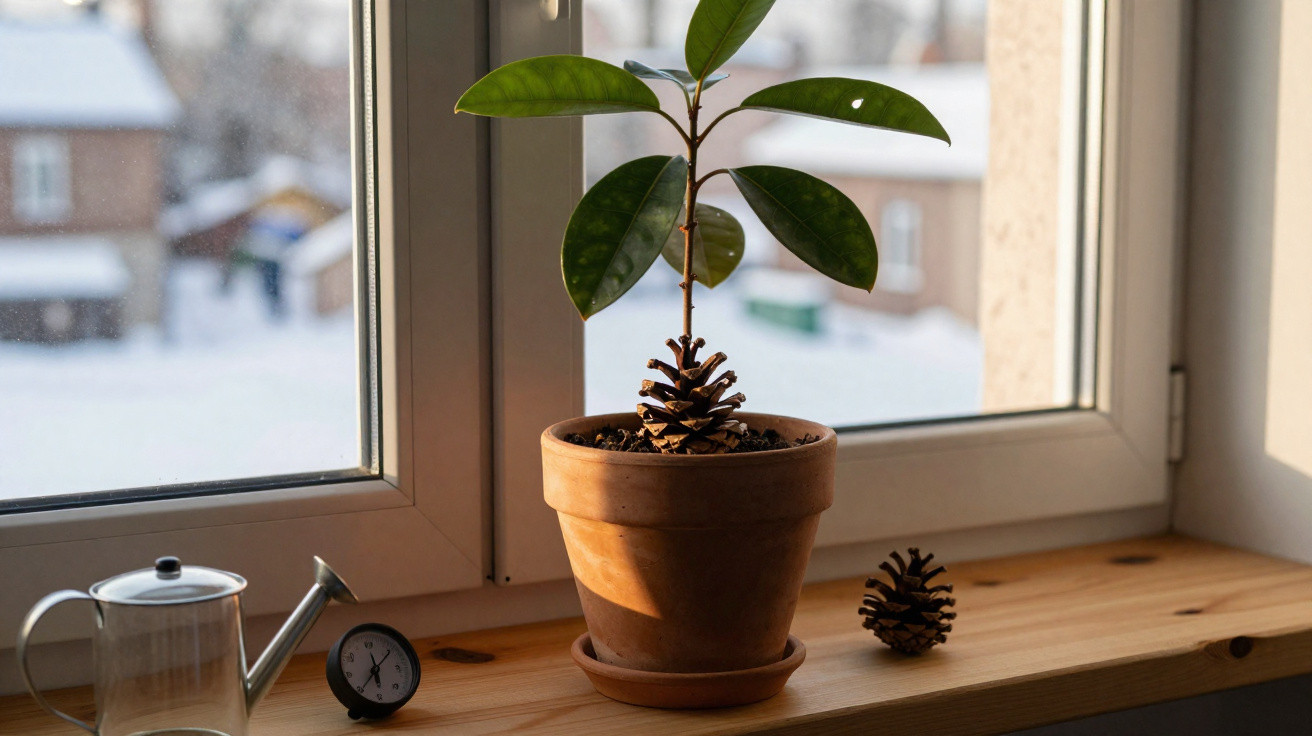
Yellowing leaves, soft stems and soggy compost: during the heating season, the living-room climate can quickly become difficult for Monstera, Ficus and similar plants to cope with. Many people instinctively reach for the watering can – and that is precisely where the real problem begins. In this delicate period, an unassuming find from the woods can become a quiet helper: a dry pine cone, with no high-tech equipment or costly specialist fertiliser required.
Central heating and winter dormancy: why your plants are so temperamental now
During winter, radiators are running at full blast in many homes. The air becomes dry, leaves lose moisture, their tips turn crisp and foliage curls up. Although this can look like thirst, it often is not.
At the same time, most houseplants are in a dormant phase. Their metabolism slows down, growth becomes more gradual and their roots absorb considerably less water. While the compost may appear dry near the surface quite quickly, it can remain damp for a long time further down in the pot.
Anyone who judges moisture solely by the surface and keeps topping up the water can unknowingly create a risky situation: waterlogged compost at the bottom, with hardly any oxygen – ideal conditions for root rot.
“Too much water during winter dormancy damages plants more reliably than a brief spell of dryness.”
As a result, roots gradually die off, the plant can no longer take up water and droops even further – prompting many people to water it still more. This classic vicious circle claims countless houseplants every year.
The simple pine cone method: a woodland find that manages moisture
This is where a dry pine cone comes into its own. It looks decorative, costs nothing and acts as a small moisture regulator directly on the compost surface.
The method could not be simpler: place one large, thoroughly dried pine cone on top of the compost. Do not bury it or break it up; simply set it down. Its woody structure absorbs excess moisture from the upper layer of compost, then gradually releases it again later.
“A pine cone acts as a natural buffer: less waterlogging, less mould, more stable conditions.”
This creates a kind of protective layer between dry indoor air and sensitive potting compost. The surface stays looser, while the familiar white or greenish coating of limescale, algae or mould forms less often.
How a pine cone tells you when your plant genuinely needs water
Pine cones are tiny precision instruments created by nature. Their scales react to moisture: they open in dry conditions and close when humidity is high. You can make use of exactly this feature in your living room.
- Scales tightly closed: The surrounding air and compost are still noticeably damp. Delay watering.
- Scales widely open: The air and upper compost layer are fairly dry. This is the time to check moisture deeper in the growing medium.
A pine cone does not replace a moisture meter, but it provides a surprisingly dependable visual cue. If you are unsure, use both methods: look at the cone, then use your finger or a wooden stick to check how damp the compost still is deep inside the pot.
Preparing pine cones correctly before putting them in a pot
Putting just anything found in the woods into a flowerpot can, in the worst case, bring insects, fungal spores or tiny larvae into your home. A short preparation step helps prevent this.
Step-by-step guide
- On a walk, collect only well-opened, dry pine cones that appear undamaged.
- Carefully remove loose dirt, soil and needles using a brush or an old towel.
- Dry the pine cones in an oven at around 90°C for 20–30 minutes, or leave them on a warm radiator for several days.
- Allow them to cool down completely afterwards.
- Place one cone in the middle of the pot; distribute two or three across larger containers.
The preparation takes less than five minutes, yet the benefit supports your plants throughout the winter season. It also creates a natural decorative effect reminiscent of a woodland floor.
Watering in winter: less is more, with clear rules
The pine cone can help manage moisture, but it does not replace an adjusted watering routine. During the heating season in particular, many houseplants need significantly less water than they do in summer.
A few straightforward guidelines are often enough:
- Extend watering intervals considerably compared with summer.
- Water only when the compost feels dry several centimetres below the surface.
- Always pour away standing water in an outer cachepot immediately.
- With sensitive varieties, it is better to water once too little than once too often.
“If you are unsure in winter, you will usually be right to skip a watering.”
It is also worth moving pots slightly away from radiators. Direct radiant heat can dry leaves out rapidly without allowing the roots to process any more water.
More light, less stress: further tips for healthy winter plants
Alongside moisture, lack of light is a major challenge for many houseplants. Short days, a low sun angle and often shaded windows drastically reduce their energy supply.
Helpful measures include:
- Move plants closer to a window without exposing them to cold draughts.
- Dust leaves regularly so that every bit of available light can reach them.
- Avoid cold bridges: in winter, leaves should not touch window glass directly.
Anyone keeping many light-hungry species can supplement conditions with simple LED grow lights during the darkest months. Just a few additional hours of light each day noticeably reduces stress.
When a pine cone is unsuitable – and what to do instead
As clever as this approach is, it does not suit every situation. In several cases, other solutions are preferable.
- For plants that need to be kept extremely dry, such as some succulents, a top dressing of mineral sand or gravel is often sufficient.
- Pots heavily affected by mould or fungus gnats usually need a compost change or a thorough drying-out period first.
- If plants are kept permanently cool, do not cover the compost further, so it can dry out more quickly.
In most normally heated living rooms containing conventional foliage plants, however, a pine cone works remarkably reliably as a small helper.
Why this woodland trick can work better than expensive gadgets
The market offers a whole range of moisture sensors, smart pots and high-tech watering aids. Many cost a substantial amount of money, while some end up in a drawer after one season.
A pine cone, by contrast, performs several functions at once:
| Function | Effect |
|---|---|
| Absorbs moisture at the surface | Less waterlogging and a lower risk of rot around the upper root zone |
| Visual moisture indicator | The position of the scales indicates whether dryness or residual moisture is more likely |
| Decorative covering | A natural look instead of bare compost, helping to suppress mould and algae growth |
The method therefore combines old natural knowledge with modern living conditions: central heating, closed windows and little air movement – an environment plants would never encounter like this outdoors.
Practical examples: which plants benefit most from the pine cone trick
Plants particularly likely to benefit are those that tend to be “drowned” in winter because their large leaves make them look limp quickly. Typical candidates include:
- Monstera
- Rubber plants and other Ficus species
- Dracaena
- Some palm species kept in living rooms
- Small indoor trees in decorative cachepots where drainage cannot be checked
For smaller pots, one more delicate pine cone is often enough. In tubs or large plant bowls, you can use a small group, creating an effect that resembles a miniature landscape.
Anyone who consciously observes the position of the scales and the compost moisture for a few weeks will soon develop a sense of how reliably this method supports their own watering routine. Your houseplants can then remain vigorous even in the depths of winter – without specialist fertiliser, but with an unobtrusive helper from the woodland floor.

Comments
No comments yet. Be the first to comment!
Leave a Comment