
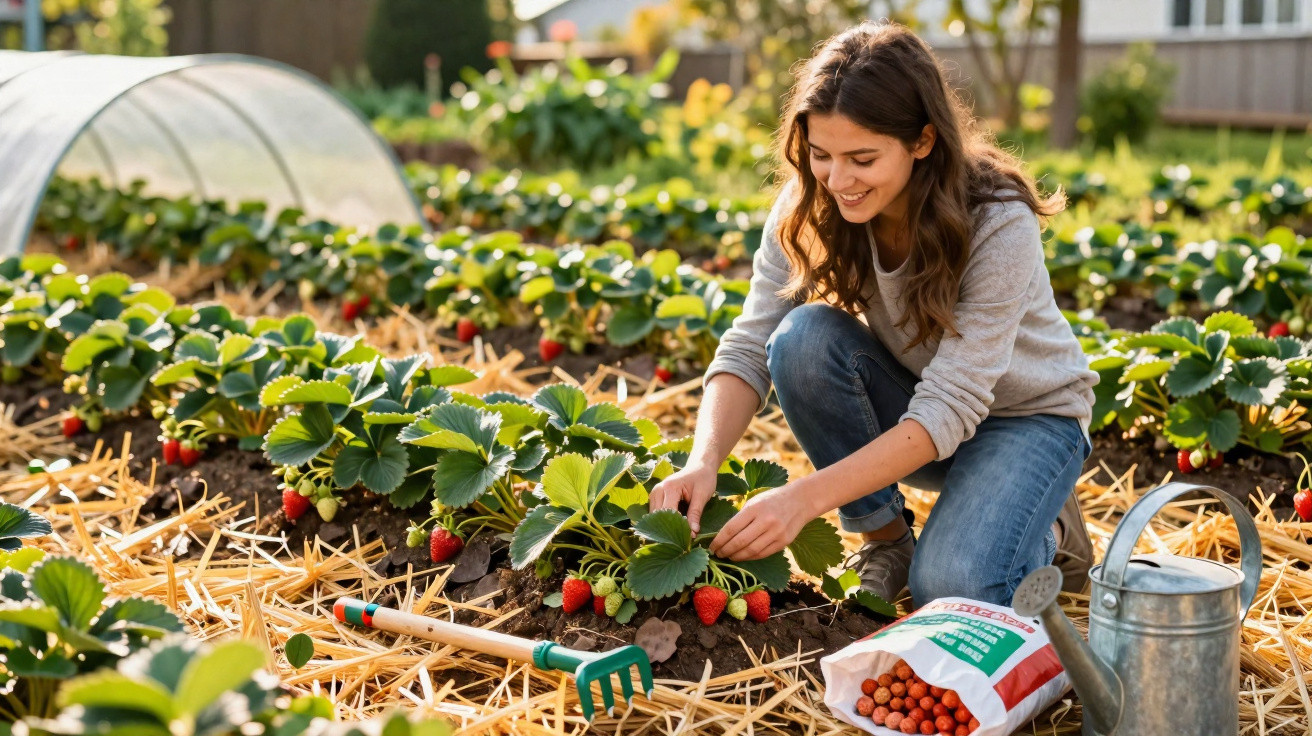
With a few well-timed jobs in spring, this is entirely achievable.
Many amateur gardeners only realise in June that their strawberry plants are struggling. By then, the opportunity has passed. Those who take a methodical approach in March and April can enjoy early, flavoursome berries in a garden bed or on a balcony. Four straightforward measures will boost the plants and guard them against disease and cold snaps.
Why spring preparation determines the harvest
Strawberries are among the easier crops to care for. Even so, they are sensitive to waterlogging, fungal diseases and a lack of nutrients. Spring is when these factors are decided. Careful work at this stage creates the conditions for early flowers and well-developed fruit.
“Anyone who cleans, feeds, mulches and waters their strawberries properly in spring has a realistic chance of a plentiful harvest from mid-June.”
The following four tasks can be carried out one after another. No specialist expertise is required: just a little time, clean tools and a sense of good timing.
Remove old leaves: give strawberry plants a fresh start
In spring, many strawberry plants are still covered by a layer of brown, spotted foliage. It may look harmless, but fungal spores and pests can shelter in it and hold back the new season from the outset.
Step 1: give the bed a thorough spring clean
- Cut off every yellow, brown or heavily spotted leaf close to its base.
- Remove dried leaf stems that are clogging the root area.
- Expose the plant crowns so that air and sunshine can reach them.
- Disinfect scissors or a knife after each plant, using 70% alcohol or a strongly diluted bleach solution.
Opening up the plant allows the sun to warm its crown more quickly. Fresh, healthy leaves will emerge sooner, while the risk of powdery mildew and other fungal diseases is considerably reduced.
If strawberries are planted closely together in a bed, check during the clean-up whether any plants have become too old. Yields often decline from the fourth year onwards, so it is worth replacing some plants with young, vigorous ones.
The right fertiliser: strawberries need feeding, not excess
After winter, the soil’s nutrient reserves are often depleted. Strawberries repay modest, targeted feeding with more flowers and larger fruit. Too much fertiliser, especially nitrogen, instead produces excessive foliage and watery berries.
Feed gently rather than overloading plants
- Spread roughly two handfuls of well-rotted compost around each plant (about 100–200 grams).
- Alternatively, use an organic fertiliser formulated for strawberries, following the directions on the packet.
- Loosen only the top 3–5 centimetres with a small hand rake, taking care not to damage the roots.
- Do not cover the plant crown with soil or compost; it must remain visible.
Loosening the surface breaks up the hard winter crust, enabling rainwater to soak into the soil more readily. Compost provides nutrients while also improving soil structure. This results in more flower buds and sturdier plants that cope better with dry periods.
“A moderate ring of compost around each plant works like an energy bar – enough strength, but no overfeeding.”
For strawberries in pots or balcony planters, a thin topping of fresh compost can also be added. After two to three years in the same container, it is worthwhile replacing part of the growing medium entirely.
Lay mulch: fewer weeds and cleaner fruit
A well-planned mulch layer is one of the most effective ways to grow healthy strawberries. It reduces weeding time, keeps berries clean and helps protect them from rot.
Suitable mulch materials
- Chopped straw
- Flax straw or hemp bedding
- Finely shredded leaves from the previous year, provided they are thoroughly dry
The layer should be about 5–10 centimetres deep. This makes a noticeable difference, particularly on light soils: the ground does not dry out as fast, yet remains loose and well aerated.
“Organic mulch keeps fruit away from damp soil and significantly reduces the risk of grey mould.”
It is important that the plant crown remains clear. Permanently damp material against it raises the risk of disease again. Mineral materials such as gravel may look tidy, but offer little benefit to the soil. Organic mulch is much more worthwhile for strawberries because it gradually builds humus.
Water correctly and protect strawberries from late frost
Flowers that will later become fruit appear in May. At this point, strawberries are especially vulnerable to drought and frost. Neglecting either can quickly cost a substantial part of the crop.
Water strategically rather than sprinkling constantly
- Always water at soil level, never over the leaves or flowers.
- Water deeply once or twice a week instead of giving a little every day.
- With mulch and slightly heavier soil, the interval can be longer; check with a finger first.
- Water in the morning or late afternoon, rather than in the midday heat.
Leaves left dripping wet in the cool of evening create ideal conditions for fungal diseases. Directing water to the root zone supplies plants more effectively while keeping foliage drier. Deep watering encourages roots to grow further down, making plants more resilient during short dry spells.
Protection on cold nights
- Have horticultural fleece or a lightweight polythene tunnel ready as soon as buds can be seen.
- Cover plants in the evening whenever night-time temperatures approach freezing.
- Check the forecast particularly carefully during the traditional mid-May late-frost period.
- Remove the fleece in the morning so heat cannot build up underneath.
Flower buds damaged by frost turn black inside and will no longer set fruit. One cold night can therefore destroy a large share of the harvest. A lightweight fleece is often enough to prevent that damage.
Tasks still to do in May before harvesting
Once flowers turn into small green berries, the crucial period begins. The focus now is on fine-tuning.
- Inspect the mulch: fill any gaps and remove mouldy patches.
- Cut off leaves that look diseased immediately and take them away from the bed.
- Do not apply any further nitrogen-rich fertiliser; the focus is now on fruit development.
- Check ripening berries regularly to catch pockets of rot early.
As soon as the first strawberries turn red, picking them in the morning is worthwhile. The fruit is then cool, flavoursome and keeps a little longer in the fridge. Ideally, pick each berry with its small stalk attached, as this helps it stay firmer.
Common mistakes and how to avoid them
Many issues in strawberry beds stem from recurring causes. Knowing them prevents unnecessary frustration.
| Problem | Likely cause | Solution |
|---|---|---|
| Lots of leaves, few berries | Too much fertiliser, especially nitrogen | Watch the amount of compost used and avoid mineral compound fertilisers |
| Rotten patches on berries | Persistently wet soil, no mulch, wet leaves | Apply mulch, water at ground level and remove diseased fruit |
| Small, dry berries | Irregular watering, drought stress | Water less frequently but thoroughly, and use mulch |
| Misshapen berries | Poor pollination, cold weather during flowering | Attract insects and use late-frost protection |
Further tips for better flavour and higher yields
Thinking about the variety at planting time can have a major effect on flavour. Early varieties generally crop from mid-June, while later ones extend the season. A mixture in the bed provides fresh berries over several weeks.
Neighbouring plants also make a considerable difference. Garlic, onions or marigolds planted between rows can deter pests and add floral variety that attracts pollinators. Heavy-feeding crops such as brassicas should not be planted directly beside strawberries, as they take large amounts of nutrients from the soil.
If plants have been growing in the same place for three to four years, consider making a new bed. A simple crop rotation prevents soil exhaustion: remove the strawberries, grow crops such as lettuce or spinach there a year later, and establish the new strawberry rows elsewhere.
By combining cleaning, restrained feeding, thoughtful mulching and suitable watering, you can build up a reliable strawberry bed step by step. The spring workload is manageable, and the reward is plump, fragrant berries to eat straight from the bed from June onwards – without travelling far or settling for disappointing supermarket flavour.



Comments
No comments yet. Be the first to comment!
Leave a Comment