
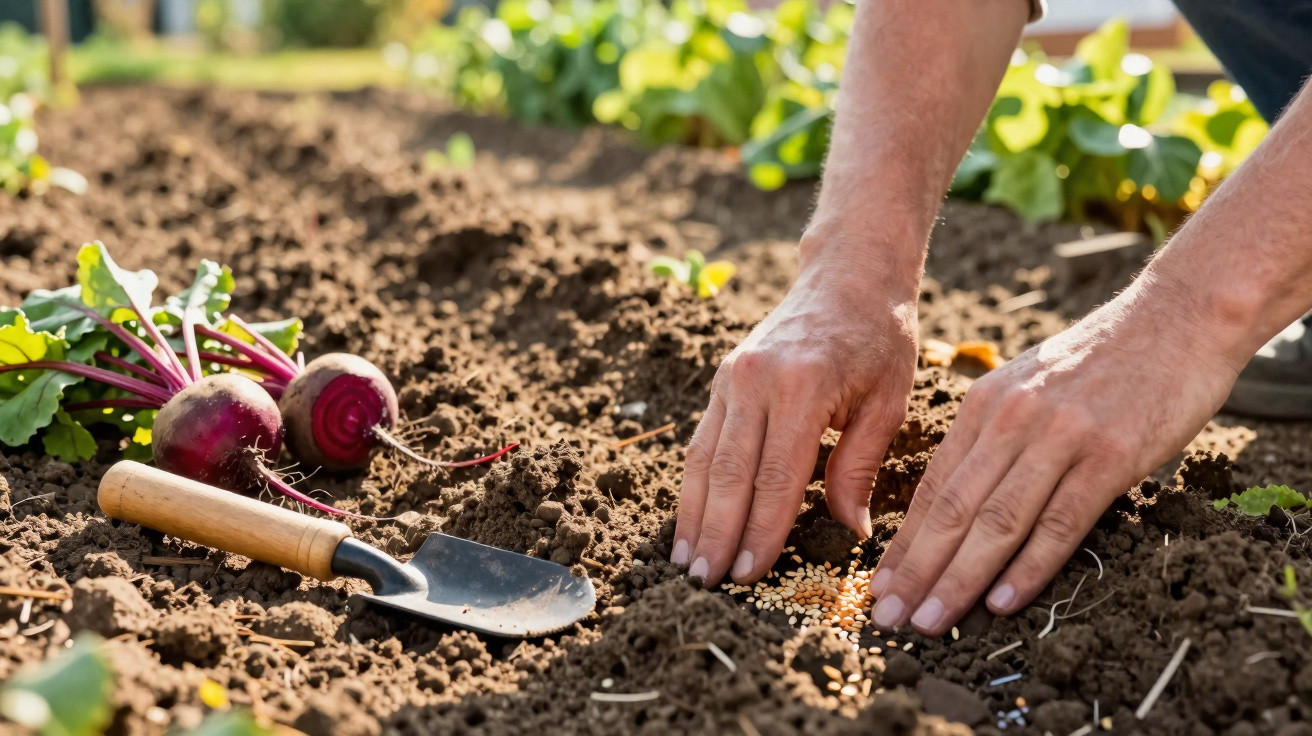
The problem is usually not the variety, the seed or the weather. What matters is a small action when making the seed drill – one that earlier generations knew well but which has now largely been forgotten. Anyone who uses it can deliberately direct root growth outwards and harvest noticeably more even, round beetroot.
Why beetroot often grows long and misshapen
Whether traditional red, yellow or striped, beetroot develops a swollen root from its main root. This so-called taproot initially grows vertically downwards to reach water and nutrients deeper in the soil. When it encounters loose soil there, it keeps pushing down rather than spreading sideways.
The result is a root that is more elongated and spindle-shaped, sometimes with “necks” or branches. Stones, large clods and periods of severe drought can further disrupt growth, producing crooked beetroot.
“Anyone who prevents the root from growing deep effectively forces it to grow outwards – and that is exactly where the round beetroot forms.”
This is where the forgotten gardening trick comes in: create a kind of ‘floor’ at the base of the seed drill that stops the taproot.
The key beetroot trick: firm the bottom of the seed drill
Rather than simply drawing a drill and dropping in the seed, there is one extra step to take. It requires fewer than five seconds for each row, yet can transform the entire harvest.
How the firm-base trick works, step by step
- Make a seed drill around 2 to 3 centimetres deep.
- Use the back of a rake, a wooden stick or, if necessary, the heel of your shoe.
- Press down firmly on the base of the drill until it forms a noticeably firm ‘floor’.
- Only then place the seed in the drill and cover it loosely with soil.
When the taproot later reaches this compacted layer, it cannot continue downwards. The plant’s growth is then directed sideways, and the beetroot starts developing into a round shape.
“The pressed-down base of the drill acts like an invisible brake: it cannot go deeper, so the beetroot grows wider.”
A fine seedbed is half the battle
Before the firm-base trick can make a difference, the rest needs to be right. Beetroot requires a well-prepared seedbed. The top few centimetres of soil should be loose, finely crumbed and free from large stones. Loosen it thoroughly once, then work only the surface afterwards – that is sufficient.
Gardeners should keep a few points in mind:
- Fine texture: The soil should feel more like coarse semolina than lumps of earth.
- Mature compost: A thin layer of well-rotted compost supports nutrients and soil life.
- Do not sow in wet conditions: Soil should have dried out and warmed slightly, otherwise seeds can rot quickly.
If the soil is heavy, it is best to loosen it in autumn, add coarse compost, and then cultivate it only shallowly in spring.
Sowing beetroot correctly: spacing and seed density matter
Beetroot seeds are grouped together in small clusters. Several plants usually emerge from each cluster. Sowing too densely ultimately results in twisted roots pressed into one another.
The ideal spacing
- Place one seed cluster roughly every 5 centimetres in the firmed seed drill.
- Cover with loose, fine soil to a depth of no more than 2 to 3 centimetres.
- Smooth the surface lightly, but do not press it down – seedlings need to emerge easily.
In suitable conditions, the first leaves appear after around ten days. If temperatures remain cool, it may take longer without anything necessarily being wrong.
Thin young plants: only the strongest should remain
Once each young plant has developed three to four true leaves, the next important task is thinning. This job is often left undone in many beds – and the consequence becomes clear at harvest time.
There should ultimately be around 20 centimetres between plants. Proceed as follows:
- Choose the strongest plant at each growing point.
- Carefully pull out weaker neighbouring plants with your fingers, or cut them off just above soil level.
- Gently loosen the soil around the remaining plant without disturbing its root.
“One strong plant with room to grow produces better beetroot than three plants getting in each other’s way.”
Watering, mulch and care: keeping beetroot in shape
Beetroot is sensitive to drastic changes between dry and wet conditions. Such fluctuations can quickly cause roots to split or growth to stall.
For reliable watering:
- Water regularly in small amounts rather than giving large volumes only occasionally.
- Water at the base of the plant, not over the leaves.
- Mulch during hot weather, for example with dried grass clippings or shredded leaves.
A light mulch also stops soil from becoming heavily compacted after rain and turning hard again. Fungal diseases occur less often when foliage stays dry and air can circulate freely.
When beetroot is ready to harvest – and how to recognise success
Depending on the variety and sowing date, beetroot takes around two to four months to reach harvest stage. One clear sign is that the rounded shoulder of the root begins to push slightly above the soil.
| Criterion | Indication that it is time to harvest |
|---|---|
| Size | Roughly tennis-ball to fist-sized roots are tender and juicy |
| Surface | Smooth and free from deep cracks, with skin that appears intact |
| Foliage | Strong but no longer growing vigorously, and easy to bend slightly |
Waiting too long risks woody texture and reduced flavour. Smaller roots are better suited to salads, while slightly larger ones can be stored, provided they do not appear coarse or fibrous.
Why the firm-base trick can also help other vegetables
A pressed-down drill base does not work only for beetroot. A similar principle can apply to other root vegetables. Carrots and parsnips are more sensitive to compaction, however, and may then branch. A gentle touch is needed here: lightly firmed rather than heavily compressed.
For keen gardeners, it is worth running short trials: sow one row conventionally and another with a firmed base. The difference is often visible when the first roots are lifted, providing useful experience for future seasons.
Practical tips for everyday work in the bed
Anyone short of time can easily make this trick part of their usual routine. When drawing the drill, simply press the rake down firmly once, then sow and leave it at that. In heavy soil, a flat board is suitable for creating even compaction along the base.
Those who grow beetroot regularly can move the crop to a different location each year. This reduces pressure on the soil, lowers the risk of disease and promotes better growth. Onions, lettuce and beans make good neighbours in mixed planting, while spinach and chard, as close relatives, are better not planted in direct succession.
“This old farming trick costs nothing, requires no extra tool and takes almost no time – but it shows in every harvest.”
For anyone dissatisfied with crooked or spindle-shaped roots, it is worth testing next season. A fine seedbed, correctly spaced sowing, consistent care and this small firm-base trick are enough to lift much more attractive and productive beetroot from the bed.


Comments
No comments yet. Be the first to comment!
Leave a Comment