
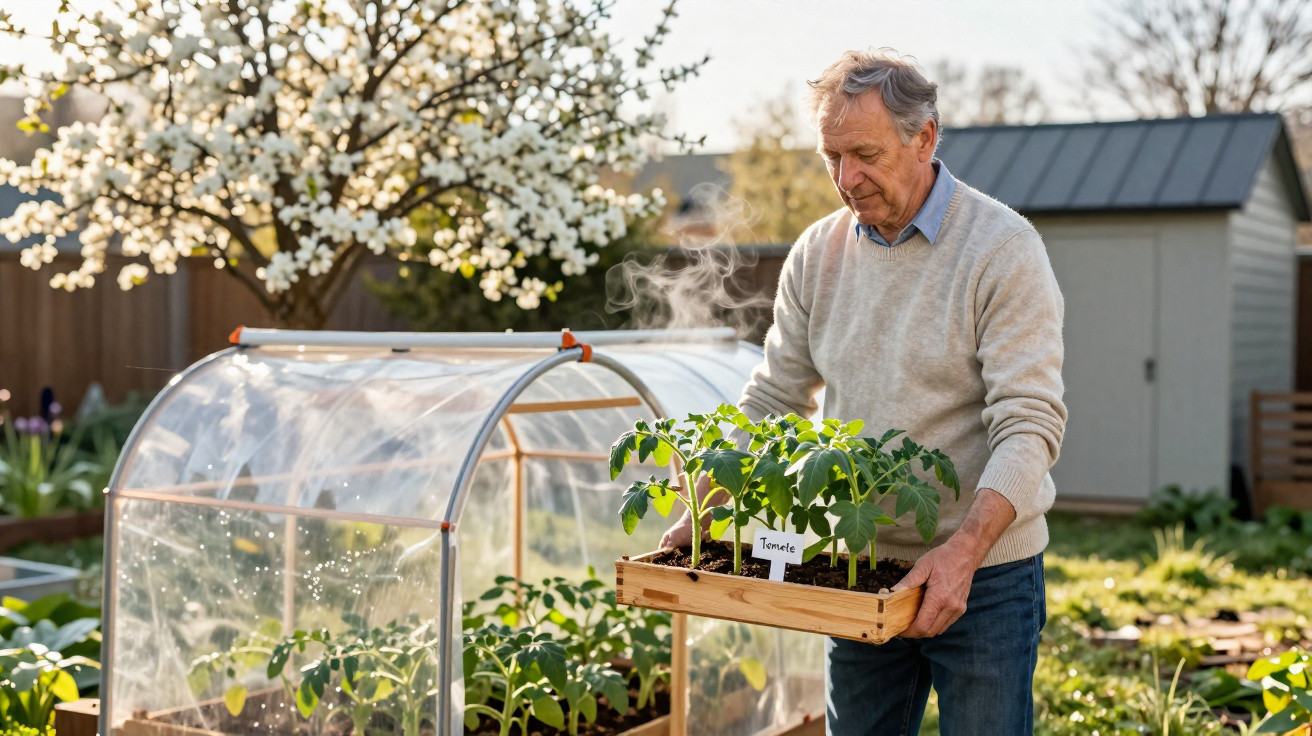
Professionals swear by a straightforward trick.
The first warm days draw people to garden centres, filling trolleys with young tomato plants and fresh compost. It is tempting to get started at once. However, anyone who impatiently plants tomatoes straight outdoors at this point often ends up with weak plants and a poor crop. Commercial growers therefore follow a clear routine before a single tomato goes into the soil – an inconspicuous step that can determine whether summer brings success or frustration.
Why tomatoes suffer when planted outdoors too early
Temperature shock: from indoor warmth to a cold spring night
Most tomato plants begin life in sheltered conditions: on a windowsill, in a conservatory or in a warm greenhouse. Temperatures there tend to remain fairly steady at around 18 to 22 degrees. There is little wind, no cold nights and no sudden drop in temperature.
When these plants are moved directly into a garden bed, they encounter an entirely different environment: sunshine during the day, temperatures often as low as 5 to 6 degrees at night, and damp air. This sudden change puts young plants under stress. Growth stops, leaves may appear wilted and the plant effectively "freezes from within".
Tomatoes planted outdoors without preparation often respond with halted growth, leaf problems and development that remains permanently weakened.
The impact is not limited to the first few days; it can continue throughout the season. Plants remain smaller, produce fewer flowers and yield less fruit.
Weak stems: no experience of wind – then a sudden gust arrives
There are no stormy gusts in a living room. A plant has no reason to reinforce its stem, so it often grows tall, thin and soft. When the first strong wind blows across the bed, the tomato may snap or be flattened against the ground.
This is especially risky for young plants that have grown long and leggy. They contain plenty of water but have little structural strength. Once bent over, they rarely straighten properly again. This is precisely where professionals differ from beginners.
The professional tomato plant trick: hardening off with purpose
Hardening off: daily trips outside instead of a shock move
Gardeners call the process "hardening off": plants are gradually accustomed to wind, sunshine and cooler air. It does not require complicated equipment, just a simple daily routine.
The principle is straightforward: tomatoes initially spend only a short time outside before returning to warmth. This allows their metabolism to adapt gradually. The plant produces more lignin – a fibrous substance that thickens and strengthens the stem.
- Days 1–2: 1–2 hours outdoors, sheltered from wind and away from intense midday sun
- Days 3–4: 3–4 hours outside, allowing gentle air movement
- Days 5–7: Half a day outdoors, partly sunny, then back under cover overnight
- Days 8–10: Outdoors for the whole day; bring them in only if frost is forecast
Usually, just three to four days are enough for stems to become visibly stronger and firmer. After one to two weeks, plants are noticeably more stable and cope far better with their move into the bed.
Preventing light shock: introduce leaves to full sun gradually
Tomatoes raised behind glass know only filtered light. Outdoors, sunlight falls directly on their leaves. If young plants are put into the midday sun without an adjustment period, the foliage can look genuinely "burnt": yellow patches that later turn brown, dry edges and limp leaves.
To prevent this, professionals begin in partial shade or behind lightweight horticultural fleece. Only after a few days are plants moved into increasingly sunny spots. This gives leaf tissue time to adapt to the stronger light.
Anyone who treats tomatoes like sun worshippers and places them straight into the midday heat risks sun scorch on the leaves and a significant setback in growth.
An unseen garden risk: late frost on fruit trees
Monitor fruit blossom – ideally early in the morning
While tomatoes are being prepared for their move, a second quiet drama may be unfolding in the fruit garden. Cherry and plum trees often flower when nights can still become critically cold. Flowers that freeze mean no fruit.
Anyone serious about their garden should inspect blossoms early in the morning. Drooping, glassy-looking or discoloured flowers can indicate frost damage. A particularly revealing sign is a dark or blackened stigma in the centre of the flower.
Spot late frost early and take targeted action
If weather forecasts predict cold nights, it is worth checking fruit trees both the day before and the following morning. Those who notice early damage should act when the next cold spell arrives:
- Cover small trees with purpose-made covers or plastic sheeting
- Wrap sensitive shrubs in horticultural fleece
- Move container plants against a sheltered house wall
This can at least save the most vulnerable specimens. The effort often lasts for only a few nights each year, but it determines whether summer brings fruit to harvest or leaves alone to look at.
Spring routine: how gardeners manage the transition
A simple emergency greenhouse for cool nights
Carrying every box of young plants back indoors all the time soon becomes tiresome. Many home gardeners therefore make a small temporary shelter: a basic timber or metal frame covered with plastic sheeting or topped with an old window. It stays open during the day and is closed at night.
This keeps tomatoes close to where they will eventually grow while still providing a small bubble of warmth on critical nights. A few bricks, old pallets and sturdy plastic sheeting are often enough to improvise an effective cold frame.
A consistent routine: out by day, in when frost threatens
Consistency is crucial. Plants should go outdoors whenever possible, but they must not spend even one frosty night unprotected. Many gardeners follow this schedule:
- Morning: take plants out of their shelter and place them somewhere bright and protected
- Afternoon: check them and move them closer to a wall if winds are strong
- Evening: depending on the forecast, return them to the house, garage or beneath a protective cover
This "exercise routine" lasts around ten to fifteen days, until the traditional mid-May frost period has passed and the risk of frost has fallen significantly. Only then do experienced gardeners plant their tomatoes permanently in a bed or large containers.
How to recognise tomato plants that are genuinely ready for planting
Signs that the timing is right
Rather than relying blindly on a calendar date, it is worth considering several factors:
| Criterion | Ideal condition |
|---|---|
| Plant appearance | Strong, relatively compact young plants with thicker stems |
| Weather conditions | Several consecutive frost-free nights and a stable forecast |
| Soil temperature | Soil feels clearly cool during the day, but no longer cold |
| Light acclimatisation | Plants have already spent several hours each day in full daylight |
When these signs coincide, there is little standing in the way of permanent planting. Tomatoes get started without shock, establish roots more quickly and begin growing immediately.
How professionals actually plant tomatoes in the ground
When planting, many gardeners use a few further useful techniques:
- Plant tomatoes slightly deeper so they can develop additional roots along the stem
- Create a watering rim so that water does not run away
- Shield plants from wind and strong sunshine during the first days after planting
Anyone who has hardened off their plants carefully will notice a clear difference: tomatoes scarcely droop after planting out, recover their upright position quickly and soon produce new leaves.
More yield, less frustration: why the effort is worthwhile
The extra work during these few spring weeks pays off several times over later on. Hardened-off plants generally produce more flower trusses, remain steadier in summer thunderstorms and cope better with heatwaves. In a home garden, the combined effect of such small measures makes the difference between "a few tomatoes" and bowls full of them.
Anyone who has seen how resilient tomatoes become after a proper hardening-off period often changes their routine for good. Instead of following the rule of "into the bed as early as possible", the approach becomes: step by step, according to the weather, while keeping an eye on the plant and the soil. One small trick – and summer harvest baskets can suddenly look very different.


Comments
No comments yet. Be the first to comment!
Leave a Comment