
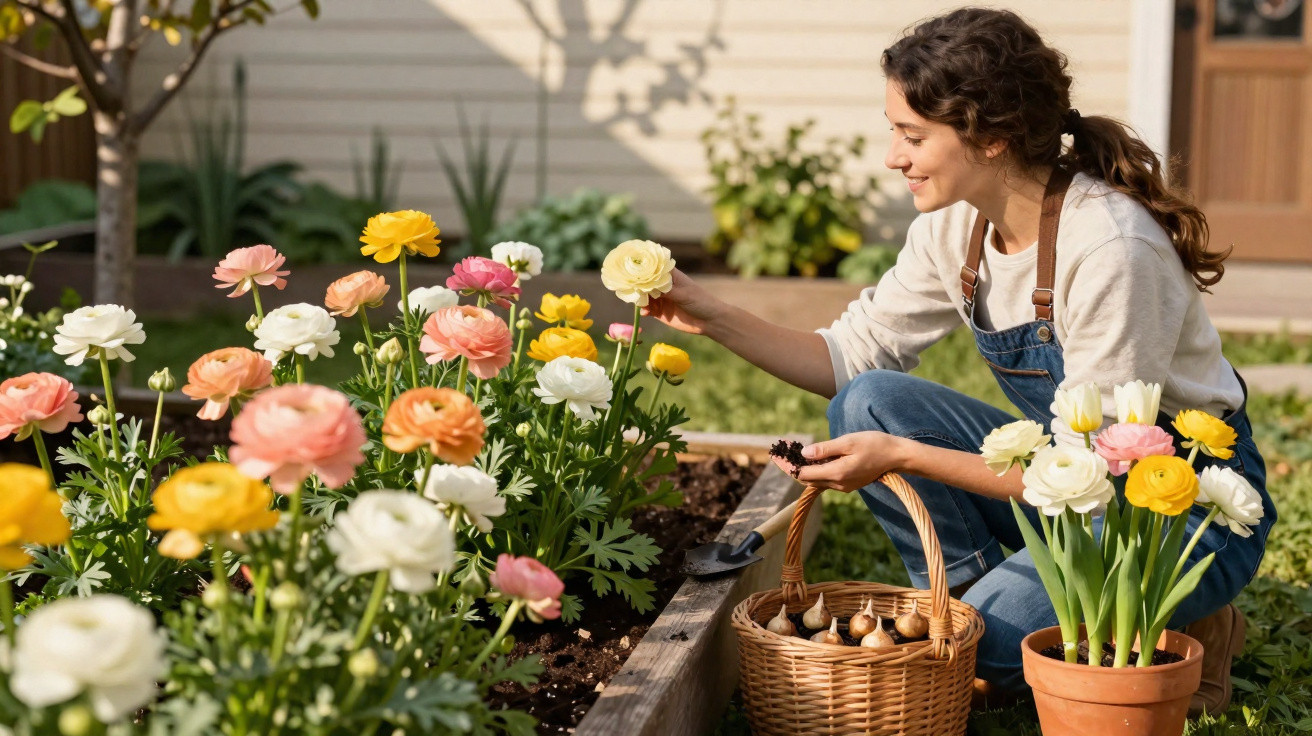
In spring, tulips still dominate the view across terraced-house gardens and allotment sites in Germany. Behind the scenes, however, preferences are shifting: more and more gardening enthusiasts are choosing another bulbous plant that flowers for longer, looks more lavish and can be used far more flexibly – the Asian ranunculus.
Why many gardeners have had enough of tulips
There is no denying that tulips look spectacular. Their display of colour, though, often lasts barely one or two weeks. A heavy shower or brief spell of warm weather can be enough to flatten the petals to the ground. What remains are bare stems and the question of whether the effort was worthwhile.
Many tulip varieties also return more weakly the following year, if they reappear at all. Anyone wanting a colourful show every spring has to keep buying replacements. That becomes expensive and, over time, frustrating.
The Asian ranunculus produces densely packed, peony-like flower heads – and keeps going far longer in late spring than most tulips.
This is precisely where ranunculus excels: it starts flowering later, but continues for weeks, often from late May into June. It fills the gap after tulips have finished but before summer bedding has properly begun.
Ranunculus asiaticus: the traditional garden flower with wow factor
Botanically, this plant is called Ranunculus asiaticus and is generally sold as Asian ranunculus or garden ranunculus. Its flowers resemble small, flawlessly rounded pom-poms. Many gardeners liken them to miniature peonies, only carried on much shorter stems.
The choice of colours is enormous, ranging from pure white and delicate pastels to bold pink, orange and deep red. Planted in groups, they create an elegant, almost florists’-shop effect.
- Form: densely double, spherical blooms
- Height: usually 25 to 40 centimetres
- Colours: white, cream, pink, yellow, orange, red and burgundy
- Uses: borders, containers, balconies and cut flowers
Anyone aiming for a more wildlife-friendly garden can easily include ranunculus in an environmentally minded planting scheme. It grows well with compost as its main nutrient source and does not need heavy applications of mineral fertiliser.
How to plant ranunculus properly: the ideal timing
The knobbly planting pieces stand out immediately in garden centres. Known as claws, they look like tiny dried octopuses. These are what later produce the rounded blooms. Getting the seasonal timing right is crucial.
In most parts of German-speaking Europe, ranunculus is planted between early March and mid-April. By then, the soil has warmed slightly while still remaining cool enough for the plants to establish roots well.
Step-by-step planting guide
- Soak the claws in lukewarm water for 12 hours.
- Prepare planting holes around 5 centimetres deep.
- Set the claws into the holes with their “fingers” pointing downwards.
- Cover with soil and press it down gently.
- Leave roughly 15 centimetres between plants.
In very mild areas, some gardeners plant as early as autumn. This allows the ranunculus to start flowering particularly early. It does, however, require a site with mild winters and, above all, well-drained soil so that the tubers do not rot in wet conditions.
The right position: sunny, but not scorching
Ranunculus likes bright conditions. A position in full sun or light partial shade generally works best. Intense midday heat on a south-facing balcony with heat-soaked paving, by contrast, can put the plants under stress.
The soil needs to be loose, rich in humus and free-draining. The tubers cope poorly with waterlogging, especially in pots and balcony planters. When planting in containers, add a layer of expanded clay, gravel or coarse sand at the base so excess water can drain away freely.
Ranunculus loves an airy, free-draining growing medium – heavy, wet soil is its greatest enemy.
Conveniently, areas used for geraniums, petunias or dahlias in summer are also ideal for ranunculus in spring in many gardens. Use the same soil, loosen it thoroughly once more and mix in a little mature compost.
Spring care: little effort, plenty of impact
During active growth, ranunculus needs consistent but not excessive moisture. Once the top layer of soil has dried out, it is time to water – a moderate amount is sufficient.
Mulching beds or containers with a thin layer of organic material helps to save water. Dried grass clippings, shredded bark or fine woodchip slow evaporation while also protecting soil life.
Because its flowering season falls in late spring, ranunculus is less likely to encounter the intense heat of summer. This generally makes it more resilient to stress than many early spring flowers that can suddenly be caught by a heat spike.
Ideal for a vase: ranunculus as cut flowers
One of its greatest strengths is that ranunculus makes an excellent cut flower. Cut the stems as soon as the buds begin to open slightly, and they will produce long-lasting, densely flowered arrangements that often remain attractive for more than a week.
Cutting also encourages the plant to form further buds. Those who harvest regularly for the vase are usually rewarded with a longer, more abundant flowering period in the border.
For appealing arrangements, ranunculus is often combined with:
- spring flowers such as anemones or daffodils, without allowing their sap to mix in the same container
- delicate grasses from the garden
- eucalyptus or bay branches from containers
- simple spring branches from ornamental shrubs
What happens after flowering
As flowering gradually fades, the foliage slowly turns yellow. It may no longer look especially attractive, but it is important for the plant: it stores reserve nutrients in the tubers.
In mild areas, many gardeners simply leave the claws in the ground. Provided drainage is good, they often sprout again the following year. In colder regions, it is worth lifting the tubers once the foliage has died back, drying them, and storing them in an airy, frost-free place.
Ranunculus, tulips and more: how to combine them effectively
There is no need to banish tulips completely. The interesting approach is to combine them with ranunculus, extending the flowering season. A typical planting sequence for a spring border might look like this:
| Phase | Plants | Visual effect |
|---|---|---|
| March to April | Crocuses, early daffodils, tulips | colourful accents signalling the start of spring |
| Late April to May | late tulips, anemones | an elegant transition of forms |
| May to June | Asian ranunculus | dense pom-pom blooms, almost like miniature peonies |
Balcony gardeners can easily recreate this succession in larger window boxes or containers. The important points are sufficiently large pots and good-quality compost that retains its structure and nutrients for several months.
Risks, practical tips and considerations
There are still a few potential pitfalls. In very wet springs, rot can develop when the growing medium is too dense. In that case, a particularly high proportion of sand or fine gravel is worthwhile. Voles may also go for the tubers, much as they do with tulips; in gardens where this is a risk, wire planting baskets can help.
Families with young children or pets should note that, like many ornamental plants, ranunculus is mildly toxic. Plant parts should not be eaten, and it is best to wash hands after gardening.
Encouragingly, insects benefit particularly from single-flowered varieties, while double ranunculus still adds structure to a border where other perennials and early-flowering wild plants can be incorporated successfully. The result is a lively combination that not only looks stylish but also makes ecological sense.
Anyone redesigning their spring borders therefore does not have to stop with the classic tulip. Asian ranunculus can extend spring’s visual appeal by weeks, with flowers that do not lose their moment in the spotlight at the first thunderstorm.



Comments
No comments yet. Be the first to comment!
Leave a Comment