
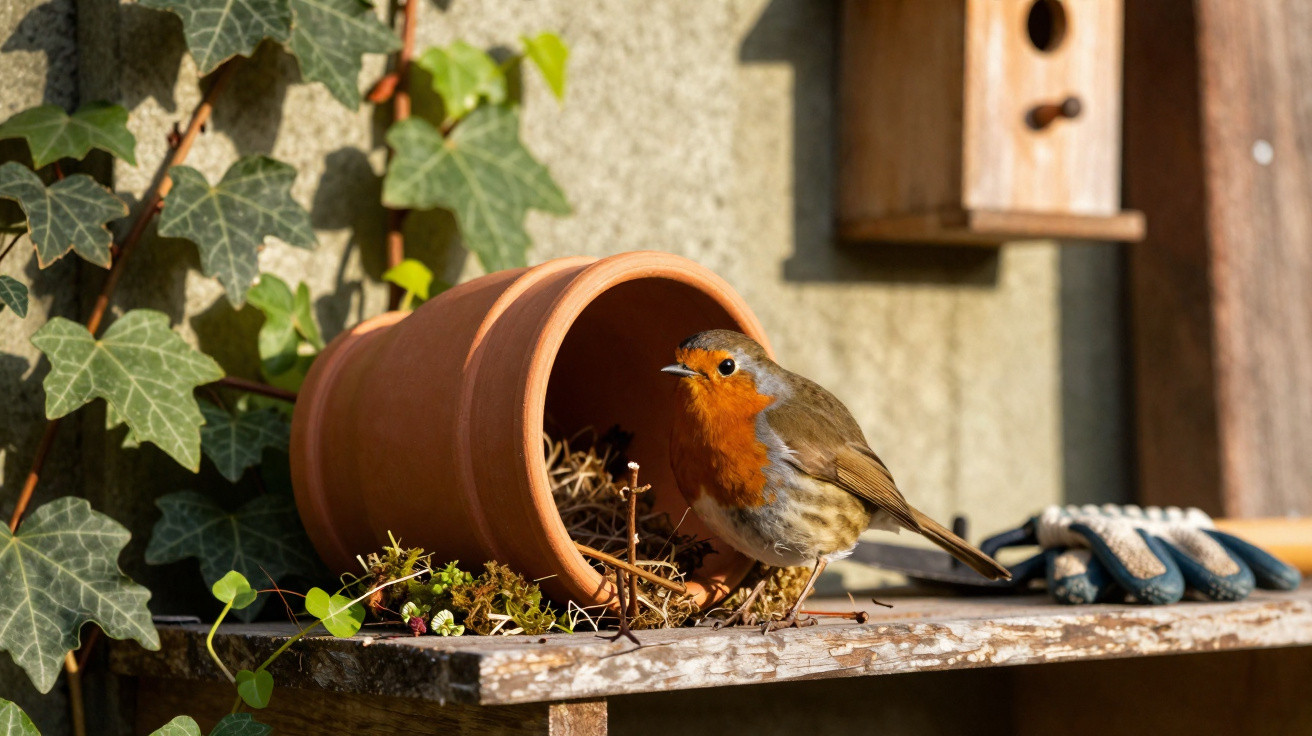
If you have a robin in your garden, you will recognise the situation: it boldly hops between the beds, perches less than two metres away on your spade – yet never moves into the carefully hung wooden nest box. While tits and sparrows readily use conventional boxes, robins appear to have other ideas. What matters is not the cost of the nesting place, but whether it suits the species. This is precisely where an unassuming clay pot comes in.
Robins behave differently from tits
Many DIY shop packages prominently say “bird nest box”, but their design is generally intended for cavity-nesting birds such as blue tits or great tits: a small hole, an enclosed box and a position high in a tree. For a robin, this is entirely the wrong approach.
According to bird conservation organisations, the robin is a semi-cavity-nesting species. It avoids cramped, elevated cavities and instead looks for:
- broad, well-protected niches
- hiding places close to the ground
- dense hedges, ivy-covered walls and shrub borders
- discreet locations that provide shelter from view and rain
From a robin’s perspective, a standard box three metres up on a smooth house wall is simply of no value. These birds prefer the lower parts of the garden, at the transition between lawn, herbaceous planting and hedges. This is where they hunt insects – and where they search for nesting places too.
“Anyone who genuinely wants to help robins must view the garden from their perspective: low down, dense, hidden and as inconspicuous as possible.”
Why a terracotta pot offers ideal conditions
A pot made from terracotta or another type of unglazed clay meets a surprising number of a robin’s requirements for a breeding site. Unlike plastic or painted wood, clay acts as a small climate regulator.
Clay manages moisture and temperature
Terracotta is porous. In the most literal sense, the pot “breathes”:
- It absorbs moisture from the air and releases it gradually.
- Less condensation forms inside – something vital for young birds.
- The clay retains a little warmth during the day before gently releasing it at night.
Nest boxes made from thin timber or plastic can quickly become wet and clammy inside. Chicks are particularly sensitive to damp draughts in cool springs. A sturdy clay pot, by contrast, functions like a small, well-insulated refuge.
A wide opening rather than a tiny hole
Robins do not want to squeeze through a narrow tunnel. They favour semi-open cavities with broad access. For the pot, this means:
- ideally, a diameter of 15 to 20 centimetres
- do not reduce the opening or fit it with entrance-hole plates
- a clear view forwards, with sheltered edges all around
A standard-sized unglazed flowerpot meets these requirements almost automatically when it is positioned correctly and given a little basic preparation.
Turning a flowerpot into a robin nesting site
Only a few simple steps are needed to turn an old flowerpot into a fully suitable nesting place. Most gardens already contain the necessary materials.
Choosing the right pot
To get started, you need:
- an unglazed clay pot, with no paint or glaze
- a diameter of between 15 and 20 centimetres
- a pot rinsed clean without soap or harsh cleaning products
- no labels, plastic film or conspicuous decoration
Glazed or brightly painted pots may look decorative, but they tend to deter robins. They reflect light and are more easily noticed by predators.
Positioning and filling the pot
The pot should not stand upright; instead, lay it on its side. The following points are important:
- Tilt the pot slightly downwards so rainwater can drain away.
- Secure it with stones, pieces of wood or wire so that it cannot wobble.
- Add a thin layer of dry leaves inside.
- Place a little moss on top as a base for the eventual nest.
Robins like to build their own nests, but a cavity that has been “started” can seem welcoming. Too much material is more likely to put them off, as the bird still wants to shape the nest itself.
Location: where a terracotta pot will actually be used
Many attempts fail because the pot itself is perfect but has been placed in the wrong spot. Robins select their breeding sites extremely carefully.
Height and direction
An installation height of around 1 to 1.50 metres is ideal. This puts the pot just above a typical cat’s reach, while keeping it clearly within the robin’s preferred zone. When choosing the direction:
- turn the opening towards the south-east where possible
- this allows morning sun and drying air to enter
- while also providing protection from prevailing westerly winds
A fully south-facing position in strong midday sun can overheat the interior, whereas a north- or west-facing location is often too cool and exposed to wind.
A hiding place, not a decorative feature
Robins favour discretion. Suitable locations include:
- deep within a dense hedge
- behind or among ivy on a bank
- beneath overhanging shrubs at the garden edge
- in a wild corner with taller grass and dead wood
Less suitable locations are:
- open lawns without cover
- paths that are used frequently
- areas with constant activity from dogs or children
- conspicuously painted or decorated spots
“The less noticeable the terracotta pot is to people, the greater the chance that a robin will judge it to be safe.”
The right timing: do not start too late
Anyone who hurriedly puts out the pot only in April will often miss the first brood. Robins begin searching for territory early and need time to inspect a new site.
The best period for installation is late February to mid-March. By then, many birds are already active in the garden but are still looking for nesting opportunities. If the pot is ready and left undisturbed at this time, the likelihood of success rises considerably.
Once it has been set up, leave it alone. Frequent inspections, touching or moving it will discourage birds. It is better to watch from a few metres away to see whether a bird tests the entrance or carries nesting material inside.
If it does not work: change the location, not the system
Sometimes the pot remains empty in its first season. This does not mean the method is unsuitable; often, just one detail is wrong.
Useful adjustments include:
- moving the pot into a denser hedge
- adding some dead wood and leaf litter to give the surrounding area more structure
- reducing disruptive light sources or exposure to wind
- limiting cat access with thorny branches or low fences
Major alterations during the breeding season, however, are not advisable. It is better to make adjustments during the quiet period between seasons.
What garden owners should also consider
A terracotta pot alone will not turn a garden into a paradise for robins. Anyone wishing to keep this bird in the garden long term should follow a few basic principles:
- Pesticide-free areas: Insects are their main food source, and sprays destroy that supply.
- Structural variety: A combination of lawn, herbaceous plants, hedges and dead wood provides cover and food.
- Quiet areas: Leave at least one corner of the garden that is rarely entered.
- Water source: Provide a shallow bowl or mini pond, cleaned regularly.
Many robins use the same garden for years when they find suitable breeding opportunities and safe places to retreat there. The terracotta pot can become a key feature, especially in gardens where shrubs and trees are still young.
Practical examples and additional ideas
If no suitable terracotta pot is available, similar containers can be used, as long as they are unobtrusive, weather-resistant and designed with an open entrance. Suitable options include:
- old metal watering cans laid on their sides
- upturned zinc tubs with a side entrance
- partly buried wooden boxes with a wide opening
The essential combination remains protection, dryness, camouflage and a position close to the ground. Many gardeners report that robins even breed in old buckets laid on their sides or among stacked planters – provided the location is right.
For those with children, creating this kind of robin hideaway can make an excellent small nature project. Keeping a fixed viewing distance, never reaching inside and moving quietly should be part of it from the outset. In this way, even the youngest children learn that helping wildlife is primarily about consideration and calm – the terracotta pot is merely the tool for doing so.

Comments
No comments yet. Be the first to comment!
Leave a Comment