
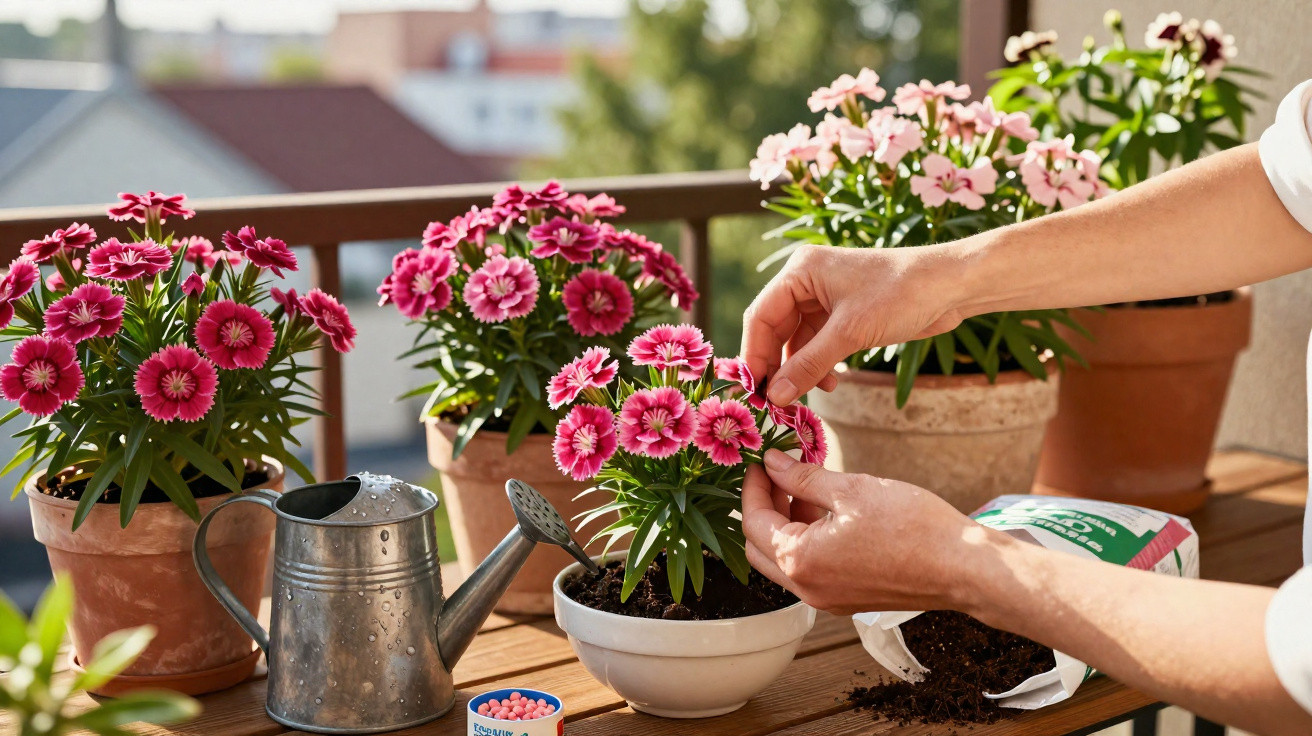
It barely attracts attention until it flowers – then it becomes the centre of attention, turning even the smallest balcony into a display of colour.
Many amateur gardeners want a plant that flowers for a long time, has a pleasant scent, is easy to care for and performs equally well on a balcony or in a garden. This is exactly where the compact, tough perennial Dianthus ‘Bumbleberry Pie’, a continuously flowering carnation type long regarded by professionals as an insider favourite, excels. Its appeal lies in a remarkably broad range of strengths.
A perennial that enhances every outdoor space
Compact habit, striking impact
Dianthus ‘Bumbleberry Pie’ forms a dense cushion roughly 25–30 cm tall. Its neat, compact growth makes it particularly suitable for bed edges, rock gardens, low borders and long balcony planters.
- Height: around 25–30 cm
- Spread: similar, depending on planting distance
- Habit: cushion-forming, dense, tidy
- Position: beds, containers, bowls, wall tops
Its grey-green foliage is understated yet elegant, creating a calm backdrop that makes the flowers appear especially vivid. The stems are impressively sturdy, so the blooms do not flop over or lie unattractively in the rain. This crisp, orderly outline brings structure to small patios in particular, without ever looking overcrowded.
Bright blooms with an added fragrance
The flowers are undoubtedly the highlight of this perennial. They are large, gently fringed and a rich pink, deepening towards a darker, almost burgundy centre. This colour transition has the look of a watercolour painting and appears far more refined in a border or on a balcony than a single flat shade.
The combination of intense colour, lightly fringed petals and a delicate fragrance makes this carnation a genuine mood-lifter.
The scent is pleasant, subtly sweet and characteristically carnation-like. Placed close to seating areas or beside steps, it soon encourages people to pause, look and inhale – precisely the garden atmosphere many people hope to create.
The blooms can also be cut without difficulty. For an easy everyday arrangement, snip a few stems and place them in a narrow vase or glass to create a fragrant miniature bouquet for the kitchen table or windowsill.
Flowers from spring into autumn
One major benefit of this variety is its extended flowering period. The first blooms emerge in spring and, with suitable care, the display continues into late summer – or into autumn in mild areas.
Regularly removing faded flowers noticeably extends the flowering season. Rather than putting its energy into seed production, the plant produces fresh buds. As a result, the cushion remains almost constantly fresh-looking, with no substantial gaps in bloom.
In addition, the flowers attract butterflies and other pollinators. At the same time, deer are considered less likely to be drawn to the plant – a valuable advantage in rural areas where newly planted perennials can otherwise become a buffet.
Positioning and planting Dianthus ‘Bumbleberry Pie’
The best conditions in a border
For Dianthus ‘Bumbleberry Pie’ to reach its full potential, one thing above all is essential: sunshine. At least six hours of direct light daily is ideal. It will survive in partial shade, but will flower much less generously.
In terms of soil, it prefers:
- light to medium soil
- good drainage, with no waterlogging
- preferably a slightly lime-rich soil
- conditions that do not remain wet throughout winter
Standing water, particularly during the colder months, damages the roots and may shorten the perennial’s lifespan. In gardens with heavier soil, incorporate sand or fine grit. A slightly raised bed or a wall top is ideal because excess water drains away more effectively.
Spring, once the soil has warmed slightly, is the best time to plant. This gives the perennial time to establish before the heat of high summer and prolonged dry spells arrive.
Allow 25–30 cm between individual carnations in a border. Over time, this produces a dense but not congested line or planting area that flowers evenly.
Containers, balcony boxes and bowls
This perennial is especially appealing for urban balconies, as it performs just as well in pots as it does in borders. The container should be at least 25 cm in diameter and must have drainage holes. Place a few pieces of broken terracotta or some expanded clay at the bottom to help water drain freely.
A mix of potting compost and sand works well, as does container compost loosened with a little sand or lava grit. This keeps the root area airy.
Compost dries out more quickly in a pot than garden soil. On hot summer days, a quick finger test is worthwhile: if the upper layer feels dry, the carnation needs water. It dislikes sitting in wet soil, but should not be allowed to dry out completely for extended periods either.
If there is very little room on the balcony, pair the carnation with only a few carefully chosen companions – this allows its distinctive flower colour to stand out best.
Easy care with a few basic routines
Watering, feeding and cutting back
Compared with many other continuously flowering plants, Dianthus ‘Bumbleberry Pie’ requires little effort. A handful of simple routines is enough:
- Watering: In borders, water thoroughly only during prolonged dry periods. In pots, water more often, but judiciously.
- Feeding: From May to August, add a small amount of liquid flower feed to the watering can every three to four weeks – particularly for container-grown plants.
- Removing faded blooms: Cutting off spent flower heads encourages new buds and keeps the cushion looking fresh.
- Late-winter care: Trim back dried stems and leaves just above the cushion. This rejuvenates the plant and gives it a tidy start to the new season.
Anyone following these points can expect almost uninterrupted flowering year after year, without having to constantly reach for the secateurs and watering can.
Suitable planting companions and design ideas
In borders, this carnation works particularly well alongside other sun-loving plants, such as lavender, gypsophila, thyme or low ornamental grasses. The blend of grey-green foliage with pink and violet shades feels both contemporary and romantic.
On balconies, silver-leaved foliage plants such as cotton lavender or silver ragwort make good partners. White or pale-violet petunias can also be used to create attractive summer containers: the carnation forms the long-lasting, dependable centrepiece, while annual flowers add extra fullness.
Further facts for keen gardeners
What “perennial carnation” actually means
Many people know carnations only as cut flowers sold in shops. The plant described here belongs to the perennial, winter-hardy garden carnations. Being a perennial means it grows again each year from the same rootstock and lives for several years, rather than dying after one season like many annual summer flowers.
Unlike classic bedding carnations, these perennials are generally tougher, cope with less water and come through normal Central European winters without difficulty, especially in free-draining soil.
Risks, common mistakes and how to avoid them
The most frequent difficulties result from an unsuitable position or incorrect watering. Too much shade and moisture lead to fewer flowers and weak growth. Waterlogging in winter can encourage root rot. A simple rule is to water slightly too little rather than too much, and to water thoroughly on occasion instead of giving constant small amounts.
There is one further consideration: older plants can become bare in the middle after several years. This can be prevented by occasionally taking offsets from the edges and planting them elsewhere. The planting then stays vigorous, and one purchased perennial can gradually become a whole small carpet.
For anyone seeking a dependable, fragrant and visually elegant addition to a border, patio or balcony, Dianthus ‘Bumbleberry Pie’ is an exceptionally good choice. With minimal effort, this small perennial brings colour and life to outdoor areas for months, making even plain corners suddenly feel like a “favourite spot”.
Comments
No comments yet. Be the first to comment!
Leave a Comment