
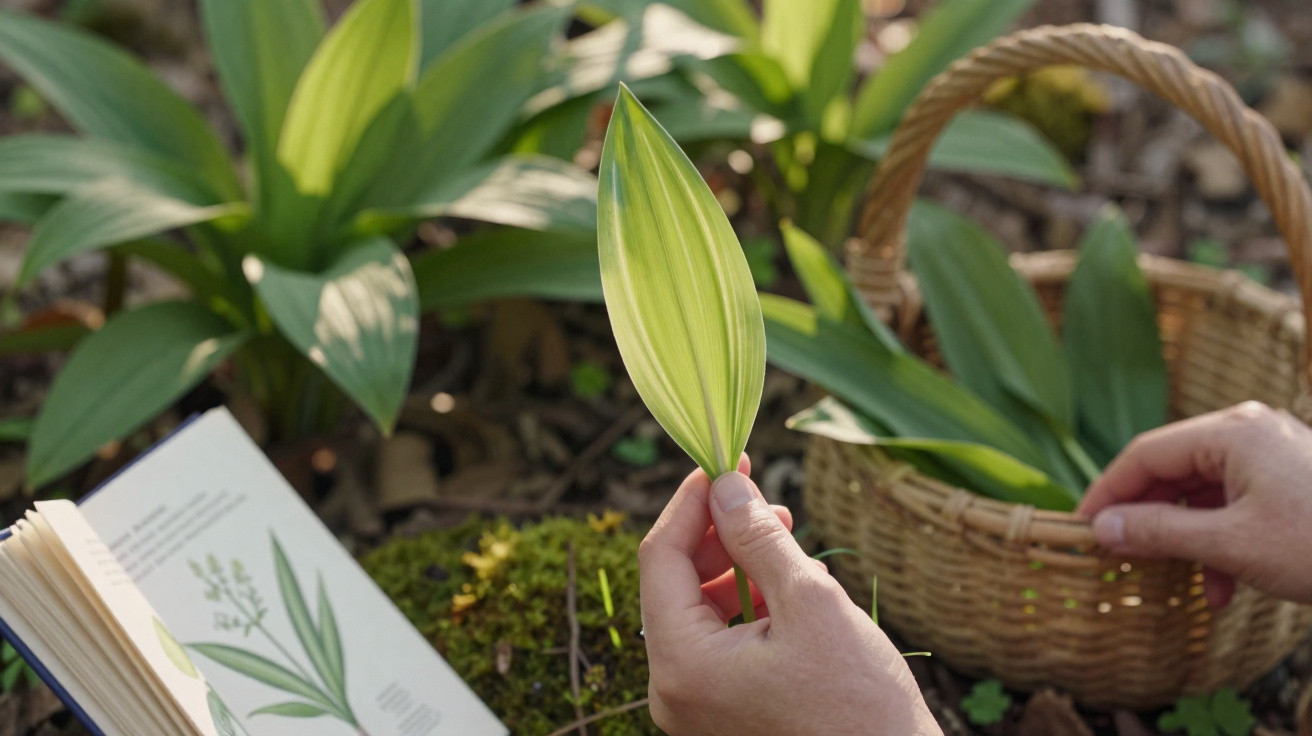
In March, wild garlic glows a rich green across the woodland floor – but then pale, striped leaves suddenly appear.
Is there any reason to worry?
Anyone heading into the woods in spring with a basket and a knife will know the sight: the air smells of garlic, the foliage is thick and lush, yet one leaf stands out from the rest. It may have a white stripe, a yellowish patch, or simply look somehow “different” from the surrounding leaves. Many foragers are alarmed at first: is the wild garlic diseased, perhaps even contaminated with something toxic? Or are these simply normal variations that the plant can show in March?
Unusual wild garlic leaves in March: what causes them?
When picking wild garlic, most people expect a clear, deep green colour. In early spring, however, woodland plants often look less uniform than they do in glossy cookery-book photographs. March in particular can bring more frequent examples of:
- pale, almost white stripes down the centre of a leaf
- leaves that are generally light green or yellowish
- glassy, slightly translucent patches after cold nights
All of these signs can be entirely harmless, although they can arise for very different reasons. Understanding why wild garlic responds in these ways makes foraging more relaxed and also helps you recognise what might genuinely be a concern.
Many pale wild garlic leaves in March are not a warning sign, but reflect genetics, location, light and weather.
White stripes: when wild garlic becomes a botanical rarity
Leaves with a sharply defined white or cream stripe through the middle are especially striking. This is known as variegation. It results from a genetic characteristic: the plant does not produce chlorophyll, the green pigment, in certain parts of the leaf.
This has several effects:
- the pale area can produce less energy from light
- the leaf often grows a little less vigorously
- the pattern looks spectacular, almost as if it had been cultivated
Such leaves are unusual in large colonies. They often reappear in the same spot over several successive years. Finding one in the wild is essentially a small stroke of luck, and for many wild garlic enthusiasts it happens only once in a lifetime.
A white-striped wild garlic leaf is generally not a disease but a quirk of its genes – a kind of special-edition wild herb.
Even so, foragers should not get carried away: variegation does not change the general rules of wild picking. Take only what you can identify with certainty, and never strip an entire colony.
Pale wild garlic leaves caused by low light and poor soil
Not every pale patch is variegation. Much more commonly, the cause is something far less remarkable: unfavourable growing conditions. In dense deciduous woodland, on north-facing slopes or beneath thick scrub, wild garlic does not receive the same amount of light everywhere in March.
The effects of insufficient light and limited nutrients include:
- foliage that appears lighter overall or slightly yellow
- whole groups of plants that differ in colour, rather than just individual leaves
- a green that looks “tired”, without the sharply defined contrast associated with variegation
The plant’s stage of growth also matters. Very young wild garlic leaves are almost always a little lighter in colour. Over the following weeks, the plant develops more chlorophyll and the green becomes stronger. Anyone familiar only with young colonies may easily mistake this natural colour change for a problem, when it is simply part of the plant’s normal spring emergence.
Soil conditions play a role too. In drier, nutrient-poor places, leaves often grow thinner and paler. They may be less photogenic, but that does not automatically make the wild garlic unsuitable for cooking.
Frost damage: when March briefly affects the plant
This is typical of the changing season: mild days followed by cold nights. Wild garlic copes surprisingly well with late frosts, but their effects can sometimes be read in the leaves. After frost, you may notice:
- yellowish or glassy marks
- soft-looking, slightly “watery” areas
- occasionally, curled or drooping leaves
The plant responds flexibly. Many lightly damaged leaves recover their stability, while fresh shoots emerge. Foragers should inspect plants closely: heavily glassy or mushy parts can be discarded if in doubt, while the remainder can still be used provided the plant is clearly identified as wild garlic.
Colour alone is not enough: how to identify wild garlic safely
Despite the interesting colour variations, one simple rule remains: colour is never the deciding feature. Anyone picking wild garlic should always identify it using several characteristics before putting a leaf in their basket.
Typical identification features of wild garlic
| Feature | How to recognise it |
|---|---|
| Growth habit | Each leaf has its own stalk and emerges directly from the ground. There are no pairs of leaves on a shared stem. |
| Feel of the leaf | Soft, thin and slightly delicate. The underside looks matt, while the upper surface is lightly glossy. |
| Smell | Crushing a fresh leaf immediately releases a clear garlic scent. |
| Habitat | Damp, humus-rich deciduous woodland, often forming dense carpets and frequently found along streams or in hollows. |
One point matters when using the smell test: always use a fresh leaf. If you have already rubbed several leaves between your fingers, the garlic smell will remain on your hands and can mislead your nose when you pick the next plant.
Colour is an additional clue – reliable wild garlic identification always depends on its growth habit, leaf structure and smell.
Dangerous lookalikes: lily of the valley and lords-and-ladies
The greatest risk when foraging is not pale or striped wild garlic leaves, but poisonous plants growing in the same habitat. Two species in particular repeatedly cause problems: lily of the valley and lords-and-ladies.
Lily of the valley
- usually has two leaves on one shared stalk
- leaves feel firmer and more leathery than wild garlic
- produces no garlic smell when crushed
Poisoning from lily of the valley can be severe. If there is even the slightest uncertainty, leave the plant where it is. Assuming “it will probably be fine” can be life-threatening in this case.
Lords-and-ladies
- has arrow-shaped leaves, often with irregular markings
- likewise has no garlic smell
- often grows right among wild garlic colonies
Beginners in particular should make a conscious effort to learn lords-and-ladies. Consulting plant guides or joining a session with experienced herb foragers can provide a great deal of reassurance.
Can you eat pale or striped wild garlic?
Looking solely at leaf colour, there is no firm rule that forbids eating wild garlic. The deciding question is always this: has the plant been identified beyond doubt as wild garlic? If so, it can normally be used in the kitchen, even if the leaf is not an ideal postcard green.
Even so, many foragers instinctively choose strongly green leaves. They are usually more aromatic and succulent, and easier to prepare. Leaves with obvious frost damage or pronounced glassy areas are best discarded, not because they are poisonous but because their quality is poorer.
Practical tips for your next wild garlic foraging trip
- Take time to identify the plant before filling your basket.
- Remember any “problem areas” in a colony, such as places where many other species are growing.
- Pick individual leaves rather than pulling up the entire plant with its bulb.
- Use several senses: look, touch and smell rather than relying on your eyes alone.
- If an individual plant looks unusual and makes you uncomfortable, leave it behind when in doubt.
For beginners, it makes sense to start at familiar wild garlic sites, ideally alongside somebody with experience. Those who forage regularly gradually develop a very reliable eye, including for unusual leaves.
Why March produces so many wild garlic variations
March is a month of transition: the soil remains cold, frost returns repeatedly, and trees are only slowly coming into leaf. Wild garlic responds flexibly, starts growing early and adapts to the conditions it encounters. The result is colonies containing side by side:
- deep-green, fully developed leaves
- pale young shoots
- occasional variegated plants
- specimens lightly damaged by frost
Once you start noticing this variety, you see wild garlic woodland differently. Irregular leaves no longer seem threatening; instead, they reveal something about the site, weather conditions and genetic diversity.
For keen foragers, this has another pleasant effect: you naturally walk more slowly, look more closely, smell more often and feel more carefully. “Quickly picking a few leaves” becomes a proper spring walk, with a basket, an alert eye and a healthy degree of respect for the plant that turns the woodland into a garlic-scented stage at the same time every year.


Comments
No comments yet. Be the first to comment!
Leave a Comment