
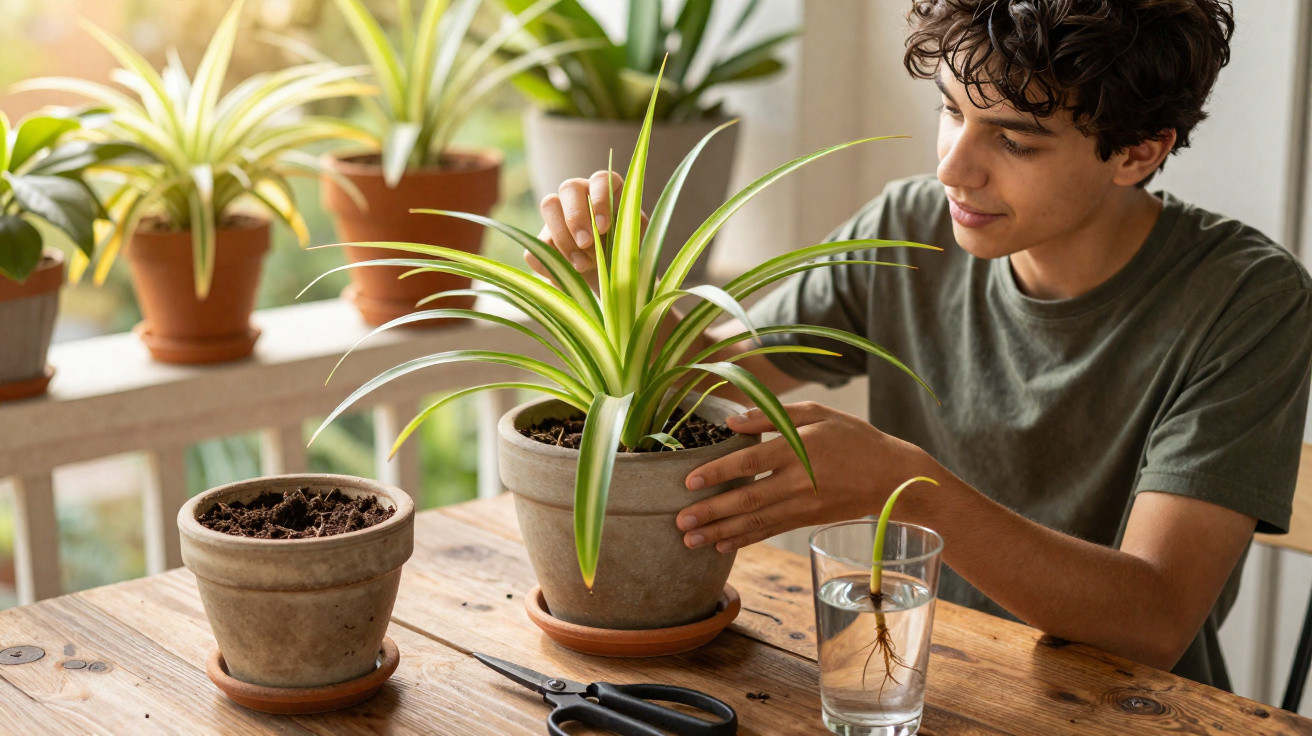
Many spider plant fans are driven to despair by one question: why are no offsets appearing?
The spider plant (Chlorophytum comosum) is regarded as an ideal beginner’s houseplant that supposedly propagates almost by itself. Yet, in reality, many owners look at a magnificent fountain of foliage while waiting in vain for the characteristic baby plants on its long shoots. This is rarely down to a lack of gardening skill; more often, it is caused by a simple issue with light or pot size.
How a spider plant decides when to produce offsets
Spider plants are among the houseplants that can multiply almost explosively in favourable conditions. However, they do not begin doing so straight away. The plant generally needs at least one to two years to build up sufficient energy reserves.
“The plant only produces offsets once it is certain that its reserves are sufficient – and its surroundings provide the right signal.”
From a botanical perspective, the process works like this:
- The plant stores nutrients and water in its fleshy white roots.
- Once it has accumulated enough reserves, it produces long, trailing shoots, known as stolons.
- Small leaf rosettes form on these shoots; these will become the young plants.
- Roots then develop from the rosettes, allowing them to grow into independent plants.
The crucial point is that a spider plant divides its energy. It either puts it into leaves and roots, or into creating offsets. So, if your plant has plenty of foliage but no baby plants, it is usually in a growth and comfort phase rather than a propagation phase.
Light: why too much of a good thing prevents propagation
For spider plants, light controls more than growth: it also triggers flowering and offset production. In their natural environment, the plants experience changing day lengths, and this is the pattern they respond to.
This may surprise many houseplant enthusiasts, but constant illumination from grow lights or exceptionally long bright days can suppress propagation rather than encourage it.
“To produce plenty of baby plants, a spider plant needs bright light but not endless days – roughly fewer than 12 hours of light each day acts as a signal to propagate.”
Practical advice for providing the right light:
- Position: Place it by a bright east- or west-facing window, away from harsh midday sun.
- Direct sun: Morning and evening sunshine is usually fine; filter midday sun with a net curtain or move the plant slightly further back.
- Artificial light: Use grow lights for no more than 10–12 hours a day, rather than providing 16 hours of continuous lighting.
- Winter: Slightly shorter days can provide an additional prompt for propagation mode.
Anyone keeping a spider plant in the living room beside a very bright LED lamp that remains on late into the night may soon wonder why the foliage becomes dense while shoots carrying young plants never appear.
Pot and roots: too much room discourages new spider plant offsets
An oversized pot is one of the most common mistakes. Many amateur gardeners assume that more space must be better. With a spider plant, this has the opposite effect.
“A spider plant is most likely to produce offsets when it feels slightly confined in its pot. If it has far too much room, it builds roots first and postpones propagation.”
How to recognise when it is time to repot
- Roots are pushing out through the drainage holes at the base.
- The root ball is lifting slightly in the pot or causing it to distort.
- Water runs through very quickly during watering because the pot is almost entirely filled with roots.
At that stage, move it into a slightly larger pot, but only go up one size rather than choosing an oversized container. Repeated repotting prolongs the period when the plant simply grows instead of moving into its propagation phase.
Feeding and watering: slight stress produces more baby plants
Spider plants are hardy and cope well with modest nutrient levels. If they are continuously fed with fertiliser and kept permanently wet, they live in abundance and have little reason to reproduce vigorously.
“A minimal shortage of nutrients and water – in other words, gentle stress – directs energy into producing shoots and young plants instead of endless foliage.”
Finding the right balance
- Fertilising: During spring and summer, feed roughly once a month with a liquid fertiliser for foliage plants, using a slightly diluted dose.
- Autumn/winter: Fertilise only very sparingly, if at all, or stop altogether.
- Watering: Let the compost dry out slightly between waterings, and avoid permanently waterlogged conditions.
- Water quality: Use water that is as low in limescale as possible; standing tap water or rainwater suits the plant well.
If the plant remains soaking wet all the time, it focuses on survival rather than propagation. However, soil that stays too dry for extended periods will also harm it. A pattern of being slightly thirsty, then properly refreshed, is the most effective way to encourage baby plant production.
Ideal conditions for plenty of healthy young plants
Temperature and humidity also matter. Spider plants are comfortable in normally heated living spaces.
- Temperature: 18–22°C is ideal. Brief spells below this are unlikely to cause harm, but constant cold will.
- Humidity: Average indoor humidity is sufficient. The plant tolerates extremely dry central-heating air, although its leaf tips may turn brown.
- Draughts: Growth is less steady if the plant sits directly beside a permanently tilted window or in a draughty spot.
When these conditions are right, little stands in the way of a whole cascade of shoots carrying young plants. Sometimes, simply reducing the lighting period for a few weeks and cutting back on fertiliser is enough to persuade the plant to expand its “family”.
How to cut and root offsets correctly
As soon as fine roots are visible on the small leaf rosettes, they can easily be grown into new plants. The best time is during the warmer months, when days are becoming longer again and temperatures are stable.
“Young plants with clearly visible roots have a much better chance of getting established and grow away more quickly.”
Step by step: growing new spider plants from baby plants
- Prepare a sharp, clean knife or a pair of garden scissors.
- Hold the shoot with the offset and cut it off 1–2 centimetres below the leaf rosette.
- Place the baby plant either in water or directly into compost.
- If using the water method, wait until the roots are about 3 centimetres long before potting it up.
- When planting in compost, keep it lightly moist rather than saturated, and choose a bright position that does not receive full sun.
For the first few weeks, the young plants should not need any fertiliser. After four to six weeks, once they are well rooted, a very weak feed is entirely sufficient.
Glass of water or compost: which method works best?
| Method | Advantages | Disadvantages |
|---|---|---|
| Rooting in water | Roots are visible, progress is easy to monitor, ideal for beginners | Water needs changing regularly, and moving to compost may briefly slow the plant down |
| Directly into compost | Immediately accustomed to its growing medium, with less stress during repotting | Root formation cannot be seen from outside, and judging moisture takes a little experience |
If you are unsure, start with the water method, especially when gardening with children or as a beginner. Those who have already developed some feel for moisture in a pot will usually do just as well by planting directly into loose, well-draining compost.
When no offsets appear despite everything: common pitfalls
Even with apparently good care, some spider plants stubbornly remain offset-free. These are frequent causes:
- The plant is less than a year old and is still building its reserves.
- The pot is considerably too large and has recently been changed.
- A grow light runs for long periods late into the night.
- Very generous fertiliser applications provide a life of complete luxury.
- Prolonged cold spells or strong draughts slow growth.
In many cases, adjusting the duration of light and the pot size is enough to turn things around. If the plant is kept a little more sparingly, without being neglected, it often responds surprisingly quickly with its first flowers and, shortly afterwards, small leaf rosettes on the shoots.
A practical bonus: air purification and gift ideas
Once you have mastered the technique, you will soon own not just one spider plant but half a collection. The plant is considered air-purifying because it absorbs certain pollutants from indoor air. Several specimens in a room can therefore improve the indoor environment.
At the same time, the young plants make ideal small gifts: a pretty pot, a well-rooted offset and a brief care note are all that is needed for a personal present that, unlike a bouquet of flowers, will not end up in the bin after only a few days.
So, if you are looking at a magnificent but “childless” spider plant, you rarely need fresh compost or expensive specialist fertilisers. Usually, a few minor changes to day length, pot size, feeding and watering routine will be enough. The plant will then show why it is considered a propagation marvel for the living room, producing a whole cascade of fresh green offsets.
Comments
No comments yet. Be the first to comment!
Leave a Comment