
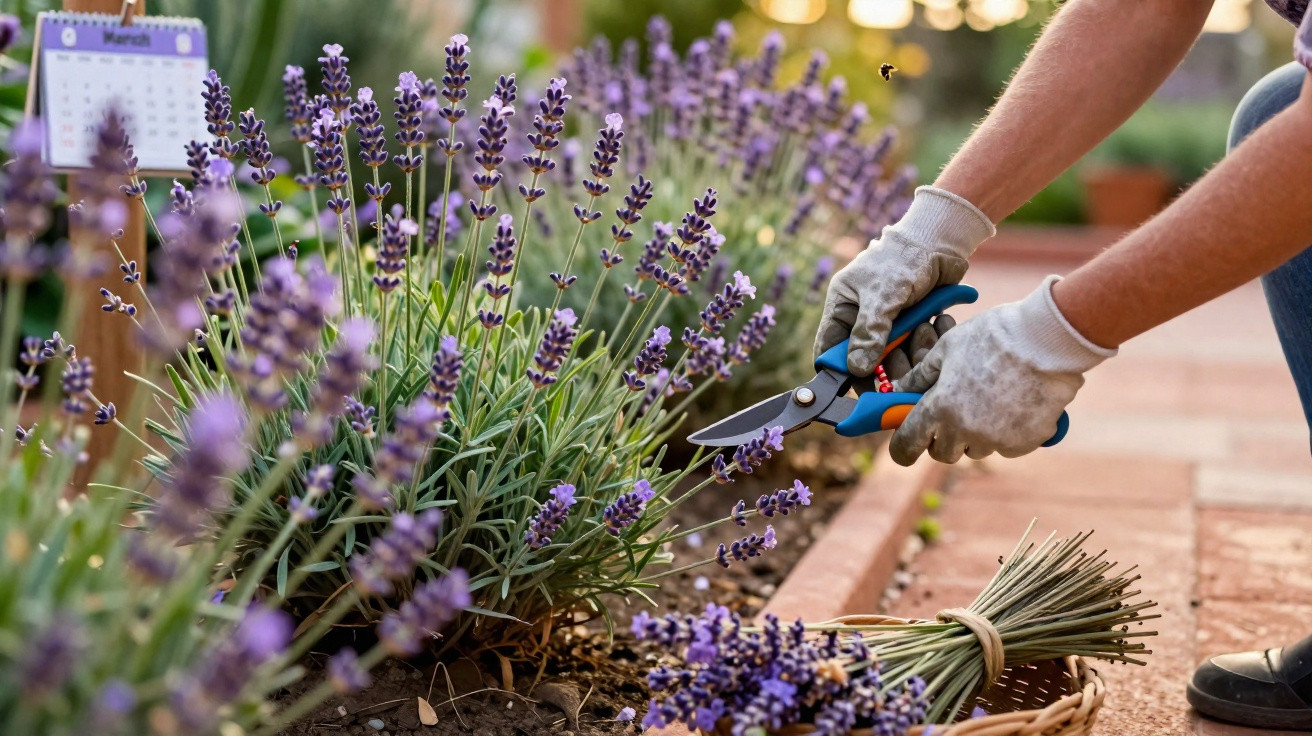
Many amateur gardeners ask themselves every year why their lavender becomes bare at the base and produces only a few sparse flowers on long stems. The good news is that this is rarely down to “poor lavender”, but almost always to a missed care task in March. Pruning correctly now prevents woody growth and brings dense cushions of purple flowers to the garden.
Why lavender becomes woody and looks bare so quickly
Lavender is a subshrub. In other words, it develops more hard wood at its base each year, while the fresh green shoots grow higher up. Without regular pruning, it produces long, bare stems topped with only a few flowers. Instead of looking like a cloud of blooms, it starts to resemble a broom.
Typical stress factors can make matters worse: wet winters, waterlogged beds, overly fertile soil or simply an unsuitable position without enough sun. These conditions weaken the plant, reduce vigorous new growth and allow the woody parts to become increasingly dominant.
A targeted prune in March redirects lavender’s energy from old wood into young, flower-rich shoots – turning a scruffy bush back into a fragrant cushion.
Lavender pruning in March: why it must be done by the end of the month
Garden experts in the UK stress that March is the crucial period for lavender. At this stage, the plant determines how many flowering shoots it will produce for summer. Using the secateurs now actively influences that process.
If pruning is left until much later, flowering is delayed and will usually be noticeably less abundant. The plant must first spend time producing new shoots before it can direct energy into its buds.
- Pruning in March: compact shape, earlier and more abundant flowering
- Pruning in April or May: flowers begin later, with fewer blooms overall
- No pruning: increasingly woody growth and fewer flowers
In German-speaking regions, the ideal period generally falls between early and late March, depending on the area. In higher locations or very cold areas, it may be delayed by one or two weeks, until severe frosts are no longer expected.
How to prune lavender correctly in March
The biggest mistake when pruning lavender is being afraid of taking off “too much” – closely followed by the opposite error of cutting it back drastically into old wood. Both extremes weaken the plant and restrict flowering.
Step 1: Understand the plant’s structure
Before picking up the secateurs, take a close look at an individual stem:
- At the bottom: a brown, woody and usually slightly thicker section
- At the top: a soft, green section of shoot with healthy foliage
The basic rule is: make every cut within the green growth, never in bare, old wood. Many lavender varieties will barely reshoot from woody stems; cutting too deeply can leave gaps or cause the stem to die.
Step 2: Use clean tools and shorten gently
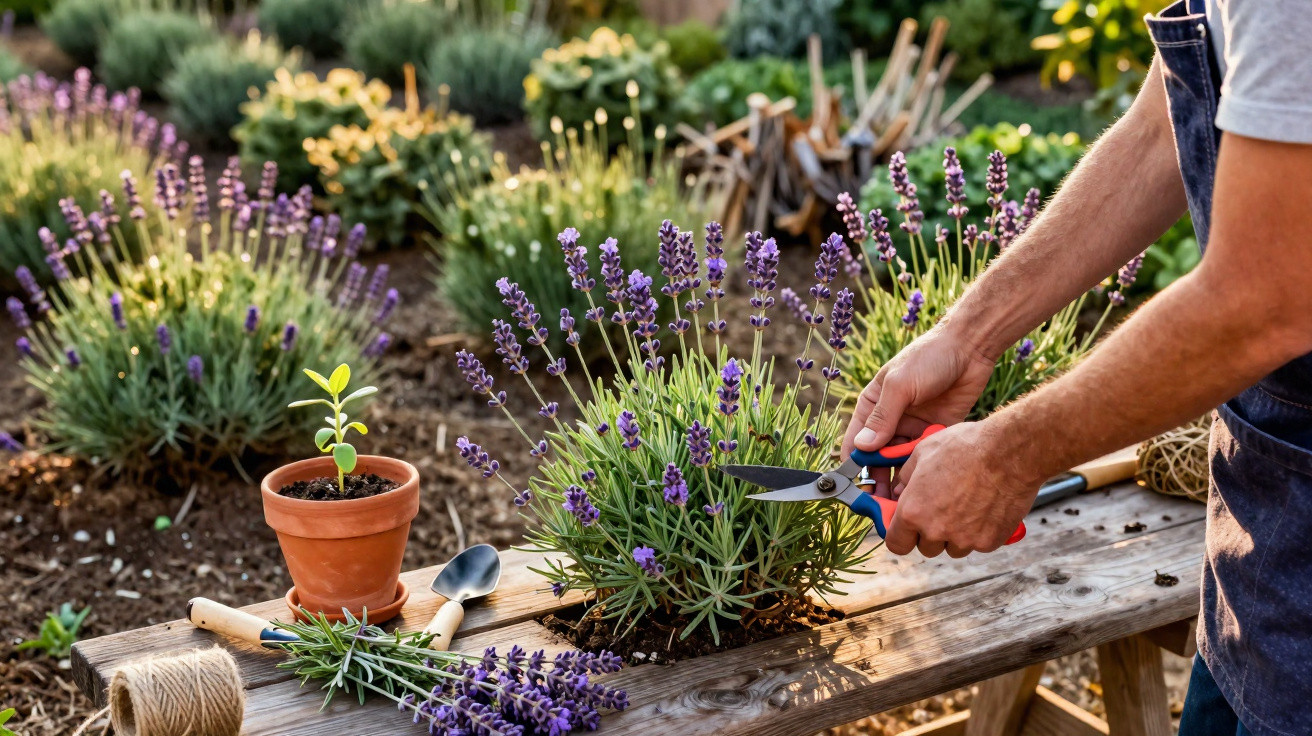
For March pruning, all you need is a sharp pair of secateurs and a bucket for the cuttings. The blades should be genuinely clean and, ideally, disinfected, so that diseases are not spread.
Proceed as follows:
- Select a stem and find the point where the woody growth changes to green growth.
- Cut the stem back two to three centimetres above the wood, within the green section.
- Work your way around the entire bush, using the same height as a guide throughout.
The aim is a gentle shaping prune rather than a drastic cut-back. Afterwards, the plant should resemble a small, evenly rounded dome.
Step 3: Remove diseased and dead stems
As you work around the bush, dead, grey or black branches are usually easy to spot. Remove these decisively at their base, even if that means cutting into wood. Such shoots are already lost and merely block light and airflow.
Frost-damaged tips, which are often brown and dry, can also be removed. This makes room for fresh, strong shoots.
When a “hard” prune makes sense
The March prune is much like a spring haircut. Lavender should only be cut back substantially once its main flowering period has ended, usually in August. At that point, the spent stems can be shortened considerably more, provided some green foliage remains on each shoot.
This combination – a light cut in March followed by a firmer prune after flowering – keeps the shrub compact for years and prevents it from splitting open or becoming straggly in the middle.
Anyone who treats lavender like a perennial and only trims “the top” now and again quickly risks ending up with an ageing, patchy bush. Combining spring shaping with late-summer pruning keeps it young.
Lavender varieties that respond especially well
Many modern varieties have been bred specifically for resilience and prolific flowering. One example is Lavandula x intermedia ‘Phenomenal’. This lavandin variety forms a dense cushion around 60 to 70 centimetres high and wide, carrying intensely fragrant blue-purple flower spikes for weeks.
Given a sunny position and well-drained soil, it needs very little water and does not require nitrogen-rich fertiliser. Excess nutrients encourage soft, unstable growth that flops more readily and has a less concentrated fragrance.
The same principles apply to classic “English” lavender (Lavandula angustifolia) and varieties sold as “French lavender” with their tufted flowers: a sunny site, lean soil and consistent pruning at the right time.
Common mistakes that reduce flowering
Most lavender problems can be traced back to a handful of recurring misunderstandings. The most common mistakes are:
- Soil that is too wet: Lavender originates from dry regions. Waterlogging causes root rot and makes the plant vulnerable to fungal disease.
- The wrong fertiliser: General-purpose fertiliser with high nitrogen levels may produce plenty of foliage, but few flowers and weak wood.
- Cutting hard into old wood: The shrub produces little new growth, and bare patches remain visible permanently.
- Pruning only in autumn: Skipping March means missing out on a large part of the summer display.
- Waiting until the bush flops apart: Once the centre begins to split, regular pruning has been neglected for years.
Practical examples: March pruning for balconies and gardens
In traditional terraced-house gardens, rows of lavender are often planted along paths or in front of rose beds. Careful shaping in March ensures that the plants form dense bands which look like a purple edging in summer. Cutting the outer shoots back a little harder than the centre creates a pleasing wave-like line rather than separate clumps.
The same approach works on a balcony. Lavender in pots and window boxes can be shaped even more precisely because every side is easy to reach. Without pruning, container-grown plants in particular tend to flop outwards and become thin in the centre.
| Location | Recommended March prune | Special consideration |
|---|---|---|
| Bed in full sun | Lightly round the plant, cutting two to three centimetres above the wood | Well suited to long bands of flowers |
| Window box / container | Cut back slightly more firmly to keep the shape compact | Ensure good drainage and water less |
| Slope / rock garden | Similar to a bed, but align the cut slightly with the slope | Ideal because water can drain away quickly |
What the right prune means for insects and fragrance gardens
Lavender is a magnet for bees, bumblebees and butterflies. The more flowers it produces, the stronger the buzzing becomes in high summer. A March prune is therefore not merely a visual trick; it also helps support pollinators in the garden.
Flower quantity is equally important in fragrance gardens. The denser the carpet of lavender, the stronger the aromatic cloud on warm days. Those who regularly harvest flowers for small scented sachets, bouquets or decoration can even encourage further flowering – provided the essential spring prune has been done properly.
How March pruning affects lavender’s lifespan over time
Many lavender shrubs appear to give up after just a few years. In reality, consistent care can extend their lifespan considerably. Pruning every March and tidying them again in late summer keeps shrubs vigorous and prevents them from becoming bare inside.
Eventually, usually after seven to ten years with good care, starting again is still worthwhile. In late summer, you can take several semi-woody cuttings, allow them to root and use them to raise new plants. This maintains the garden’s style while gradually renewing the planting.
If you missed March this year, use the next frost-free spell available and make a plan for the following season. A note in the calendar helps. Next spring, lavender bushes will repay the effort with densely packed flower spikes and a fragrance that quickly makes any missed gardening season fade away.


Comments
No comments yet. Be the first to comment!
Leave a Comment