
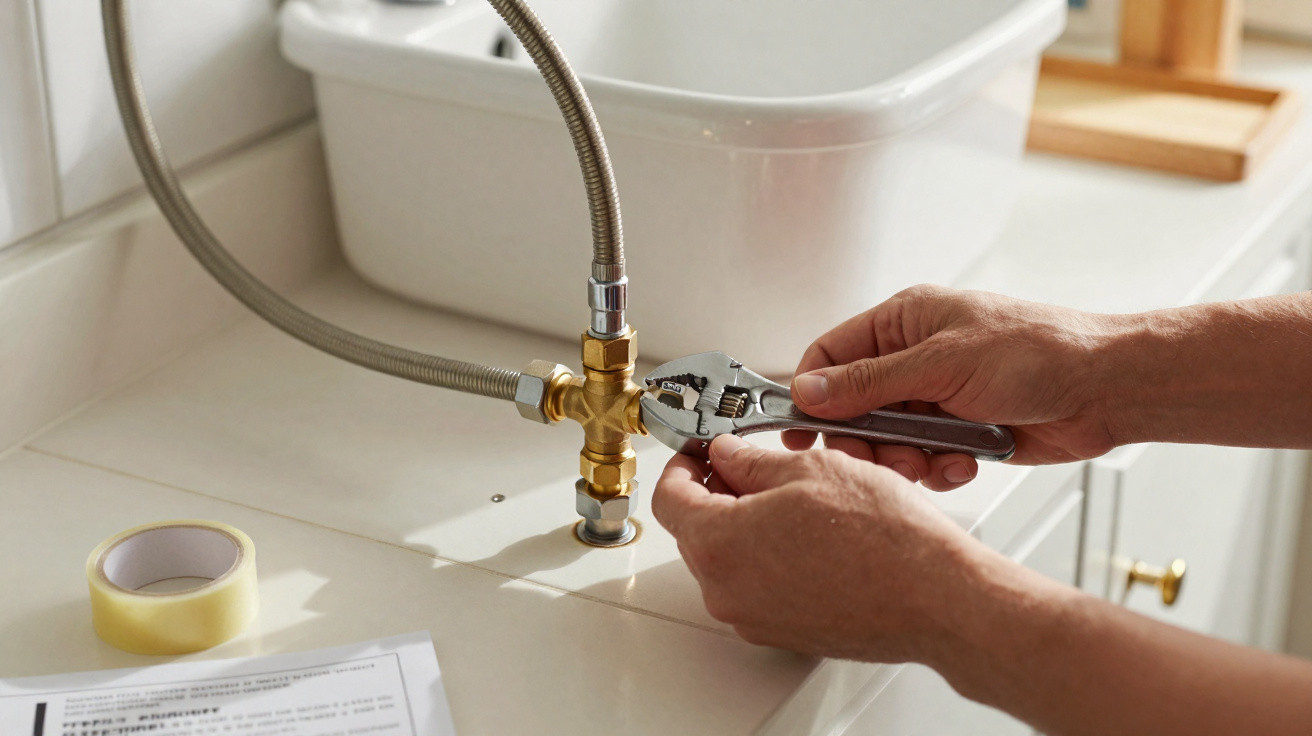
A poorly tightened plumbing fitting can cause leaks and costly damage. A little-known rule, popularised in the United States, promises to limit the damage.
A US DIY enthusiast with millions of social-media followers has highlighted a basic rule for tightening a plumbing fitting correctly, according to specialist website Angi. His advice, based on the well-known “quarter-turn rule”, has caught the attention of many people who are always worried about stripping a thread or damaging a tap. This very straightforward principle applies both to installations in the United States and to work carried out in France, provided a few distinctions are observed.
The quarter-turn rule: a simple principle that is often overlooked
In the video shared by Angi, the American plumber says that most issues stem from overtightening: distorted collars, crushed seals, damaged threads and even cracked tap fittings. His recommendation can be summed up simply: tighten the fitting by hand first, then use a tool to add just one further quarter turn.
The recommended method is to tighten by hand until it stops firmly, then add only a quarter turn with a spanner to ensure a watertight seal.
This approach is intended to strike a balance between two risks:
- tightening too little, allowing water through and causing a slow leak;
- tightening too much, crushing the seal, distorting the fitting and potentially causing a leak… or breaking the part.
According to the expert quoted by Angi, the vast majority of modern domestic fittings are designed to seal with this small additional amount of tightening, without any need to force them. Manufacturers size seals, collars and threads to withstand this moderate pressure.
How to apply the quarter-turn rule to a plumbing fitting
For a standard fitting - such as a tap hose, toilet cistern feed, screw-on trap or compression fitting - the detailed method follows the American plumber’s guidance:
- Line up both parts properly, without forcing them, and start the thread by hand.
- Screw it in by hand only until the nut stops naturally.
- Use an open-ended spanner or an adjustable spanner that fits correctly.
- Turn it by roughly another quarter turn, or 90 degrees, and no further.
- Turn the water on slowly to check that the connection is watertight.
If a slight drip appears, the expert advises taking the spanner again and adding a very small amount of extra tightening, only a few degrees at a time, testing after each adjustment. The key is never to “give it everything” in one go.
| Step | Action | Objective |
|---|---|---|
| 1 | Hand tightening | Prevent cross-threading |
| 2 | Tightening by hand until it stops | Reach the seal’s contact point |
| 3 | Quarter turn with a spanner | Compress the seal to create a watertight connection |
| 4 | Check under pressure | Confirm that there is no leak |
Why overtightening can do more harm than good
The plumber interviewed by Angi stresses the damage caused by excessive enthusiasm. Tightening too hard can produce several physical effects:
- the rubber or fibre seal is compressed beyond its limit and loses elasticity;
- the brass thread, a relatively soft metal, may distort or split;
- pressure applied to a tap or mixer tap can cause a microcrack, which is often invisible at first.
These flaws may not be immediately apparent. An installation can appear watertight on the day it is fitted, only to start dripping several days later as materials deform or a crack widens. Angi notes that many cases of domestic water damage originate with this type of incorrect tightening.
An overtightened fitting can leak… later on, when the crushed seal no longer does its job or the thread has been damaged.
Conversely, the quarter-turn rule mechanically limits the maximum force applied to the fitting. By following it carefully, a DIYer can avoid the instinct to “tighten it until it cannot move at all”, which remains common among occasional DIY enthusiasts.
Metal, plastic and flexible fittings: adapting the rule
The US specialist points out that not every fitting responds in the same way. Brass or steel parts withstand more than plastic components, which are common on toilet cisterns and some traps.
For plastic parts, he advises being even more cautious than with the standard quarter turn, stopping as soon as resistance becomes clear, particularly when the seal is already fitted and correctly positioned. Plastic can crack very quickly if the spanner is not handled carefully.
For tapered metal fittings, sometimes assembled with sealing tape - commonly known as PTFE or Teflon tape - the same logic broadly applies: tighten by hand, then make measured progress with a tool. Angi’s central point is that the seal or tape should always provide the watertightness, rather than brute force applied through the spanner.
The right approach for tap hoses
Braided hoses supplying taps and mixer taps are especially vulnerable to overtightening at their nuts. The plumber explains that most are designed to bottom out by hand, then accept only a very slight additional rotation.
In this situation, a quarter turn is an upper limit. He recommends watching the nut’s position: if it starts marking the metal or seal, it is better to stop and test it than to force it to the spanner’s mechanical limit.
What does this mean for DIYers in France?
Although Angi’s example takes place in the United States, the tightening principle also applies to French installations. Domestic water systems in France use different thread standards, but the underlying logic of seals and fittings is similar.
French plumbers likewise advise tightening “firmly but without excess”, often teaching that only slight resistance should be exceeded once the seal makes contact. Professionals favour spanners matched to the nut size to reduce the risk of slipping or deformation.
In France, leaks caused by poorly tightened small fittings are a routine reason for calling out tradespeople. For a DIYer, the principle to remember remains close to the rule described by the American plumber:
- never start a thread with a spanner: always begin by hand;
- let the seal play the main role in creating a watertight connection;
- do not aim for “maximum force”, but for controlled tightening;
- always test with water after the work, then adjust again if necessary.
The “quarter-turn rule” can therefore be used as a guide rather than an absolute doctrine. Above all, it helps curb the urge to crush everything, which is very common among non-professionals.
A few points to understand before reaching for the spanner
Seal, thread and tightening torque: what these terms mean
In his practical explanation, the plumber interviewed by Angi underlines the role of the seal. This ring, made from rubber, fibre or plastic, is compressed between two metal surfaces to stop water passing through. The thread merely brings those surfaces together and maintains pressure on the seal.
When tightening a fitting, the aim is not to “crush the metal”, but simply to compress the seal properly - neither too little nor too much.
Engineers call this “tightening torque”: the amount of rotational force exerted on the nut. In industry, torque is often controlled using torque wrenches. In domestic plumbing, experienced plumbers rely on feel, which is why a simple marker such as the quarter turn is useful for DIYers.
A practical example at home
One typical case mentioned by the US professional is replacing an old tap with a modern mixer tap. Once the new tap has been fixed to the sink, the user must connect the two flexible hoses - hot and cold water - to their respective supplies.
They first screw each nut on by hand until it stops, then use an open-ended spanner to make one additional quarter turn. They then open the isolation valves slowly while watching the connection closely. If no drip appears, the fitting is considered tight enough. If there is a very slight leak, they turn the water off, tighten it by a few more degrees and test again.
This technique admittedly takes a little more time than tightening aggressively from the outset, but it avoids having to dismantle everything if a thread is damaged or a leak persists, as Angi’s article points out.
For people in France carrying out DIY work in their bathroom or kitchen, this simple principle is a useful safeguard: tighten by hand, finish with a spanner in small increments, and accept that a properly fitted connection does not need to be crushed to be reliable.






Comments
No comments yet. Be the first to comment!
Leave a Comment