
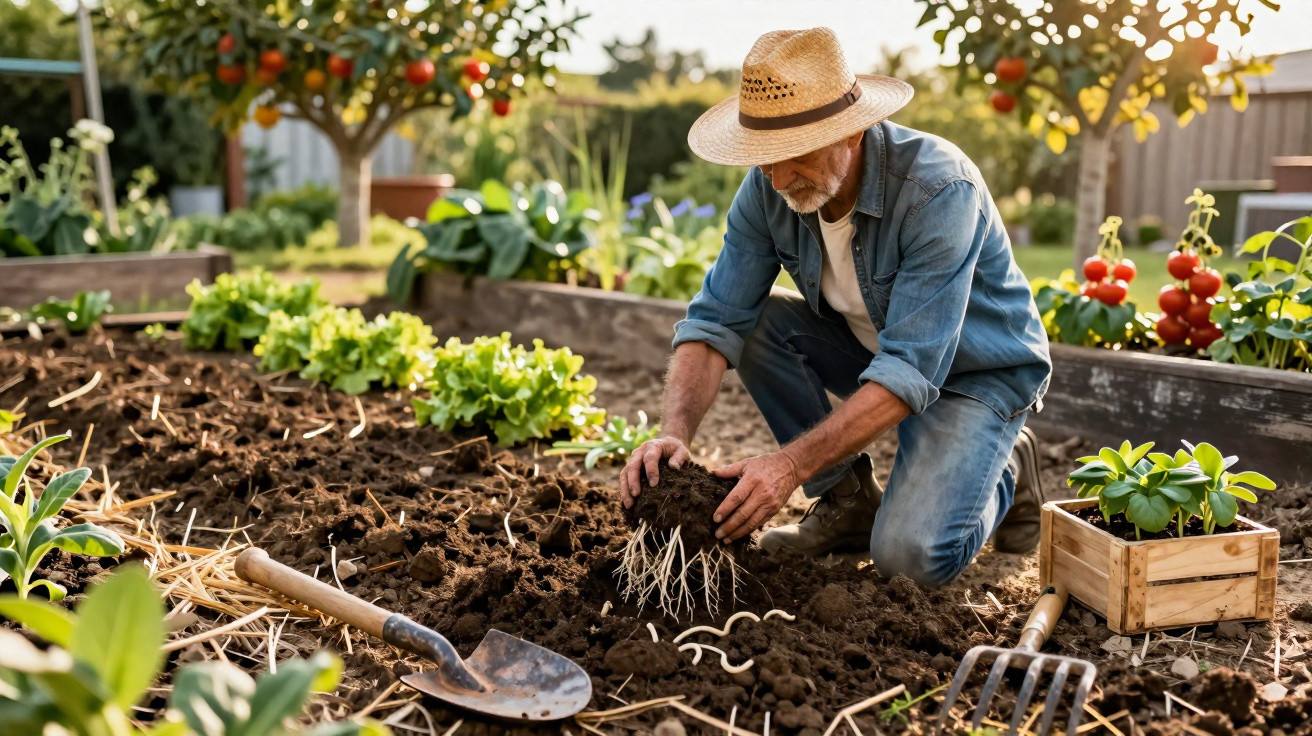
For years, amateur gardeners have repeated the same spring ritual – and in doing so, damaged precisely what they want to protect: their soil.
Between frosty January days and the first plans for spring, many people automatically reach for a spade or shovel. Beds are meant to be “nicely loose”, thoroughly dug over and as free from weeds as possible. Yet this apparently exemplary routine is one of the biggest mistakes in the vegetable garden, affecting yields, soil life and your back.
Why we think good vegetables require hard work
One belief remains remarkably persistent among amateur gardeners: if you do not crawl away from the bed with a sore back, you have not worked “properly”. A turned-over brown bed looks like visible proof of diligence and control.
There is also a misunderstanding borrowed from agriculture. Deep ploughing of vast fields by machine has simply been transferred to the home garden, even though the objectives, scale and conditions are entirely different. What may still be debated across hundreds of hectares of monoculture often causes more harm than good in a vegetable bed of just a few square metres.
Appearance is another factor. Many amateur gardeners favour “tidy” surfaces: no root remains, no leaves and no wild plants. Raked smooth like a freshly swept kitchen floor. In nature, this is virtually never found. Healthy soil is always covered, rooted through, loose and crumbly – not bare like concrete outside a DIY store.
If you treat your soil like tiles, you will end up with soil that behaves like tiles: hard, lifeless and difficult to work.
What really happens beneath your boots when you dig
When you dig, you see lumps of earth. Within the soil itself, however, an earthquake is taking place. Soil is not inert “dirt”, but a complex, living system of animals, fungi, bacteria and delicate structures.
Essential soil helpers are destroyed
Every thrust of a spade cuts through earthworm tunnels. These animals work for you around the clock: they create channels, loosen soil, provide drainage and incorporate organic matter. Many species live at particular depths; turning the soil literally tears them from their habitat and throws them to the surface, where light and predators quickly finish them off.
At the same time, the spade tears apart the fine threads of mycelium, the network formed by soil fungi. These fungi create an invisible system with plant roots that distributes water and nutrients and even passes on “warning signals” about pests. Every cut forces the plant to invest energy in rebuilding these links – energy then unavailable for growth, flowers and fruit.
From loose to concrete-hard: the mystery of the crust
Many gardeners know the pattern: painstakingly loosened in February, then rock-hard after a few showers in March. The explanation is a soil crust, known technically as “battance”.
In healthy soil, particles are held together in stable crumbs. Intensive digging and fine breaking-up destroy these structures. The soil becomes dust. Raindrops force the fine particles together, clogging the pores, and a dense, water-repellent layer forms as it dries. The surface hardens, water runs off, air enters the soil less easily and roots struggle.
The more often you make soil finely “fluffy”, the greater its potential to turn into a hard slab later.
Many gardeners read this as a sign that “the soil is too heavy, so I need to loosen it even more”. This starts a vicious cycle of digging, crusting, further digging and the continuing breakdown of the soil’s natural structure.
Digging as a weed accelerator: how you treble your own workload
Another consequence is especially frustrating. Those who dig extensively often spend ever more time weeding in astonishment. The reason lies in the soil’s “seed-bank account”.
Millions of wild plant seeds lie dormant in every garden soil. Deep down, they can remain inactive for decades. When digging brings these layers to the top, the seeds receive light, air and changing temperatures – their signal to germinate.
- Digging brings ancient seeds to the surface.
- They germinate in large numbers in freshly loosened soil.
- The gardener weeds more, loosens the soil again and brings up fresh seeds.
By contrast, leaving soil as undisturbed as possible and covering it with mulch keeps most of these seeds in darkness permanently. They remain inactive. Visible growth declines noticeably, and weeding is reduced to a manageable level.
When soil becomes “addicted” to fertiliser
Digging is often seen as a “fertiliser substitute”: people assume that moving the soil activates nutrients. In the short term, this is indeed true – but at a high cost.
The sudden boost of oxygen from intensive cultivation stimulates certain bacteria. They break down organic matter, or humus, very quickly. This releases many mineral nutrients in a short time. Plants initially grow with visible vigour, and everything appears lush.
But the effect is like a flash fire. The humus layer shrinks, while the soil loses its ability to store water and nutrients. After a few years it seems “empty”, dries out faster, and harvests become meagre unless fertiliser is continually added.
Anyone who digs deeply every year heats the soil with its own substance – until eventually there is nothing left to burn.
The result is dependent soil: without bags of fertiliser from the garden centre, very little will grow; plants react immediately and badly to small nutrient shortages; and the system tips towards “hydroponics in the open ground” – but without the control.
Put away the spade? Protect soil and your back at the same time
The good news is that no one needs to let the garden become overgrown simply because they stop digging. The point is to adopt a different approach to cultivation – less aggressive and more supportive.
Loosen with a broadfork rather than turning the soil
One tool is becoming increasingly popular in this context: the broadfork, also sold as a digging fork or bio-fork. It has several tines and a wide handle. You push it into the ground, tip it slightly backwards and break up the subsoil without turning it over.
The key advantage is that soil layers remain in their natural order. Organisms that require oxygen stay near the surface, while those from deeper, less oxygen-rich zones remain below. Earthworm tunnels are largely preserved, and the fine fungal structure suffers less damage.
Mulch and roots as free soil workers
The second, even gentler approach is to let nature do the work. Instead of leaving soil bare in winter, give it a covering:
- Leaves from trees
- Straw or hay
- Woodchips or grass clippings, in thin layers
- Unprinted brown cardboard as a base layer
This layer protects against heavy rain, reduces evaporation and provides food for earthworms. They draw the material downwards and loosen the soil more effectively than any tool could. Plant roots also do heavy work at the same time. Deep-rooting species such as oilseed radish, lupins or rye break through compacted layers, then later die back and leave channels behind – ideal routes for water and the roots of young cultivated plants.
What avoiding digging changes in practice
Anyone switching from traditional digging to gentle soil care will usually notice clear results within two or three years:
| Before | After |
|---|---|
| Hard ground after rain, with standing puddles | Crumbly structure, with water draining away faster |
| Several weeding sessions each season | Less weed pressure, particularly from seeds |
| High demand for fertiliser and watering | Better storage capacity and more stable plant health |
| Significant strain on the back from digging | Shorter, easier tasks with ergonomic tools |
Many gardeners report that after several years of “no-dig”, their soil feels noticeably warmer, is easier to work and stays moist for longer even during dry periods. This is due to humus building up and the dense population of soil organisms.
Practical advice for changing next gardening year
Anyone who has dug for decades does not have to change everything overnight. A gradual approach removes the pressure and quickly provides personal experience.
- Choose one bed as a trial area and do not dig it for one year.
- Apply a thick layer of mulch before the season begins.
- Open only planting rows or planting holes slightly, rather than the whole bed.
- Sow green manures selectively in between, such as phacelia or clover.
It is also helpful to examine the soil consciously: test its crumbs in your hand, dig a soil profile and count the earthworms. Anyone who has seen the difference between “tired”, grey-yellow subsoil and dark-brown, visibly living soil will quickly understand why less intervention can mean a better harvest.
Terms such as humus, mycorrhiza and green manure may sound as though they belong in a technical book, but they describe very tangible processes in the vegetable bed: humus is the main store cupboard, mycorrhiza is the delivery network, and green manure is the layer of living workers. Anyone strengthening these three building blocks will eventually need neither a rotavator nor a spade – and can still harvest plump tomatoes, crisp carrots and robust lettuces.


Comments
No comments yet. Be the first to comment!
Leave a Comment