
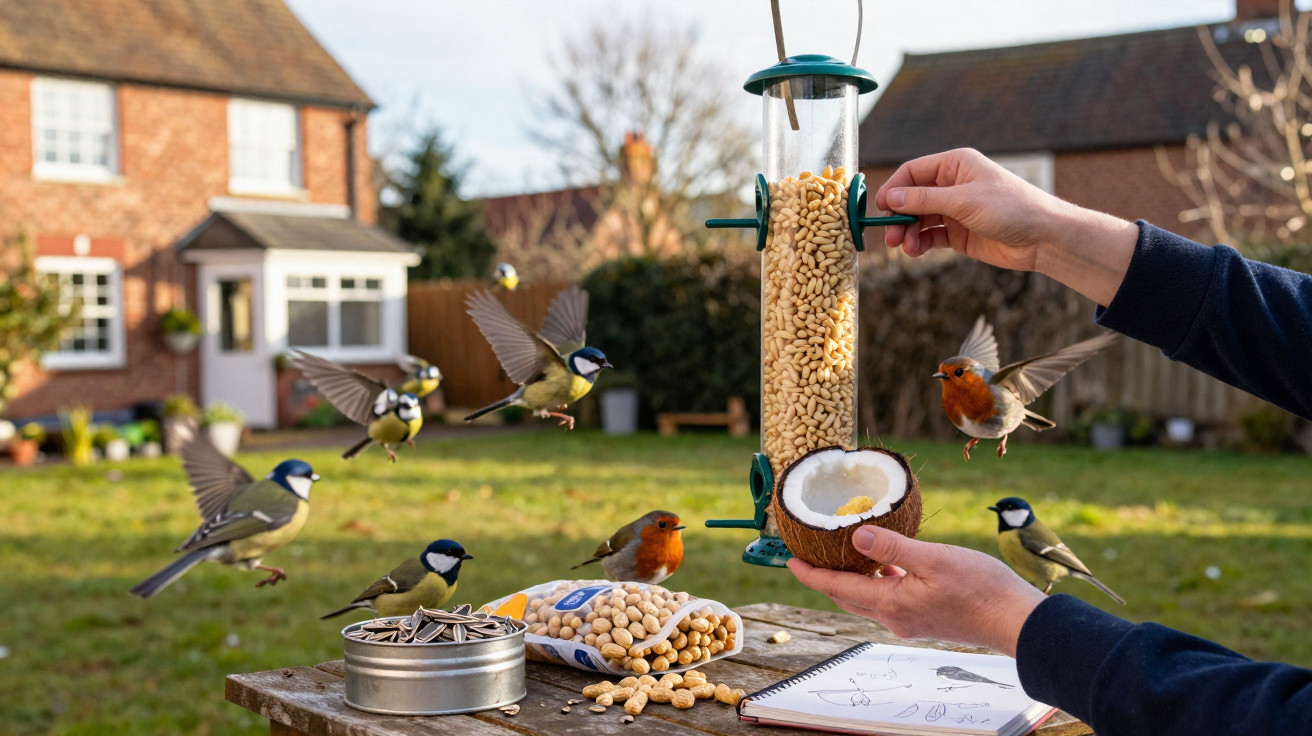
While many feeding stations fall quiet in winter, English gardens buzz with bird activity – thanks to a surprisingly simple change.
Over the years, England has developed a different approach to feeding wild birds. Rather than simply tipping whatever is available into a bird feeder, people offer food selected to help small birds through cold nights. This same approach can be used with very little effort in any garden, balcony or back yard across German-speaking countries.
Why English bird feeders attract so much more activity
Many people still scatter bread, cheap seed mixes or old leftovers in the garden during winter. Although this may ease the conscience, it offers birds only limited help. Winters have become less predictable: sometimes wet and mild, sometimes suddenly bitterly cold. For sparrows, tits and robins, this creates major fluctuations in their energy needs.
This has led to a clear conclusion in England: quantity is not what matters most – energy content is. Instead of large bags of inexpensive grain mixes, the focus is on high-quality foods that provide readily available calories and are unlikely to be left sitting in the feeder.
“The principle is: less filler, more genuine fuel for small bodies.”
The results are easy to see: a greater variety of species, busier feeders, less wasted food and birds in noticeably better condition as spring begins.
Fat rather than filler: how high-energy food saves lives
For a bird weighing only a few grams, a winter night is like an elite endurance event. Its body must continually generate heat or it risks dying from exposure. Every calorie matters – and it needs to be available immediately.
That is the heart of the English approach: food should deliver as much energy as possible in a form that is easy to access. Seeds that take effort to crack open yet provide little nutritional value no longer have a place in the selection.
Three food groups are especially popular:
- Hulled sunflower hearts: These can be eaten without effort, provide fat and protein, and leave no shells beneath the feeding station.
- Fat blocks and soft plant-based fat balls: Particularly suitable when temperatures drop. They work like energy bars, helping birds build up reserves.
- Dried mealworms: A high-quality source of protein, especially appreciated by tits, robins and blackbirds.
Replacing cheap wheat or cracked maize with these food sources turns a bird feeder into a genuine survival station. This is often apparent when more selective species suddenly begin visiting, having avoided basic seed mixes.
Matching food to the birds in the garden
Another lesson from England is to adapt the food on offer to the visitors actually using the garden. An all-you-can-eat buffet that mainly attracts pigeons or rats does little for native songbirds.
Anyone who watches closely will soon spot typical preferences:
| Species | Favourite food | Preferred location |
|---|---|---|
| Blue tit, great tit | Sunflower hearts, mealworms, fat blocks | Hanging feeders |
| Robin | Soft food, insects, pieces of berries | On the ground or on low feeding tables |
| Goldfinch | Fine seeds such as Niger seed | Special tubes with small feeding ports |
| Blackbird | Raisins, pieces of apple, insects | On the ground, in open areas |
Feeding selectively achieves two things: fewer leftovers are left behind, and more sensitive species have a chance to reach energy-rich food rather than being pushed aside by more aggressive birds.
“Every gram of food that reaches the right species makes a direct contribution to biodiversity in the local area.”
Why every calorie now affects breeding success
A bird’s condition after winter determines how effectively it can find nest sites, defend its territory and rear young in spring. An animal that is exhausted in February will have less energy to invest in breeding by April.
For this reason, many amateur ornithologists in England regard February as a crucial month. Providing targeted food rich in fat and protein at this stage increases the likelihood that more birds will enter the breeding season in good health. More adult birds surviving ultimately means more young birds fledging in May and June.
How to use the “English method” in German-speaking countries
The good news is that no large plot is required. A balcony, a small courtyard or a terraced-house garden is enough to make a noticeable difference. A few measures bring immediate improvements:
- Gradually replace cheap seed mixes with black or hulled sunflower seeds.
- Hang soft fat blocks without plastic netting, so that birds’ legs cannot become trapped.
- Clean feeding stations with hot water at least once a week to prevent disease.
- Provide a shallow dish of fresh water, even when temperatures are just above freezing.
- Deliberately place some food on the ground, for example for robins and blackbirds.
Many garden owners report that, once they change the food provided, species not seen for a long time appear within just a few days. The garden feels more alive, birdsong increases and even neighbours take notice.
Mistakes that immediately reduce the benefits
Despite the best intentions, familiar habits often creep in and undo the benefits. Common obstacles include:
- Stale bread: It swells in the stomach, has little nutritional value and can go mouldy.
- Large amounts of maize or wheat: These are readily taken by pigeons but hold little appeal for small songbirds.
- Dirty feeding stations: These encourage diseases such as trichomoniasis, which can reduce entire populations.
- Plastic nets around fat balls: They pose a serious risk of injury to birds’ legs and toes.
Avoiding these issues already does half the job. The rest comes down to observation: which species visit, what food remains, and when is activity at its highest? After a few weeks, the offering can be fine-tuned accordingly.
Practical additions: more than food alone
Energy-rich food is the foundation, but the surrounding habitat matters too. Dense hedges, an untidy corner with nettles or a pile of branches provide shelter, roosting places and natural food in the form of insects. A wildlife-friendly garden supports the feeding strategy twice over.
Nest boxes are also useful and should be put up in good time during late winter. Anyone already running suitable feeding stations in February while also providing appropriate breeding sites makes their garden a complete package for many species.
Why the effort pays off in several ways
Providing high-quality food in winter does not only help individual birds. It benefits whole populations, particularly in densely built-up areas where natural food sources are scarce. At the same time, many people develop a stronger connection with their immediate surroundings, as they can see each day how much life the nearby space can hold.
The English experience shows that one simple change at the bird feeder can transform a quiet garden into a place full of flight, song and breeding activity. Those who start now will enjoy more life between the fence, balcony rail and tree canopy as early as next spring.


Comments
No comments yet. Be the first to comment!
Leave a Comment