
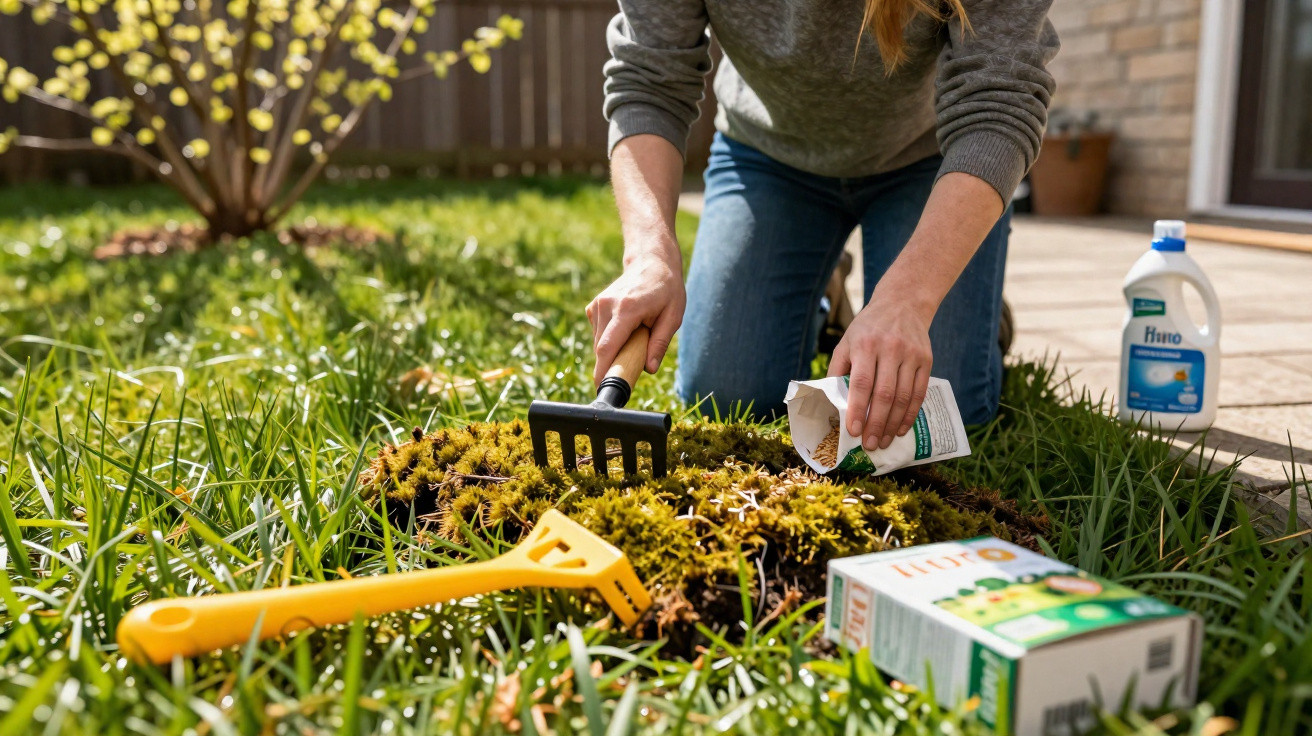
Many amateur gardeners turn to quick “secret tips” online in spring – and unintentionally cause more harm than the moss itself. One kitchen household product is especially popular, yet it has no place on a lawn and can weaken the soil over time.
Why lawns suddenly become full of moss in spring
After a few mild days in March or April, people tend to look at the garden more critically. What was hidden beneath snow, leaves and mud throughout winter is now impossible to ignore: bare patches, matted areas – and plenty of moss.
Certain parts of the garden are particularly prone to it:
- beneath dense trees
- alongside hedges and walls
- in permanently damp dips
- in areas where the ground has been compacted by foot traffic
In the dark, wet winter months, the lawn has very little vigour in these places. Cold weather, waterlogging and insufficient light hold the grass back. It grows more slowly, becoming thin and patchy. Moss takes ruthless advantage of precisely these gaps.
Soil scientists and gardening specialists have highlighted the same link for years: when soil is heavily compacted, low in nutrients or continually wet, moss will almost inevitably take over. Grass plants receive too little air, water cannot drain away, and nutrients are scarce – perfect conditions for moss, but poor ones for a lawn.
“In many gardens, moss is not a sign of laziness but a warning signal: the site no longer suits the lawn.”
Infrequent lawn care, limited feeding and never aerating the ground make the problem worse. The soil becomes matted, rainwater penetrates less effectively, the turf weakens further – and the moss cover grows denser each year.
The major misconception: washing-up liquid as a weapon against moss
A supposed “hack” has been circulating in gardening groups and forums for some time: spray moss with diluted washing-up liquid, wait briefly, and the job is done. It sounds straightforward, inexpensive and conveniently easy. In reality, it is a serious burden on the lawn.
Washing-up liquid is designed for grease, plates and frying pans – not living soil. Its surfactants break down fats and fatty proteins, which are exactly the sort of substances that play an important role in the soil’s microbial life. Applying it liberally across the turf does not affect moss alone.
Possible consequences include:
- fine grass roots may be damaged or die
- soil organisms that help keep soil loose may be disrupted
- the soil structure can deteriorate, causing water to drain less effectively
- nutrients become less readily available
Landscaping professionals regularly warn against these impulsive fixes. The area may look “cleaner” in the short term, but the lawn becomes weaker in the long run – handing moss an advantage again when the next winter arrives.
There is also an environmental issue. Any surfactants and additives that do not remain in the soil can be carried by rainwater into soakaways, drainage systems or groundwater. That is a high price to pay for a little less moss.
“Quick household tricks from the internet may appear to save time at first – but on closer inspection, they often damage exactly what you are trying to rescue.”
The straightforward approach: strengthen the lawn instead of fighting moss
The good news is that a noticeably improved lawn requires neither harsh chemicals nor specialist equipment. Many professionals use the same remarkably simple method every spring.
Step 1: Mow short to expose the surface
At the start of the season, a slightly shorter cut than in summer is worthwhile. This lets more light reach the turf and reveals the moss cushions. Keep the mower blades sharp so the grass is cut cleanly rather than torn and frayed.
Step 2: Rake out the moss thoroughly
Once mowing is complete, use a rake. In many gardens, a sturdy leaf rake or lawn rake is entirely sufficient. Press the tines lightly into the ground and pull them across the lawn in different directions – this lifts out moss and old thatch.
For larger lawns or heavily thatched areas, a scarifier is the better option. This machine scores the soil surface by a few millimetres, bringing moss, dead grass blades and thatch to the top while opening the turf to air, water and nutrients.
“Many people are initially alarmed by the brown, ragged-looking surface after scarifying – but a few weeks later, the lawn usually repays this treatment with much denser growth.”
Step 3: Overseed bare areas
Where bare spots remain after raking or scarifying, targeted overseeding will help. A high-quality lawn seed mixture suited to the site is best, such as a hard-wearing lawn mix or a shade-tolerant lawn mix.
Method:
- lightly roughen the soil or scratch it with a rake
- sow lawn seed thinly
- spread a thin covering of fine soil or lawn dressing over it
- keep it evenly moist during the first few weeks
This allows young grass plants to establish quickly within the existing turf, preventing moss or weeds from reclaiming the open ground.
When moss already dominates: targeted measures
Some areas are so heavily covered that mechanical methods reach their limits. In such cases, a specialist moss treatment, for example one based on ferrous sulphate, can be useful. It turns moss cushions black and dries them out within a few days.
Important points when using it:
- apply only the dosage stated in the instructions
- ideally use it on moist soil
- avoid contact with patio slabs and metal, as staining may occur
- rake up moss remains thoroughly afterwards
Without subsequent soil improvement and overseeding, however, the result will be short-lived. The actual causes – compaction, nutrient deficiency and waterlogging – still remain, so moss will soon return.
Those who prefer a gentler approach sometimes try wood ash or bicarbonate of soda. Both methods work only in certain conditions, such as on relatively acidic soil. There are no guarantees, and applying incorrect quantities can disrupt the soil balance rather than improve it.
How to prevent moss in lawns over the long term
The best “anti-moss strategy” is not one individual intervention, but a series of small, regular tasks. Three areas are particularly important:
| Problem | Cause | Possible solution |
|---|---|---|
| lots of moss in dips | persistent dampness | loosen the soil, install drainage, level uneven ground |
| moss on walking routes | heavy foot traffic, compacted soil | create paths, aerate the soil, incorporate sand if necessary |
| thin, yellowish lawn | nutrient deficiency | feed appropriately, ideally in spring and early summer |
| moss in permanent shade | insufficient light for grass | use a shade-tolerant lawn mix or redesign the area |
Regular scarifying, sufficient feeding and occasional work on the soil with a lawn roller or aerating fork shift the balance decisively in favour of the grass. Dense turf leaves moss with very little room to establish.
When a lawn is not the best solution
There is one point amateur gardeners rarely discuss: sometimes the idea of an “English lawn” simply does not suit the location. In extremely shady corners, beneath large conifers or on north-facing slopes, moss nearly always wins, regardless of how much effort is invested.
It is worth asking a more fundamental question here: does grass really need to grow there? Alternatives may include:
- ground-cover plants such as ivy, barren strawberry or periwinkle
- a shade-tolerant herbaceous planting area
- woodchip or bark mulch for a low-maintenance surface
These options are often better suited to the microclimate and avoid years of frustration with an area that never becomes properly dense.
Practical tips for next spring
Anyone who cares for their lawn in autumn will usually face fewer moss problems the following spring. A final cut that is not too short, light scarifying and an autumn fertiliser high in potassium help grass enter winter in stronger condition. The plants build up reserves that support vigorous growth again in spring.
It is also useful to understand common specialist terms: “scarifying” means lightly scoring the turf, while “aerating” is the targeted ventilation of soil by making holes, which are often subsequently filled with sand. Both improve airflow and ensure water drains through rather than sitting on the surface.
“Those who see their lawn as a long-term project rather than a weekend quick fix will be rewarded year after year with less moss and denser greenery.”
It is best to leave washing-up liquid, vinegar, cola and other kitchen experiments in the cupboard. In many gardens, a sharp mower, a sturdy rake, some lawn seed and a little patience are all that is needed to turn a mossy carpet back into a well-kept lawn, step by step.




Comments
No comments yet. Be the first to comment!
Leave a Comment