
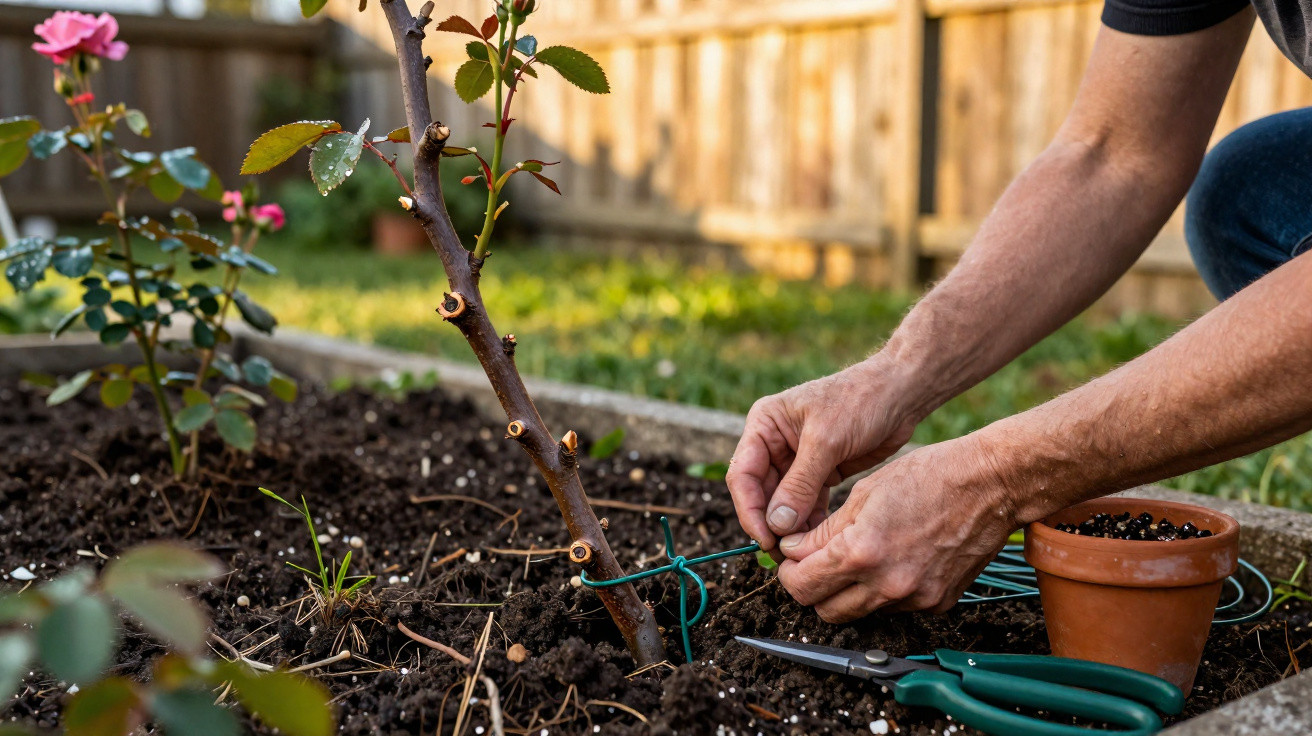
Many amateur gardeners cut back old, grey rose canes without hesitation. Yet these tired-looking shoots often still contain a surprising amount of life. A straightforward wire technique can deliberately redirect the plant’s energy, turning a “hopeless case” into a vigorous rose bush of its own – with no costly equipment or specialist knowledge required.
Why old rose canes should not be cut off too quickly
Ageing roses can look unforgiving: grey bark, few fresh shoots and perhaps even damage to the stem. Many gardeners then reach for sharp secateurs and discard anything that no longer appears fresh. This is exactly when valuable plant material is often lost.
As long as a cane has not dried out completely, sap is still moving through its wood. That remaining energy can be used purposefully to create fresh roots and, in turn, an independent plant. The principle is known as layering or air layering with wire; it has long been part of professional horticulture, yet is surprisingly rarely used in home gardens.
“A piece of wire in the right position can transform a ‘lost’ rose cane into an independent young bush.”
Essentially, this method imitates a natural process. Many shrubs root where a shoot has been lightly damaged, bent or held against the ground for an extended period. Wire allows this response to be triggered in a controlled way – precisely where it is needed.
What happens inside the rose cane
To properly grasp the technique, it is helpful to take a brief look inside a rose cane. There is no need to be a botanist.
- Xylem: carries water and minerals upwards from the roots
- Phloem: positioned immediately beneath the bark, it transports sugars and growth hormones downwards
- Auxins: plant hormones that encourage root formation
When soft wire is wrapped tightly around the bark, the following takes place: water transport through the inner tissue continues, while the outer transport tissue for sugars and hormones is partly constricted. As a result, root-promoting substances build up in the part of the cane above the wire.
The rose then produces a swollen wound area at this restricted point, known as a root callus. Fine roots later emerge from this callus. Depending on the weather, the process takes around three to six weeks.
“The wire does not stop life in the cane – it simply directs it to a tightly defined point, where new roots then form in concentrated numbers.”
The best time and the right rose cane
Timing has a major influence on the likelihood of success. Two periods are particularly suitable:
- Spring: when sap is rising and the rose is producing strong new growth
- Late summer: when the plant remains active but is no longer growing at full speed
Do not choose a completely fresh, soft shoot. Instead, select a healthy, mature cane from the previous year, roughly the thickness of a pencil. Such a cane is less likely to snap, while still being flexible enough to layer later or place into a pot.
Materials: what you actually need
This technique requires only basic equipment, much of which is likely already in the shed.
- Soft wire (1–2 mm), ideally copper wire
- Flat-nose pliers and clean, sharp secateurs
- A pot or planting container with a saucer
- A loose growing medium made from 50% compost and 50% sand
- A transparent cover, such as a cut plastic bottle, plus a label marked with the date
Nothing more is necessary: no specialist hormones and no expensive professional container. Using copper wire can also reduce the risk of rot at the small pressure point, particularly in damp regions.
How to position the wire correctly
Where the wire loop is placed is the crucial part of the process. Proceed as follows:
- Choose a vigorous cane from the previous year, free from cracks or signs of disease.
- About 15 centimetres from the base of the cane, wrap the wire tightly around the shoot once.
- Use pliers to tighten it until the bark is visibly indented, but not cut through.
- Leave the cane attached to the plant and continue caring for the rose as usual.
The next stage is simply waiting. Within three to six weeks, a thickened area should develop above the wire. This swelling will become the future root mass. Continue only once the callus feels firm and is clearly noticeable.
Two ways to create a new rose bush
Method 1: Layering into the soil
If there is room in the border, the “restricted” section can be rooted directly in the ground:
- Dig a trench around ten centimetres deep.
- Fill it with a mixture of sand and loose soil.
- Bend the prepared cane so that the callus section sits inside the trench.
- Secure it with a wire peg or tent peg, then cover it with soil.
The cane remains connected to, and supplied by, the parent plant. Over the course of the season, it develops its own root system underground. In the following spring, carefully check whether a fine, dense network of roots has formed.
If it has, cut the connection to the old rose between the callus and the stem. The rooted section can then be moved to its final position or placed in a larger pot first.
Method 2: Rooting in a pot
Where it is not possible to lay the cane into the soil, use a container instead:
- Cut the cane just below the wire position, ensuring that the entire callus remains on the future cutting.
- Shorten the shoot to about 15 to 20 centimetres in length.
- Insert two thirds of its length into the prepared compost-and-sand mixture.
- Water thoroughly and cover with a transparent hood.
The pot is best kept in partial shade, sheltered from wind and maintained evenly, lightly moist. If fresh shoots appear or there is clear resistance when the cutting is gently tugged, the young rose has established roots of its own. The cover can then be removed gradually.
“Fresh growth and a ‘firmly anchored’ cutting are the clearest signs that the former problem cane has become an independent young plant.”
When to move the rose into the border
Once the root system is stable, the question becomes where to plant it. Frost-free spells in spring or early autumn are ideal. The soil should be loose, free-draining and well prepared. Waterlogging is harmful to young rose roots.
After planting, a simple support cane helps protect the still-delicate plant from being blown over. During the first few months, provide a steady but not excessive water supply. Frequent small amounts of water are preferable to occasional heavy soaking, which can compact and seal the soil surface.
Common mistakes that are easy to avoid
- Wire too loose: phloem flow is not slowed sufficiently, so little or no callus forms.
- Wire too tight: the cane is crushed or even severed, causing it to dry out.
- Wrong timing: during deep winter dormancy, the rose responds slowly and the method works far less effectively.
- Site too dry: without basic moisture, root formation stalls.
When working with a very old rose growing on its own roots, this technique can even preserve a valuable specimen. Historic varieties that are no longer commercially available particularly benefit from this form of “self-rescue” through a rejuvenated new plant.
Practical guidance for healthy young roses over the long term
Once rooting has succeeded, the real establishment phase begins. For the first two years, take care not to demand too much from the young plant. Hard pruning immediately after it has established itself is more likely to slow it down than help it. The aim is to build a sturdy framework of two to four strong basal shoots.
During dry summers, a thin mulch layer of bark compost or shredded prunings is useful. It retains moisture in the soil without smothering the rose’s sensitive base. Always water directly around the roots rather than over the foliage – this reduces the risk of fungal disease.
Why the effort is worthwhile for rose lovers
At first reading, this wire technique may sound slightly technical, but its everyday advantages are clear. It not only saves specimens that seem beyond recovery, but also allows favourite varieties to be propagated deliberately without relying on grafting. Many amateur gardeners report success rates well above those achieved with conventional, unprepared cuttings.
Anyone who has watched an unremarkable, nearly abandoned cane grow into a vigorous bush in its own right will often view rose care differently from then on. Rather than disposing of it radically, it is worth taking a second look – and perhaps using a piece of wire to encourage the rose into new life.
Comments
No comments yet. Be the first to comment!
Leave a Comment