
Many amateur gardeners know the situation: after being away for a few days or weeks, they return to find their once lush green lemon tree looking almost dead. There are no leaves, the branches are hard and the pot feels feather-light. In a panic, the plant is quickly thrown onto the compost heap. That is a mistake, because citrus plants in particular have remarkable reserves – and a simple, free rescue method can have them producing new shoots again in around two weeks.
When a bare lemon tree can still be saved
After the initial shock, it is time to assess the facts. A lemon tree that has lost all of its foliage often looks worse than it really is. In many cases, neither fungus nor pests are responsible; instead, the cause is severe lack of water.
A common trigger is what is known as a “dry pot”: the compost contracts inside the container, pulls away from the sides and forms a hard, water-repellent mass. If you water from above as usual, the water simply runs down the edges and out through the drainage holes – while the fine roots in the centre of the root ball remain virtually thirsty.
“A leafless lemon tree is rarely dead – it has usually simply switched into survival mode and dropped its leaves as an emergency measure.”
Before taking action, carry out a straightforward vitality check:
- Lightly scratch a thin branch tip with your fingernail.
- If the tissue underneath is green and moist, the shoot is alive.
- If it is brown, brittle and crumbly, that branch has died.
If there is any green beneath the bark anywhere on the tree, a rescue attempt is always worthwhile.
Day 1: Pruning and a water bath instead of a watering can
Be bold with the secateurs: substantially reduce the crown
The most important measure comes right at the start: the tree needs pruning. Although this may seem drastic, it reduces stress because the remaining roots have less crown to supply with water.
Proceed as follows:
- Use clean, sharp secateurs or loppers, ideally disinfected.
- Remove every clearly dry, brittle branch completely.
- Shorten the overall crown by around 30 per cent, cutting back into healthy, greenish wood.
- Consistently remove fine, dried twigs and old leaf stalks.
If preferred, larger cuts can be coated with wound sealant. This is not essential, but many gardeners find it reassuring.
The water bath: the root ball needs to soak thoroughly
Ordinary watering is no longer enough in this situation. The root ball has contracted so severely that water can barely penetrate it. The answer is a prolonged soak.
Instructions for day 1:
- Fill a sufficiently large bucket or tub with water at around 20°C.
- Place the entire pot – not just its lower section – into the water.
- Leave it there for at least 15 to 20 minutes; for extremely dry compost, up to two hours.
- Watch for an important sign: as long as air bubbles are rising, the root ball is still absorbing water.
Once no more bubbles are visible, lift out the pot and allow it to drain thoroughly. The container should then stand in the shade for 24 hours, without a saucer underneath, so excess water can run away.
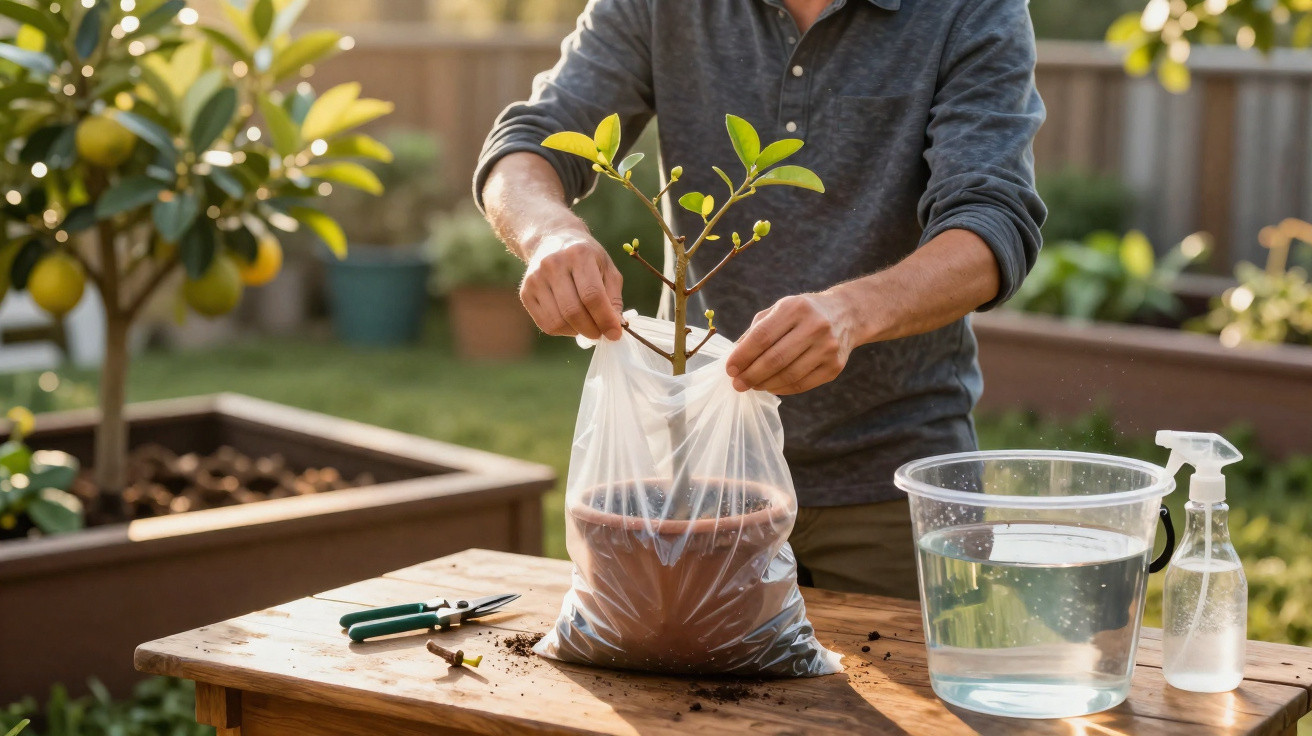
The “mini greenhouse trick” using a plastic bag
Following the soak, the lemon tree primarily needs a gentle environment in which it can form new buds. This is where the traditional household technique comes in: the tree is turned into a makeshift greenhouse.
All that is needed is a transparent plastic bag, such as a garment cover or a large refuse sack. Loosely place it over the crown and pot, then seal it around the pot rim with string or an elastic band.
“The plastic bag creates humidity close to 100 per cent – meaning the tree loses significantly less water through its bark and can form new shoots.”
Important rules during this stage:
- Keep it somewhere bright but out of direct sunlight, otherwise heat can build up.
- Maintain a room temperature of around 15 to 18°C.
- Open the bag for roughly ten minutes every two days to prevent mould forming.
- Water only very sparingly during the first few days, or do not water at all – the root ball is still well saturated.
In this microclimate, many plants produce their first delicate new buds after just one to two weeks.
The first 15 days: what to do and what to avoid
Days 2 to 7: a calm “intensive care unit” for the tree
During the first week after soaking, stability is the priority. Keep the lemon tree in one fixed, draught-free place. The bag should remain over the crown and only be opened briefly for ventilation.
When it comes to watering, use the finger test rather than a rigid schedule:
- Push a finger around three centimetres into the compost.
- If it still feels slightly damp at that depth, do not water.
- Only give it a thorough watering when this layer is dry.
Constant top-ups are harmful at this point. The roots need oxygen, and the root ball should be allowed to dry slightly between waterings.
Days 8 to 15: gradually return to normal conditions
As soon as the buds swell or the first tiny leaves emerge, stop sealing the bag completely. Instead, open it a little further each day so the tree can gradually acclimatise to normal indoor air.
During this second phase, the position can become somewhat brighter, but direct midday sun remains off limits. Temperatures can now range between 18 and 22°C. If using a windowsill, avoid cold draughts and sharp drops in temperature overnight.
Only when a visible quantity of fresh leaves has appeared after around two weeks is it time to consider the following two steps:
- Apply a weak feed, ideally a specialist liquid fertiliser for citrus plants at half strength.
- Consider repotting if the root ball is very compacted or roots are growing out of the drainage hole.
When repotting is genuinely worthwhile
In a panic, many people reach first for a larger container. This may work, but it is not the key factor in saving the tree. Repotting is mainly worthwhile when:
- the compost feels like concrete and barely becomes loose again;
- roots can be seen circling around the edge of the pot;
- water rushes through in seconds without remaining in the compost.
For citrus plants, a loose, free-draining mix has proved effective. A practical blend consists of high-quality container compost, some sand or lava grit, and a proportion of compost. Dense, peat-rich soil does retain water, but it also tends to shrink dramatically when dry.
Common mistakes that place unnecessary stress on lemon trees
The rescue process works far better when common pitfalls are avoided. These include:
- Fertilising while the tree is in shock: Nutrient salts can effectively burn already stressed roots.
- Leaving the pot permanently wet in a saucer: Waterlogging displaces oxygen and causes roots to rot.
- Putting it in direct sun shortly after severe leaf loss: The crown can barely regulate transpiration, causing sun scorch and further stress.
- Moving it repeatedly: Every change of position requires adaptation, and citrus plants are particularly sensitive to this.
Anyone who follows these points gives their tree a realistic chance of making a visible recovery within a few weeks.
What really happens during water shortage
The technical term “water stress” describes what happens inside the tree. When the water content of the soil drops sharply, the plant can no longer supply its leaf surfaces adequately. As an emergency response, it sheds foliage, reduces water loss through transpiration and focuses its remaining strength on the trunk and roots.
This looks particularly dramatic in citrus plants because they can lose almost all of their leaves in a short period. It is normal for apparently nothing to happen afterwards: the tree first reallocates its internal reserves before eventually producing new growth. The soaking bath and humid microclimate support precisely this stage.
How to prevent future dry spells
Once the tree has been successfully brought through this crisis, you will want to prevent it happening again. A few simple routines can help:
- Use the finger test regularly instead of watering according to a calendar.
- Choose a pot size that suits the crown: containers that are too small dry out exceptionally quickly.
- Prefer bright, airy positions without constant draughts or proximity to radiators.
- In summer, water less often but thoroughly, then allow the compost to dry out again.
If you travel regularly, a few simple measures can provide protection: terracotta watering cones, a thick mulch layer on the surface, or placing the pot in a larger box filled with damp soil will all significantly slow drying out.
This turns the alarming sight of a “dead lemon tree” into a useful lesson. With a few targeted steps, a little patience and a simple plastic bag, the plant can usually return to life in around 15 days – without expensive specialist products.


Comments
No comments yet. Be the first to comment!
Leave a Comment